Phở 24 Brand Guidelines
A 2003 Saigon phở chain that took the bowl indoors.
Aa
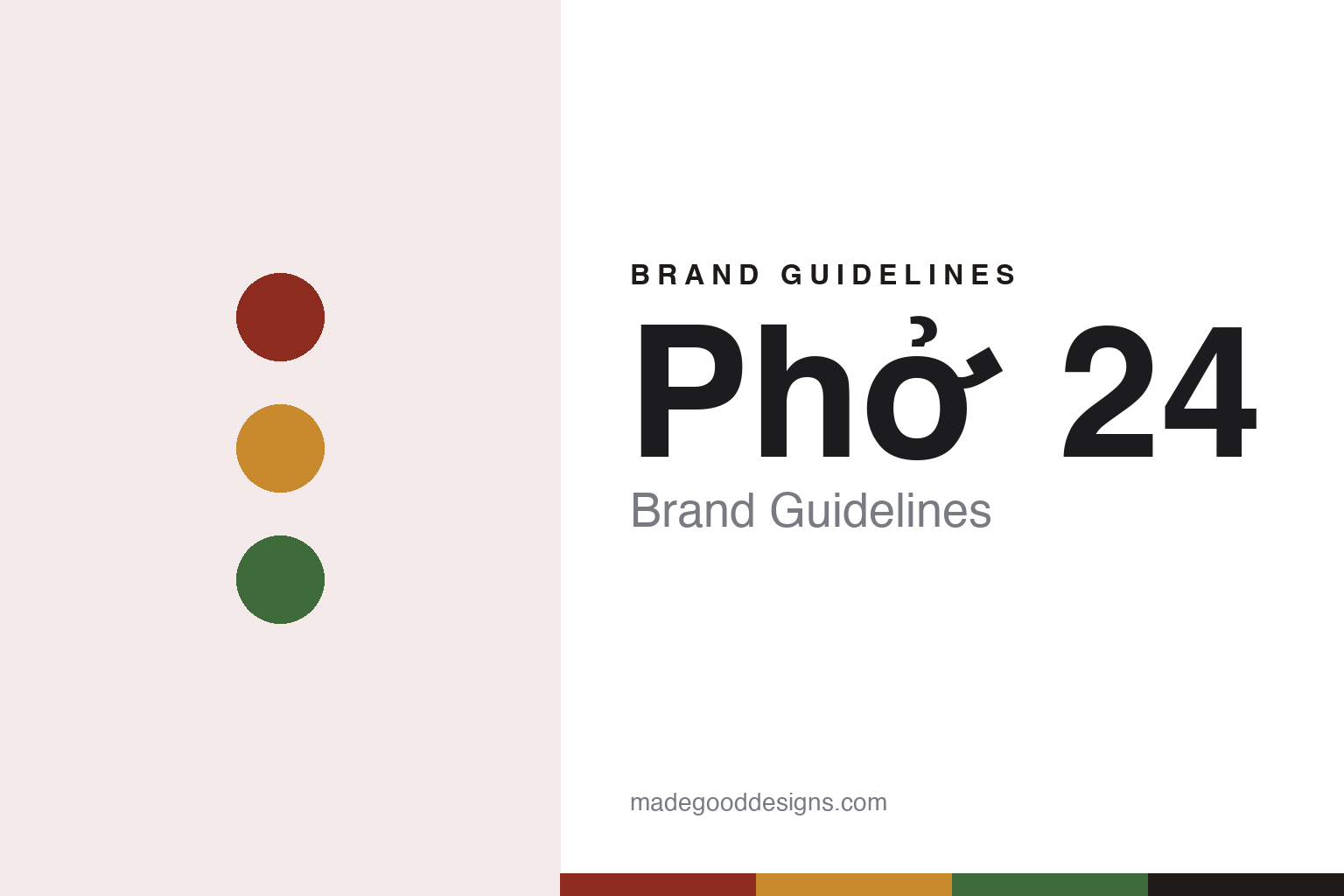
Two constants: a chilli red, broth amber and basil green palette and a Vietnamese sans register. Abstract homage — not a Phở 24 product or mark; no bowl, logo or shopfront is reproduced.
District 1, 2003
Phở taken off the pavement and into a dining room.
Phở 24 opened its first restaurant in Ho Chi Minh City in June 2003. The Investor, the English-language business site, reported in May 2023 that the chain began by presenting phở as an elevated restaurant dish rather than in its traditional street-food format. The founder was Lý Quí Trung, a businessman working in restaurants, and the first shop was on Nguyễn Thiệp street in District 1, according to a May 2023 profile in the business section of Báo Pháp luật Việt Nam.
That profile describes the idea plainly: Phở 24 moved the bowl of phở from the traditional noodle shop into an air-conditioned room. It also explains the name. The “24” refers to the 24 ingredients that go into the dish, drawn from the tastes of Vietnam’s three regions, and to the 24 hours of the day, standing for a wish that the brand would travel and never close.
The chain grew through franchising. Báo Pháp luật lists new restaurants in Hanoi, Ho Chi Minh City, Đà Nẵng, Vũng Tàu and Nha Trang, and then franchised shops in large cities elsewhere in Southeast Asia, in South Korea, Australia and Japan. At one point, it says, the total of shops at home and abroad passed 70.
A dated count from the time of the sale shows how far the network had spread. In January 2012, The Philippine Star reported that Phở 24 had 48 restaurants in Vietnam, 11 in Indonesia, four in Hong Kong, three in Tokyo, one in Cambodia and two in the Philippines. The paper described the chain as serving the traditional Vietnamese dish, with rice noodles as its core products.
Outside money had come in before the sale. VietNamNet reported in July 2013 that the investment fund VinaCapital had held a stake in Phở 24 for about five years and was preparing to divest when the founder decided to sell. The same report says that, in his autobiography, Lý Quí Trung named finance as the main reason: the chain needed money to upgrade restaurants, advertise and expand abroad, and he preferred not to rely on bank loans.
Colour
Viet Thai International, Jollibee and SuperFoods.
The sale came in two steps. In November 2011, Viet Thai International, the company behind Highlands Coffee, bought all of the shares in Phở 24 from its founder, VietNamNet reported in 2013 and The Investor repeated in 2023. VietNamNet added that the negotiations had taken about 11 months, and that the three parties had never publicly confirmed or denied the details reported in the press.
The second step brought in the Philippine restaurant group Jollibee Foods Corporation. According to The Philippine Star of 25 January 2012, Jollibee, through its unit Jollibee Worldwide, completed the purchase of half of the SuperFoods Group, under an agreement signed with Viet Thai International on 20 May 2011. SuperFoods ran three businesses: the Highlands Coffee shops in Vietnam, franchised Hard Rock Cafe restaurants in Macau, Hong Kong and Vietnam, and Phở 24. The paper said Jollibee would account for its share as a joint venture.
Under the new owners the chain kept opening. VietNamNet reported that by June 2012, about half a year after the deal, Phở 24 had 70 stores, and that more restaurants opened in December 2012. In 2017, Jollibee raised its stake in SuperFoods to 60 percent, according to Báo Pháp luật.
From then on, Phở 24 sat inside a venture that also ran a coffee chain and franchised cafés, rather than in a stand-alone noodle company. The Philippines, Jollibee’s home market, already had two Phở 24 restaurants in January 2012, according to The Philippine Star, and stores there were later run under a franchise agreement that Jollibee ended in 2023.
The arrangement ended in 2023. On 10 May 2023, Jollibee told the Philippine Stock Exchange that SuperFoods had signed a deal to transfer the assets of the Phở 24 business to East-West Restaurant Concepts, a company wholly owned by Viet Thai International, Context.ph reported. The same filing ended the franchise agreement for Phở 24 stores in the Philippines.
On 16 May 2023, Inside Retail Asia reported that SuperFoods had transferred all of its Phở 24 assets to East-West Restaurant Concepts. Báo Pháp luật added that East-West had been set up in February 2023 in Ho Chi Minh City and is legally represented by a co-founder of Highlands Coffee.
Typography
Design and documentation.
Vietnam’s café and restaurant chains grew up in a country with a deep street culture of coffee, tea and noodle soup, and most of them present themselves through the shop itself. A chain’s identity is carried by its shopfronts and seating, by the cup a drink is handed over in, and by the bags of ground coffee and boxes of tea sold at the counter or in supermarkets.
Menus are built around named drinks and dishes rather than abstract promises. Coffee chains list house blends, iced coffee with condensed milk and ice-blended drinks; tea chains list fruit teas, milk teas and loose-leaf varieties from Vietnam’s highland growing areas; phở, pizza and hot-pot chains name their broths, toppings and set menus. Store formats vary too, from large flagship cafés to kiosks placed inside supermarkets, and the press has followed which formats the chains keep and which they close.
Ownership is often part of the story. Several of the chains in this set belong to wider groups: Highlands Coffee sits under SuperFoods, in which the Philippine group Jollibee Foods holds a stake, alongside Phở 24; Phúc Long is a subsidiary of the Vietnamese consumer group Masan; others covered here belong to the restaurant group Golden Gate or the retail group Seedcom, as their own guides set out. Store counts change quickly, so each guide gives its figures with the date and the publication that reported them.
Each guide sets out what can be checked about a brand from independent, dated reporting by publications such as VnExpress International, Tuoi Tre News, Viet Nam News and Vietnam Investment Review: who founded it, who owns it, how it trades and what its stores and products look like, with company statements marked as the company’s own word.
Aa
A clear Vietnamese sans with full diacritics. (Specimen set in Be Vietnam Pro, a sans STAND-IN; NOT the Phở 24 logo.)
Phở 24
A smaller chain back with its Vietnamese owner.
The chain that came out of the 2023 handover was much smaller than the one of the early 2010s. In its May 2023 filing, as reported by The Investor and Context.ph, Jollibee said Phở 24 then operated 14 stores and one factory in Vietnam. Báo Pháp luật gave the same count in May 2023 from the chain’s own website: 13 shops in Ho Chi Minh City and one at Đà Nẵng airport.
Those are the latest dated figures in the sources for this guide, so the network is described here as it stood in May 2023. The Philippine franchise was formally ended in the same filing.
The brand’s premise was set at the start. From its first shop in District 1, Phở 24 presented a street dish in a restaurant setting: a name built on a number, a single signature dish, and an indoor, air-conditioned room. The Investor summed up the original format in 2023 as an elevated version of a dish usually sold as street food.
After the 2023 transfer, ownership sat with the same Vietnamese group that first bought the chain from its founder in 2011, through a company set up in February 2023. The story therefore runs in a loop: a founder-led chain, a sale to a coffee group, a joint venture with a Philippine restaurant company, and a return to the Vietnamese side of that partnership.
For a design guide, Phở 24 shows how a name built from a number and a dish can carry a restaurant format across borders through franchising, and how the same name can be scaled back to a home city. Compare Highlands Coffee, its former stablemate inside SuperFoods, and Pizza 4P’s, another restaurant brand born in Ho Chi Minh City. For this guide we use chilli red, broth amber and basil green on rice-paper cream with a sans, an unofficial interpretation; no product or logo is reproduced.
Explore & save
Keep Phở 24’s identity on hand — save it to a board in the Made Good inspiration library.
Phở 24 identity set
Pin the Phở 24 chilli red, broth amber and basil green palette and the Vietnamese sans register to your own board.
Source & notes
Frequently Asked Questions
What font can I use to match the Phở 24 look?
This guide describes Phở 24’s type as “A clear Vietnamese sans with full diacritics”. Its type specimen is set in Be Vietnam Pro from Google Fonts as a stand-in; Be Vietnam Pro is not Phở 24’s own lettering.
What colours are in the Phở 24 palette?
This guide’s Phở 24 palette is Chilli red #8E2B1F, Broth amber #C98A2E, Basil green #3F6B3A, Lacquer ink #1E1A17 and Rice paper #F6F0E4. The tones are the guide’s own unofficial interpretation, not official Phở 24 hex codes.
When was Phở 24 founded?
Phở 24 was founded in June 2003, in Ho Chi Minh City, Vietnam.
Who founded Phở 24?
Phở 24 was founded by Lý Quí Trung in June 2003.
Who owns Phở 24?
Phở 24 is owned by East-West Restaurant Concepts (Viet Thai International), from 2023.