Habib’s Brand Guidelines
A Portuguese-born baker’s Arab fast food from São Paulo.
Aa
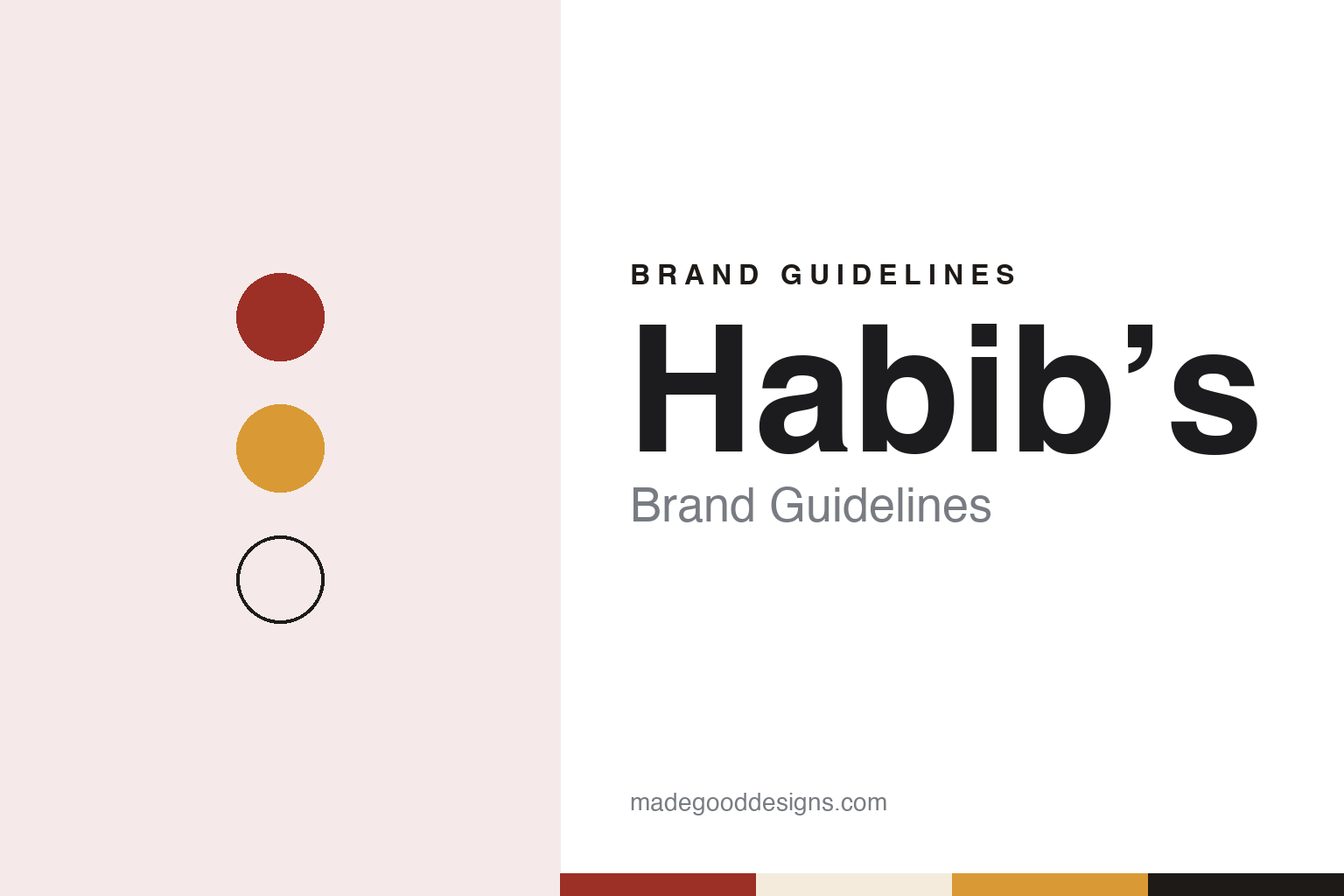
Two constants: a brick red, saffron and sesame cream palette and a friendly sans register. Abstract homage — not a Habib’s product or mark; no logo, sign or packaging is reproduced.
Rua Cerro Corá
A baker from Portugal and a cook who taught him.
Habib’s is a Brazilian fast-food chain built on Arab dishes, and its founder had no family link to them. BBC News, in a report from São Paulo published in December 2005, described Alberto Saraiva as born in Portugal and brought to Brazil as a young child. In 1973, the BBC reported, he was studying medicine in São Paulo when, as the eldest of three sons, he took over a padaria, one of the city’s Portuguese-style bakeries, that his father had recently taken on. “In that padaria, I learned to be a businessman,” he told the BBC.
Saraiva then built up and sold other businesses. In one of them, he told the BBC, a retired Arab cook of about 70 came to him asking for work, and Saraiva learned Arab cooking from him. He saw the Arab restaurants of the time as traditional places that were not aimed at most Brazilians, and decided to take the main dishes of the cuisine into a fast, low-cost format for the wider middle-class public rather than for the Arab community alone. English Wikipedia tells the same story in brief and says Saraiva hired the cook for the new restaurant.
The dates differ slightly between sources. English and Portuguese Wikipedia both say the first Habib’s opened in 1988, on Rua Cerro Corá in São Paulo, and the BBC’s 2005 report, which spoke of a start “17 years ago,” fits that year. Reports by g1 and NeoFeed in August 2026 date the business to 1987; g1 named its founders as the brothers Alberto and Belchior Saraiva. According to the BBC, the shop on Rua Cerro Corá, in the west of the city, drew long queues from the start.
Colour
Esfihas, a waiter at the table and a delivery promise.
The menu was built around two items. The BBC named the esfiha, a small round flatbread topped with minced beef or cheese, and the kibe, a beef croquette shaped “like a rugby ball,” as the most popular products, and reported that the chain sold some 600 million esfihas and 60 million kibes in 2004. Around them sat about 50 other options, including pizzas and burgers, and set menus that ranged from a full Arab meal to combinations of esfihas, kibe, fries and fruit juice. Low prices were the core of the offer from the start, g1 wrote in 2026.
The service model differed from most fast food. In 2005, the BBC noted, a waiter took orders at the table and knives and forks were always provided. Saraiva told the BBC that foreign chains had misread Brazilian habits, such as eating with the hands. Other features the BBC listed were a home-delivery service branded 28 Minutes, with a promise tied to that time, and a sponsorship deal that put the Habib’s logo on the sleeve of the São Paulo Futebol Clube shirt. Saraiva had also written a book, which the BBC rendered as The Commandments of Profitability.
Growth came first through company-run shops. Saraiva built a chain of 16 outlets before offering franchises in 1992, the BBC reported; by late 2005 Habib’s had 260 outlets in 15 of Brazil’s states plus the Federal District, and Saraiva owned 45% of them, with the rest franchised.
The group also made much of what it sold. g1 wrote in August 2026 that, to support its low-price strategy, it produced part of its own ingredients and products, with factories, dairies and bakeries, and that it went on to create Ragazzo, focused on coxinhas and other snacks, and the Tendall rodízio steakhouses. NeoFeed reported in September 2019 that the group had also set up the contact-centre company Voxline in 2002 to serve Habib’s.
Typography
How the category presents itself.
Latin American restaurant, burger, chicken and café chains tend to present themselves first through the street. A shop front carries the name, a short line of colour and often a counter or an ice-cream window that can be read from the pavement, and many chains run more than one format under the same name: a quick-service counter, a table-service restaurant, a kiosk in a shopping centre or a separate ice-cream shop. Drive-through lanes, delivery apps and self-service ordering screens have since joined the shop front as places where the name has to work.
Menus do much of the brand work. Chains in the region usually give their signature dishes their own names, from a house burger to a named roast chicken or a crêpe, and repeat those names across menu boards, packaging and campaigns. Mascots and characters appear in some of these identities, and seasonal campaigns are often built around a new named dish or a limited line rather than around the company itself.
Ownership is often a group matter. Several of the larger chains belong to food or restaurant groups that run a number of brands side by side, sometimes including franchises of international names, and the parent usually describes each brand as a separate business with its own identity. Others have stayed in the hands of their founding families for decades and present that continuity as part of the story.
Corporate pages and the business press fill in the rest: who founded the chain, in which city and year, who owns it now, and where it has opened abroad, usually through franchising in neighbouring countries, Spain or the United States. For a design reader, the useful evidence is what each company itself publishes, and how consistently its name, colours and dishes carry from one format to the next.
Aa
A friendly sans for a counter-service menu board. (Specimen set in Rubik, a sans STAND-IN; NOT the Habib’s logo.)
Habib’s
A founder’s return and a court process.
The chain’s recent years have been uneven. In September 2019, NeoFeed reported, Saraiva returned as chief executive after four years as chairman of the board, during which his cousin Mauro Saraiva had run the company; Mauro Saraiva moved to chief operating officer. The network had closed 20 shops in that time, the report said, and visits had fallen. At that point the group counted 549 stores: 320 Habib’s, 223 Ragazzo and six Tendall steakhouses, with about 18,000 staff, and it was relaunching its own ordering app.
In August 2026 the parent company, Grupo Gennius, which controls Habib’s, Ragazzo and Tendall, filed for recuperação judicial, Brazil’s court-supervised restructuring. g1 reported that the filing was made on 24 August and accepted by a São Paulo court the next day, which appointed KPMG as judicial administrator. In its petition the group pointed to lower footfall in shopping centres and city centres from 2020, the shift towards delivery and higher interest rates. NeoFeed reported that the process covered 178 legal entities, among them 119 Habib’s stores, 26 Ragazzo units and six steakhouses, and that it followed an earlier request, about two months before, for temporary protection from creditors. Franchised units were not part of the process, g1 said, and the group stated that its shops remained open and operating normally. The most recent press reports on the case date from August and September 2026, and the process was under way at the time of writing.
For a design guide, Habib’s shows how a chain can borrow a cuisine’s name and dishes and give them a mass-market, low-price frame, with table service and delivery as part of the brand. Compare Giraffas, another Brazilian chain that built a national franchise network from one shop, and McDonald’s, the US chain the BBC used as its yardstick in Brazil. For this guide we use a brick red, saffron and sesame cream with a sans, an unofficial interpretation; no product or logo is reproduced.
Explore & save
Keep Habib’s’s identity on hand — save it to a board in the Made Good inspiration library.
Habib’s identity set
Pin the Habib’s brick red, saffron and sesame cream palette and the friendly sans register to your own board.
Source & notes
Frequently Asked Questions
What font can I use to match the Habib’s look?
This guide describes Habib’s type as “A friendly sans for a counter-service menu board”. Its type specimen is set in Rubik from Google Fonts as a stand-in; Rubik is not Habib’s own lettering.
What colours are in the Habib’s palette?
This guide’s Habib’s palette is Brick red #9C2F26, Saffron #D99A35, Charcoal #1E1A18, Sesame cream #F4EBDD and Olive #5C6838. The tones are the guide’s own unofficial interpretation, not official Habib’s hex codes.
When was Habib’s founded?
Habib’s was founded in 1988 first restaurant (group dated 1987), in São Paulo, Brazil.
Who founded Habib’s?
Habib’s was founded by Alberto Saraiva in 1988 first restaurant (group dated 1987).