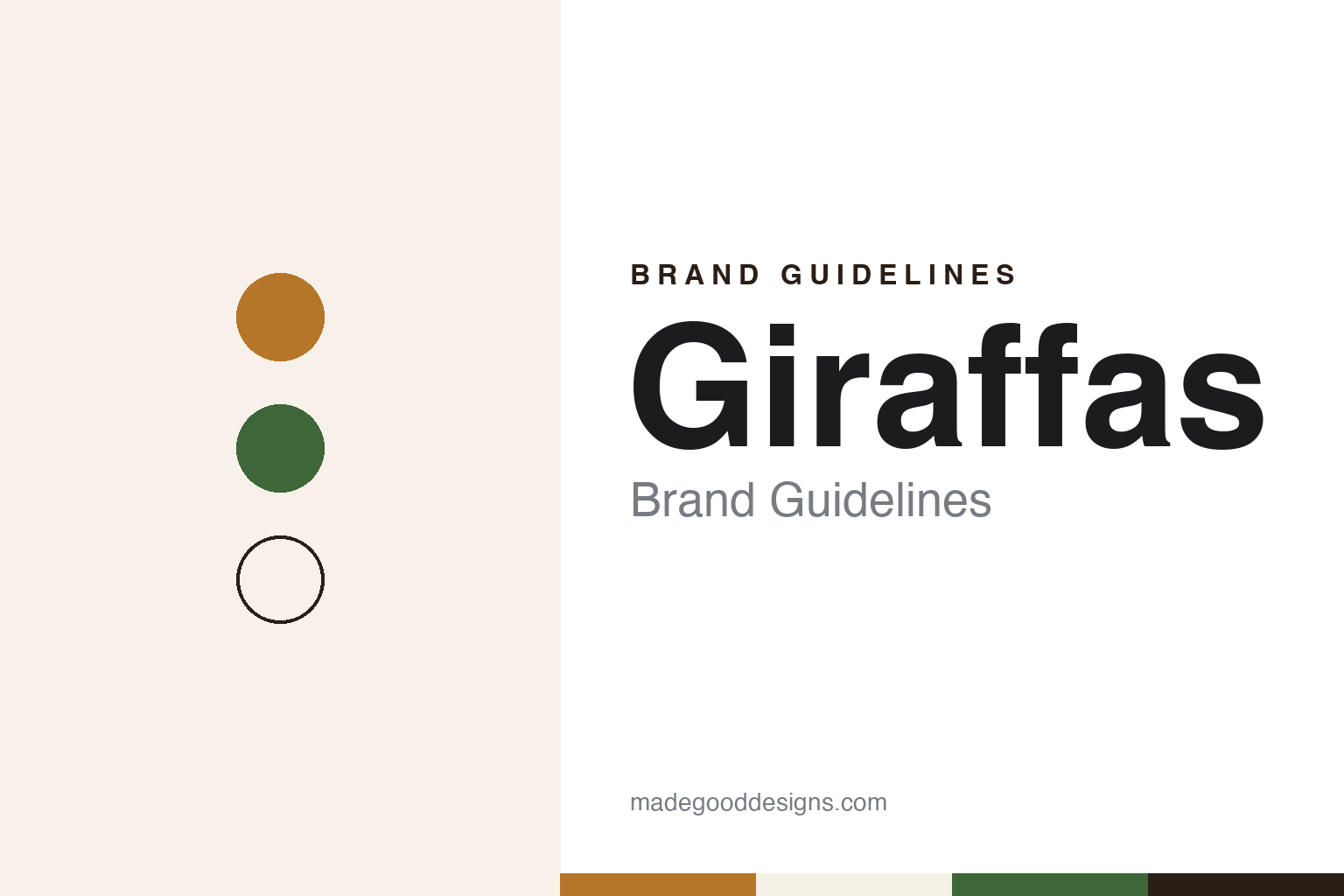
Giraffas Brand Guidelines
Two giraffes, Brasília 1981 and rice and beans as fast food.
Aa
Two constants: a savanna ochre, leaf green and rice white palette and a rounded sans register. Abstract homage — not a Giraffas product or mark; no giraffe drawing, logo or sign is reproduced.
Raio de Luz
Two students, a sandwich bar and a giraffe in the news.
Giraffas began in Brasília in 1981 as a sandwich bar for students. In a long first-person account published by Exame in June 2012, Carlos Guerra, born in Recife and then an electrical-engineering student who had transferred to the University of Brasília, said he set it up that year with his friend Ivan Aragão. The first shop, he said, was in 105 Sul, and it was still at the same address in 2012. It became a meeting point for university friends, who would put on an apron and fry burgers when an employee was missing. It sold sandwiches, crêpes, juices and ice cream, and two of the early sandwiches, the Brutus, a burger, and the Galo de Briga, made with chicken breast, were still on the menu when he spoke to the magazine. Guerra left his degree as the business grew. Aragão later moved to Recife and left the partnership.
Wikipedia tells the founding differently. English and Portuguese Wikipedia both date the opening to April 1981 but name the founders as Mauro Lacerda and Muniz Neto and place the first shop in Lago Sul, in the Federal District. Later trade reports, such as Mercado & Consumo in June 2025, describe Guerra as the company’s founder and chief executive.
The name came from the news. Exame recounted that in 1981 a male giraffe called Raio de Luz was sent from Rio de Janeiro’s zoo to Brasília to join a female of his species, a story that the poet Carlos Drummond de Andrade turned into a newspaper crônica, “A Solidão do Girafo.” The friends liked the story and the name, spelled with two f’s.
Colour
Rice and beans with a knife and fork.
The logo grew out of the same story. Guerra told Exame that the partners thought a drawing of two giraffes would make a friendly logo; the style of the drawing had changed several times by 2012, he said, but the two giraffes, a couple, were still there. When the chain opened in Miami, he added, it used different brand colours from those in Brazil.
The menu moved away from the sandwich bar. In the 1980s, Guerra said, fast food in Brazil meant mainly Bob’s and McDonald’s, and the snack bars all looked alike, so the partners put rice and beans on the menu, a format he described as home-style food served fast. Exame reported in March 2020 that the chain had sold some 20 million plates of rice and beans in 2019. Burgers stayed on the menu alongside the plated meals.
The business was rebuilt more than once. Cláudio Miccieli, a friend who had eaten there many times, joined as a partner in 1987, when there were four shops, each buying and cooking on its own, he told Exame. The partners set up a central production and supply unit that made bread and ice cream and cut meat for all of them. By 1991 there were 11 shops, and that year Giraffas began franchising, which both Wikipedia versions also date to 1991. After the 1994 Real Plan ended high inflation, Miccieli said, the partners saw that much of their apparent performance had come from financial gains rather than from the restaurants, and that he feared the company might not survive. They responded by selling all the company-owned shops, outsourcing logistics and burger production, and concentrating on the brand, new dishes and support for franchisees. In 2012, Exame reported, the company had six shareholders, whose strategic decisions were taken by a partners’ board.
The franchise network spread outward from the Federal District. Portuguese Wikipedia lists expansion to states such as São Paulo, Rio de Janeiro, Minas Gerais, Paraná and Bahia, and says that in 2006, its 25th year, the chain held a festival of local rock bands in Brasília called Giraffestival and reached 200 restaurants.
Typography
How the category presents itself.
Latin American restaurant, burger, chicken and café chains tend to present themselves first through the street. A shop front carries the name, a short line of colour and often a counter or an ice-cream window that can be read from the pavement, and many chains run more than one format under the same name: a quick-service counter, a table-service restaurant, a kiosk in a shopping centre or a separate ice-cream shop. Drive-through lanes, delivery apps and self-service ordering screens have since joined the shop front as places where the name has to work.
Menus do much of the brand work. Chains in the region usually give their signature dishes their own names, from a house burger to a named roast chicken or a crêpe, and repeat those names across menu boards, packaging and campaigns. Mascots and characters appear in some of these identities, and seasonal campaigns are often built around a new named dish or a limited line rather than around the company itself.
Ownership is often a group matter. Several of the larger chains belong to food or restaurant groups that run a number of brands side by side, sometimes including franchises of international names, and the parent usually describes each brand as a separate business with its own identity. Others have stayed in the hands of their founding families for decades and present that continuity as part of the story.
Corporate pages and the business press fill in the rest: who founded the chain, in which city and year, who owns it now, and where it has opened abroad, usually through franchising in neighbouring countries, Spain or the United States. For a design reader, the useful evidence is what each company itself publishes, and how consistently its name, colours and dishes carry from one format to the next.
Aa
A rounded sans for a food-court menu board. (Specimen set in Nunito, a sans STAND-IN; NOT the Giraffas logo.)
Giraffas
Miami, Ciudad del Este and 25 states.
Giraffas has tried to work abroad. In June 2012, Exame reported that the chain was in 128 Brazilian cities, in Miami and in Ciudad del Este, in Paraguay. The Miami restaurant, Guerra said, was the result of a five-year project and was owned by the company rather than franchised, so that it could test ideas new to the business: waiters brought meals to the table and the menu included pasta, which was not served in Brazil. Mercado & Consumo wrote in June 2025 that the chain had operated company-owned stores in the United States until 2018, and Portuguese Wikipedia says both the US and Paraguay operations were discontinued, leaving Giraffas trading only in Brazil.
At home the network kept growing. By March 2020, Exame reported, Giraffas had more than 400 units in 25 Brazilian states. The company works mainly through franchisees, as it has since the strategy change of the 1990s, and Carlos Guerra was its chief executive as of June 2025, according to Mercado & Consumo.
For a design guide, Giraffas shows how a name drawn from a local news story, and a logo of two animals redrawn over the years without losing the pair, can carry a chain from one student snack bar to a national franchise network. Compare Habib’s, another Brazilian chain that franchised in the early 1990s, and McDonald’s, which Guerra named as one of the few fast-food brands in Brazil when Giraffas started. For this guide we use a savanna ochre, leaf green and rice white with a sans, an unofficial interpretation; no product or logo is reproduced.
Explore & save
Keep Giraffas’s identity on hand — save it to a board in the Made Good inspiration library.
Giraffas identity set
Pin the Giraffas savanna ochre, leaf green and rice white palette and the rounded sans register to your own board.
Source & notes
Frequently Asked Questions
What font can I use to match the Giraffas look?
This guide describes Giraffas’ type as “A rounded sans for a food-court menu board”. Its type specimen is set in Nunito from Google Fonts as a stand-in; Nunito is not Giraffas’ own lettering.
What colours are in the Giraffas palette?
This guide’s Giraffas palette is Savanna ochre #B5762A, Bean brown #4A2F22, Leaf green #3E6638, Rice white #F6F1E6 and Deep umber #2A1E17. The tones are the guide’s own unofficial interpretation, not official Giraffas hex codes.
When was Giraffas founded?
Giraffas was founded in 1981, in Brasília, Brazil. Giraffas is known for Plated rice-and-beans meals, Brutus burger.


