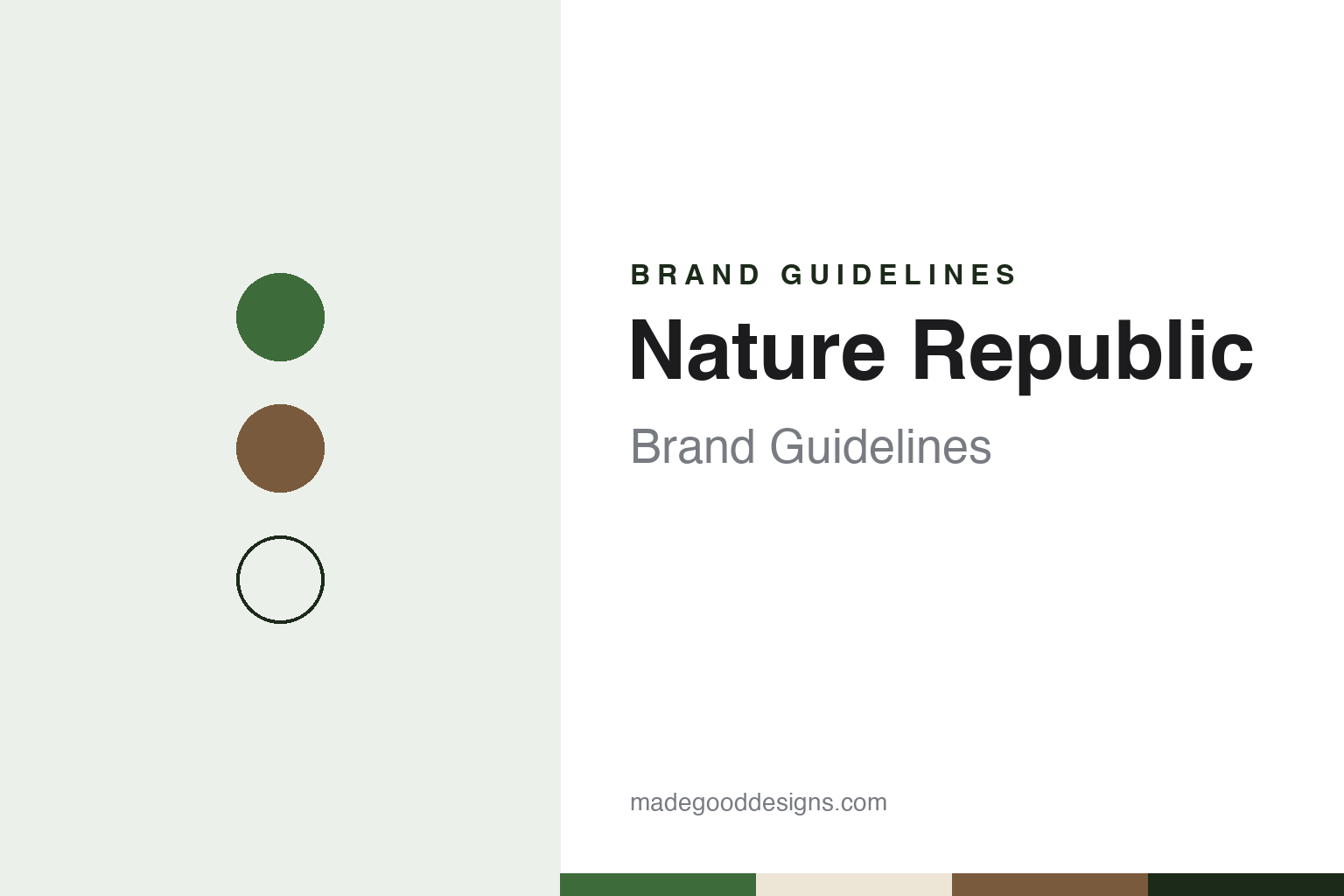
Nature Republic Brand Guidelines
A 2009 road shop, a wooden Myeong-dong front and an aloe range.
Aa
Two constants: an aloe green and bark brown palette and a botanical serif register. Abstract homage — not a Nature Republic product or mark; no pack, logo or shopfront is reproduced.
A second start
Founding members of The Face Shop begin again.
Nature Republic is a South Korean cosmetics brand founded in 2009. The Korea Times reported in April 2016 that Jung Woon-ho founded it that year after selling The Face Shop to LG Household & Health Care, and the Korea Herald wrote in June 2016 that the company was created by founding members of The Face Shop, including Jung, who became its chief executive in 2010. English Wikipedia says the first Nature Republic store opened in March 2009.
A year and a half later the brand was already a fixture of Seoul’s tourist shopping. In September 2010 The Korea Times called Nature Republic “a relative newcomer” to the budget cosmetics market, having opened only the year before, but said it was fast becoming popular with tourists. The paper listed it among the street-front chains, with The Face Shop, Missha, Etude House, Skin Food and Innisfree, that sold make-up and skincare at low and mid-range prices with campaigns built around Korean Wave stars.
Its shares were not listed: the Korea Herald described it in June 2016 as an unlisted company, and in October 2016 named the founder as its majority shareholder. Its business model is the franchise store: in January 2021 the Korea Herald described Nature Republic as one of Korea’s “road shop” beauty brands, selling its products through its own franchise network.
The store count has moved with the market. Data from Korea’s Fair Trade Commission, cited by the Korea Herald in January 2021, showed Nature Republic stores falling from 701 in 2017 to 521 in 2019, and a company official told the paper that the brand was closing several shops to concentrate on key locations. The same report said that other road-shop brands, including Skin Food and Tony Moly, had followed a similar path.
Colour
Brown timber, a star billboard and four-language labels.
The most documented piece of the brand’s design is its flagship. Describing Myeongdong in September 2010, The Korea Times wrote that the Nature Republic store was hard to miss, with a brown wooden facade and a huge billboard of the singer Rain. Inside, the paper found a special section for foreign visitors staffed in English, Japanese and Chinese, products labelled in English, Japanese, Chinese and Korean, a currency exchange rate board, tax refunds on larger purchases, and free coffee, water and seats for tired shoppers.
That shop, known as the Myeong-dong World Branch, stands on unusually valuable ground. In May 2021 the Korea Herald reported, citing data from the Seoul Metropolitan Government, that the 170-square-metre plot under Nature Republic’s flagship had been named the most expensive land in South Korea for the eighteenth consecutive year; the plot has held that position since 2004. In January 2021 a company official told the same paper that the Myeong-dong World Branch had stayed open while some of its other own stores closed temporarily.
Faces have changed over time. English Wikipedia lists the actor Jang Keun-suk as a model in 2011 and the group EXO from 2013, and says that in January 2020 the company announced EXO would no longer front the brand, naming NCT 127 as its new model in April 2020; it lists the girl group Lightsum in 2023.
Products are sold under named lines. When Nature Republic entered Italy in 2018, the company told the Korea Herald that it had spent two years registering some 80 products on the European Union’s Cosmetic Products Notification Portal, among them its signature Ginseng Royal Silk Watery Cream and an aloe vera gel. In November 2024 Aju Press reported growing sales in the Philippines for its California Aloe Sun Stick.
Typography
Design and documentation.
Korean beauty brands tend to present themselves through the groups that own them as much as through their own names. Two companies own many of the labels in this guide. Amorepacific, whose history page dates its founding company, Pacific Chemical, to 1945, lists brands including Sulwhasoo, Laneige and Innisfree on its corporate website. LG H&H owns lines such as The History of Whoo, Sum 37 and O HUI, according to the Korea Times in 2023. Other names covered here are run by separate companies, and each guide states its owner as dated sources give it.
The companies publish a good deal about themselves. Corporate history pages give launch years, founders and owners, and brand pages set out philosophies in the companies’ own words; those claims are attributed in each guide rather than repeated as fact. Where a launch date differs between a company and the press, both versions are given.
Much of the visual identity is set out in shops. Korean trade and daily press have reported flagship stores in detail: a lantern-themed building in Gangnam, a hanok store in Bukchon, a glass-walled visitor house among Jeju’s tea fields. Logo changes are reported as news too, with new wordmarks, colours and packaging announced to the press and rolled out across products, advertising and store interiors.
Export markets shape the story. Brands covered here have opened stores in China, Hong Kong, Australia and North America, and some later closed them; the Korea Herald, Korea Times and Korea JoongAng Daily have covered each move. Campaigns often pair a named range with a celebrity ambassador or a cultural partner, and each guide names those only as dated reports do.
Aa
A calm, bookish serif to sit against timber and leaf. (Specimen set in Lora, a serif STAND-IN; NOT the Nature Republic logo.)
Nature Republic
From Myeong-dong to Riyadh, Milan and Manila.
Nature Republic went abroad within two years of opening. English Wikipedia says it opened stores in 2011 in Taiwan, Singapore, Thailand, Malaysia and Cambodia, and launched its first store in the Philippines on 13 November 2012. The brand entered the United States in 2012 and had 17 stores there by July 2016, half of them in major shopping centres, the Korea Herald reported, when it launched a store in the Del Amo Mall in Torrance, California. By 2015, The Korea Times reported, the company ran some 700 stores in Korea and 120 stores in 14 foreign countries.
New regions followed in 2018. The Korea Times reported in June 2018 that Nature Republic had opened its first store in Saudi Arabia, a flagship in Al Nakheel Mall in Riyadh, under a partnership with the local retailer Fawaz Alhokair, making Saudi Arabia its 18th country; the company had entered Indonesia earlier that year. In December 2018 the Korea Herald reported four pop-up stores inside Italy’s Coin department stores in Rome, Milan, Torino and Bari, taking the brand’s presence to 19 countries. English Wikipedia adds a shop in Uzbekistan in December 2019.
The most recent dated picture comes from Aju Press. In November 2024 it reported that Nature Republic had 31 stores in the Philippines, had held pop-up events in Manila in June and at the Shangri-La Mall in Mongolia in May, and had added locations that year in the Dubai Mall and in Costco stores in the United States. As of that report, the brand described its reach as spanning Asia, North America and Europe.
For a design guide, Nature Republic shows how a road-shop brand can turn one shopfront material and a clear plant theme into a recognisable street presence. Compare The Face Shop, the earlier brand of its founding team, and Innisfree, another Korean road-shop brand with a green, plant-led image. For this guide we use an aloe green, a moss ink, a bark brown and a linen sand with a serif, an unofficial interpretation; no product or logo is reproduced.
Explore & save
Keep Nature Republic’s identity on hand — save it to a board in the Made Good inspiration library.
Nature Republic identity set
Pin the aloe green and bark brown palette and the botanical serif register to your own board.
Source & notes
Frequently Asked Questions
What font can I use to match the Nature Republic look?
This guide describes Nature Republic’s type as “A calm, bookish serif to sit against timber and leaf”. Its type specimen is set in Lora from Google Fonts as a stand-in; Lora is not Nature Republic’s own lettering.
What colours are in the Nature Republic palette?
This guide’s Nature Republic palette is Aloe green #3E6B3A, Moss ink #1C2A1A, Bark brown #7A5A3C, Linen sand #EDE6D6 and Paper #F9F7F1. The tones are the guide’s own unofficial interpretation, not official Nature Republic hex codes.
When was Nature Republic founded?
Nature Republic was founded in 2009, in South Korea. Nature Republic is known for Myeong-dong World Branch, aloe and ginseng lines.
Who founded Nature Republic?
Nature Republic was founded by Jung Woon-ho in 2009. Nature Republic is known for Myeong-dong World Branch, aloe and ginseng lines.