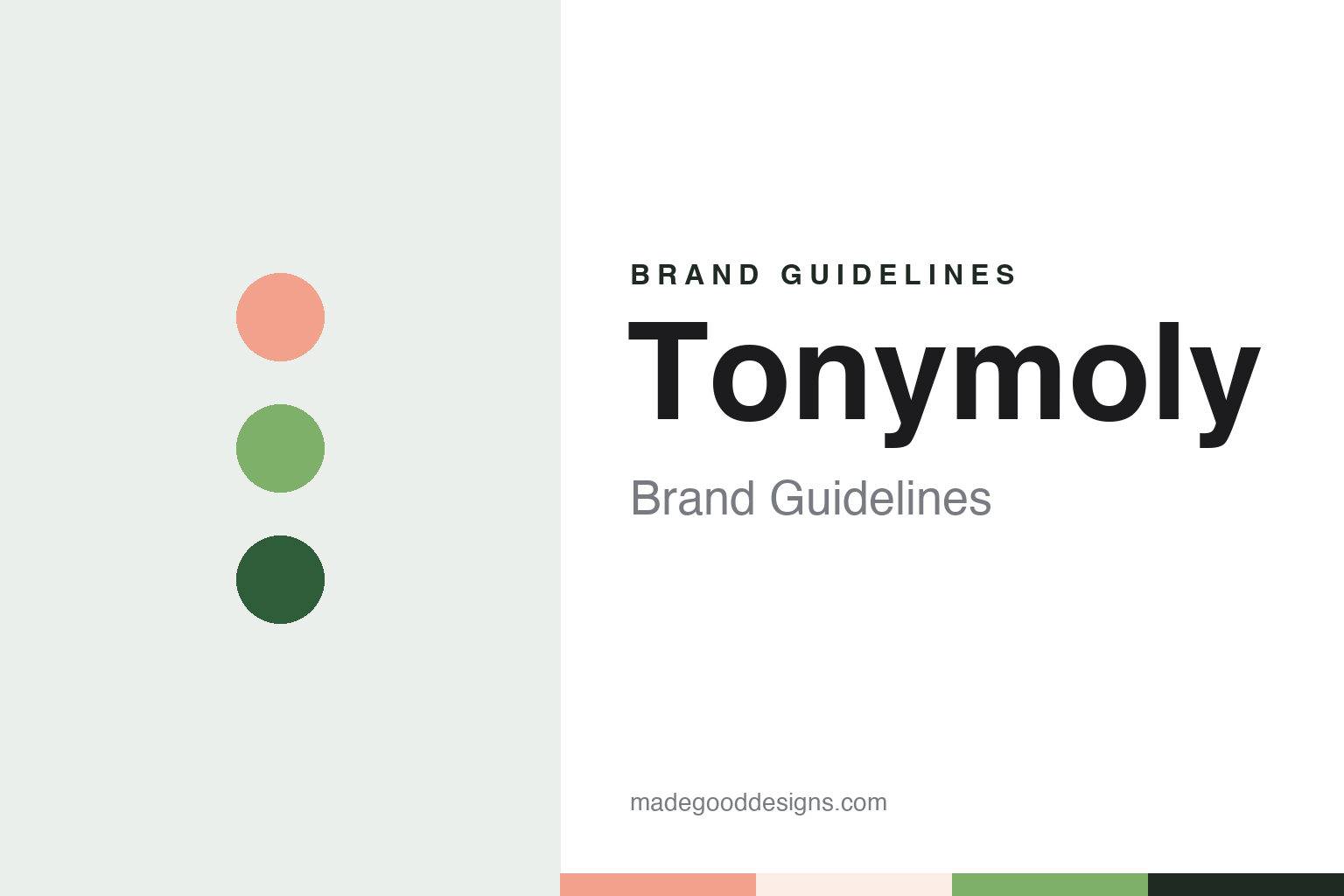
Tonymoly Brand Guidelines
The Seoul brand born from a cosmetics container maker.
Aa
Two constants: a peach, leaf green and forest ink palette and a rounded sans register. Abstract homage — not a Tonymoly product or mark; no container, logo or pack is reproduced.
Taesung and Tonymoly
A container designer starts a cosmetics brand.
Tonymoly is a South Korean cosmetics brand launched in Seoul in July 2006, English Wikipedia says, with the backing of Tae Sung Industry. The Korea Herald reported in June 2015 that the company was set up by Bae Hae-dong, its chairman, who had studied product design at a Korean university and began his career designing cosmetics containers for the domestic beauty firm Julia. In 1994 he founded Taesung CNC, which supplied containers to Korean cosmetics firms and to international groups such as the Estée Lauder Companies, the paper reported, and with that business established he launched Tonymoly in 2006, during a boom in budget cosmetics in Korea.
The packaging business shaped the brand from the start. English Wikipedia says the name Tonymoly means “putting style into packaging.” The Korea Herald wrote that Bae wanted customers to fix their eyes on the product design, citing a lip balm in a red plastic container shaped like lips and hand creams in the shape of peaches and apples. The paper reported that Tonymoly handed product development and production to the contract manufacturer Cosmax while it concentrated on marketing, sales and container development, and that before its stock-market listing the brand was wholly owned by Taesung CNC, which also supplied its containers.
The store network grew quickly. English Wikipedia says the company had 60 stores in Korea by April 2008 and more than 120 by November 2009, opened its 200th shop in 2010 and its 300th in 2011, and opened stores in Japan, Taiwan, Hong Kong, China, Vietnam and Myanmar in 2009, in the Philippines in April 2011 and in Russia in August 2013, with two stores in Rostov-on-Don and Ulan-Ude. It reached a tenth single-brand shop in Indonesia in 2013 and, in 2015, opened an official store in Colombia, starting in Bogotá and Medellín. By 2016, the same article says, it counted 825 stores in 15 countries. The Korea Times reported in June 2015 that Tonymoly then ran nearly 600 outlets in Korea and hundreds more across 20 countries, including the United States and Hong Kong.
Colour
Fruit, animals and lips.
Tonymoly’s look is built on containers that tell the shopper what is inside. When the company opened its New York flagship on West 32nd Street on 13 August 2015, Korea JoongAng Daily reported, the products that drew shoppers were those in containers shaped like fruits and cute animals, and the store’s manager told the paper that customers could guess a product’s purpose just by looking at its container, adding that the brand’s strong point was how approachable it was. The company told the paper that about 95 percent of the store’s customers were not Korean. The same report said Tonymoly had opened a flagship in San Francisco a month earlier, and that the company was then marking its tenth anniversary. In June 2015 The Korea Herald reported that Tonymoly products were sold in more than 16 countries.
The paper also traced how one product changed its name for export. The Kiss Kiss Lip Essence, launched about five years before the report, was sold in the United States as the Bbo Bbo Lip Balm. Tonymoly entered Sephora stores in the United States in August 2014, Korea JoongAng Daily reported.
Later Korean press reports name the ranges that carry the brand abroad. Daily Hankook reported in September 2025 that Tonymoly had opened a counter in Ulta Beauty’s first store in Mexico, in the Antara Fashion Hall mall in Mexico City, with the Wonder Ceramide Mochi line, the Panda’s Dream line, I’m Mask sheets and the Wonder Hyaluronic Acid line; the company said it also sold through Costco, Sephora and Walmart in Mexico and ran seven brand shops there, and that it was building its name in North America through Ulta Beauty and Target.
Typography
Design and documentation.
Korean beauty brands tend to present themselves through the groups that own them as much as through their own names. Two companies own many of the labels in this guide. Amorepacific, whose history page dates its founding company, Pacific Chemical, to 1945, lists brands including Sulwhasoo, Laneige and Innisfree on its corporate website. LG H&H owns lines such as The History of Whoo, Sum 37 and O HUI, according to the Korea Times in 2023. Other names covered here are run by separate companies, and each guide states its owner as dated sources give it.
The companies publish a good deal about themselves. Corporate history pages give launch years, founders and owners, and brand pages set out philosophies in the companies’ own words; those claims are attributed in each guide rather than repeated as fact. Where a launch date differs between a company and the press, both versions are given.
Much of the visual identity is set out in shops. Korean trade and daily press have reported flagship stores in detail: a lantern-themed building in Gangnam, a hanok store in Bukchon, a glass-walled visitor house among Jeju’s tea fields. Logo changes are reported as news too, with new wordmarks, colours and packaging announced to the press and rolled out across products, advertising and store interiors.
Export markets shape the story. Brands covered here have opened stores in China, Hong Kong, Australia and North America, and some later closed them; the Korea Herald, Korea Times and Korea JoongAng Daily have covered each move. Campaigns often pair a named range with a celebrity ambassador or a cultural partner, and each guide names those only as dated reports do.
Aa
A rounded, friendly sans for a brand built on playful containers. (Specimen set in Fredoka, a rounded sans STAND-IN; NOT the Tonymoly logo.)
Tonymoly today
A listed company since 2015.
Tonymoly went to the stock market in 2015. The Korea Herald reported in June that year that the company would go public in July and had just held a meeting with investors in Shanghai, and The Korea Times reported that subscriptions for its initial public offering ran from 1 to 2 July 2015, with 40 million new shares among those offered. Its shares trade on the Korea Exchange: in June 2024 The Asia Business Daily reported on their trading, named Megacos as a Tonymoly subsidiary and quoted a securities analyst on the brand’s new entry into multi-brand shops such as Daiso and Olive Young.
That move from single-brand road shops into other retailers’ stores has continued. In November 2026 Money Today reported that Tonymoly had begun selling in Beauty Onnuri Pharmacy, a beauty-focused pharmacy that opened in September 2026 in the basement of the Musinsa Beauty store in Hongdae, Seoul, with the Ceramide Mochi Toner among the products on its shelves. The company writes its own name in capitals, as TONYMOLY, on its websites.
For a design guide, Tonymoly shows how a container maker can make the pack itself the brand, so that shape, colour and name explain a product before any label is read. Compare The Face Shop, LG H&H’s road-shop brand, and Nature Republic, which The Korea Times reported in 2015 was also preparing a stock-market listing. For this guide we use peach, leaf green and a forest ink with a rounded sans, an unofficial interpretation; no product or logo is reproduced.
Explore & save
Keep Tonymoly’s identity on hand — save it to a board in the Made Good inspiration library.
Tonymoly identity set
Pin the Tonymoly peach, leaf green and forest ink palette and the rounded sans register to your own board.
Source & notes
Frequently Asked Questions
What font can I use to match the Tonymoly look?
This guide describes Tonymoly’s type as “A rounded, friendly sans for a brand built on playful containers”. Its type specimen is set in Fredoka from Google Fonts as a stand-in; Fredoka is not Tonymoly’s own lettering.
What colours are in the Tonymoly palette?
This guide’s Tonymoly palette is Peach blush #F2A28C, Leaf green #7FB069, Deep leaf #2F5D3A, Forest ink #1E2A22 and Rice paper #FBEDE6. The tones are the guide’s own unofficial interpretation, not official Tonymoly hex codes.
When was Tonymoly founded?
Tonymoly was founded in July 2006, in Seoul, South Korea.
Who founded Tonymoly?
Tonymoly was founded by Bae Hae-dong (Taesung CNC) in July 2006.


