Wardah Brand Guidelines
Paragon’s 1995 halal make-up line, relaunched in 2009.
Aa
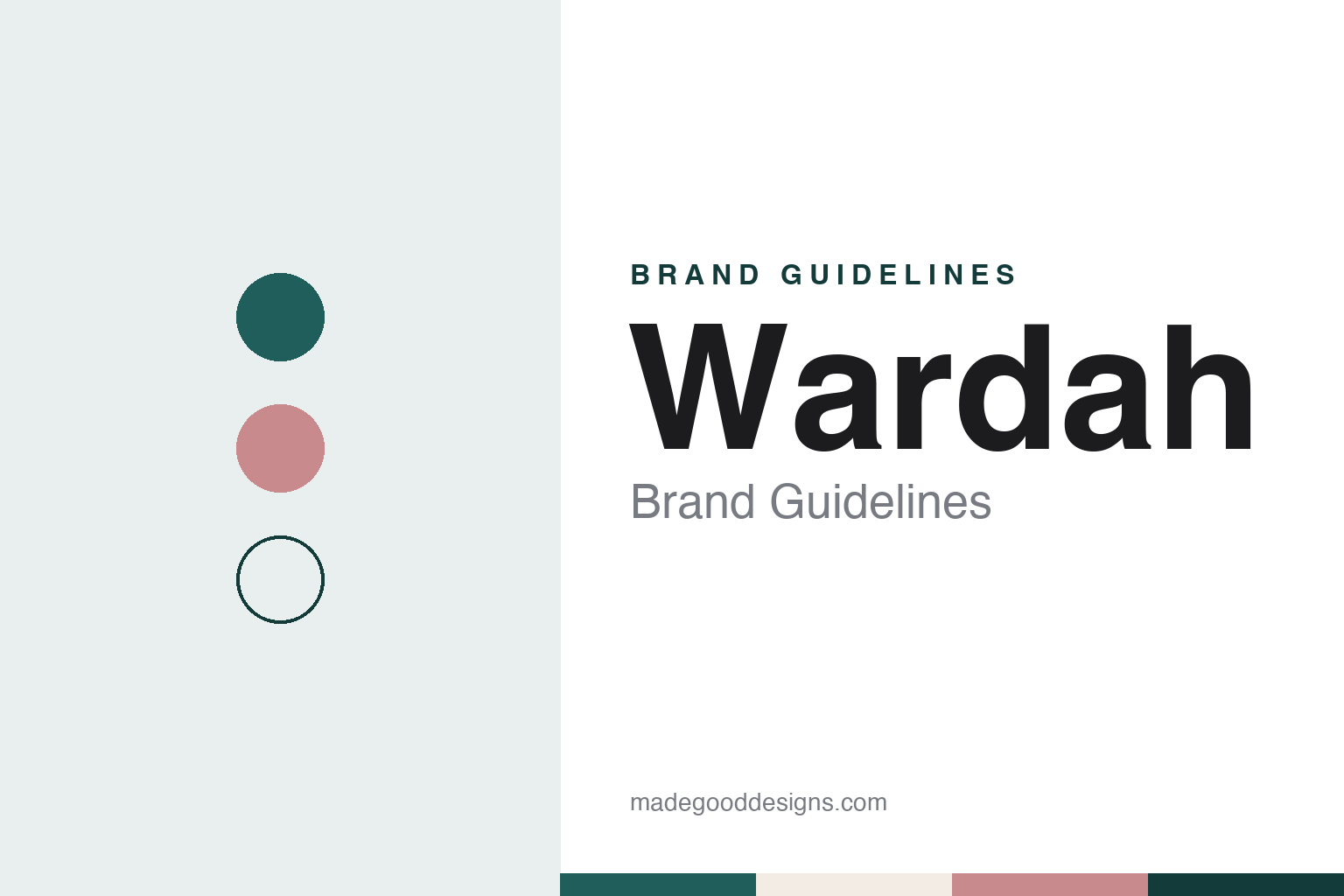
Two constants: a deep teal, dusty rose and warm sand palette and a soft display serif register. Abstract homage — not a Wardah product or mark; no pack, logo or campaign image is reproduced.
Pusaka Tradisi Ibu
A home business, a shampoo and then a halal make-up line.
Wardah is younger than the company that makes it. Monocle reported in May 2025 that the business now called Paragon Corp was founded in 1985 by Nurhayati Subakat, a pharmacist trained at the Bandung Institute of Technology, after she left a quality-control job at the German haircare company Wella to make her own professional hair products. CNBC Indonesia wrote in February 2024 that her first product was a shampoo called Putri, sold under the name Pusaka Tradisi Ibu as a small home business, marketed door to door. In an interview with The Jakarta Post in June 2019, the founder said she had been with the company since it was set up in 1985.
The Wardah brand followed in 1995. Salaam Gateway reported in November 2020 that when Wardah made its debut that year, few Indonesian shoppers were familiar with halal cosmetics, and that the founder sold it door to door and through multilevel marketing before opening her first store in 2004. Liputan6 wrote in December 2022 that the brand received a halal certificate from the Majelis Ulama Indonesia (MUI) in 1999. The name means “rose” in Arabic, Monocle noted, and the magazine reported that in the 1990s and early 2000s the company’s buyers travelled abroad to explain halal certification to the suppliers of its raw materials.
Two relaunches shaped the brand that exists today. The founder told The Jakarta Post that from 2002 the second generation of the family began relaunching the company’s products to reach younger buyers, and that Wardah itself was relaunched in 2009, the year she linked to the spread of the hijab as everyday fashion. Salaam Gateway said that relaunch came after substantial changes to quality and packaging. In 2011, CNBC Indonesia reported, Pusaka Tradisi Ibu was renamed PT Paragon Technology and Innovation.
Colour
Headscarves, singers and a racing driver.
Wardah’s campaigns have long used familiar faces. Fimela reported in July 2014 that the brand’s ambassadors had included Inneke Koesherawati, Tatjana Saphira, Zaskia Sungkar, Rya Miranda and Dian Pelangi, and that on 16 July 2014 it presented the singer Tulus as a new ambassador, to work with Wardah on creative projects for two years. The same event launched a Ramadan campaign online, “Share Your Inspiring Stories with Wardah,” which asked fans to write letters of encouragement.
Monocle linked the brand’s rise to the years 2008 to 2010, when more Indonesian women chose to wear the hijab and Wardah’s halal certification and its campaigns with models wearing headscarves found an audience. Deputy chief executive Sari Chairunnisa told the magazine that this lifestyle was not being shown by the large international make-up brands. The founder, though, told The Jakarta Post in 2019 that Wardah did not put its halal certificates at the centre of its advertising, and that its campaigns were about how users feel about their own beauty.
Fashion has been part of the brand’s stage. A photograph published by Salaam Gateway in May 2017 showed a make-up artist using Wardah eyeliner on a model at Indonesia Fashion Week in February that year, and Liputan6 mentioned a Wardah Inspiring Young Designer Competition held at Jakarta Fashion Week 2019.
Recent campaigns have looked abroad and to younger buyers. Marketing-Interactive reported in November 2025 that ParagonCorp had launched Light+ by Wardah in Jakarta on Youth Pledge Day under the theme “Every side has its light,” with face-care and decorative lines that the company said were shaped by the views of 1,000 young Indonesians. In May 2026 the same publication reported a six-month campaign, “Own your finish,” to introduce two lip products, StayLock and Glasting. It starred the Emirati racing driver Amna Al Qubaisi, was shot in Dubai and Abu Dhabi, and was produced and directed by Iskandar Siva and Taufik Fauzi of Parastudio.
Typography
How the category presents itself.
Indonesian beauty and modest-fashion brands tend to present themselves through people, packaging and the places they sell, and only occasionally through a published identity manual. Logos and colour codes are rarely documented in the press, so a design reading has to rest on what companies show in public: the pack, the campaign, the ambassador and the corporate page that names founders and owners.
Halal statements are part of that picture, but companies publish them in different ways. Liputan6 reported in 2022 that Wardah received a halal certificate from the Majelis Ulama Indonesia in 1999, while Wardah’s founder told The Jakarta Post in 2019 that the brand did not put its certificates at the centre of its advertising. A marketing analyst quoted by the same paper linked the growth of halal cosmetics to the spread of the hijab as everyday fashion from around 2009, saying that fashion and cosmetics moved together.
Campaigns lean on familiar faces. Singers, racing drivers and other public figures appear as named ambassadors in dated launches, from a 2014 Wardah event in Jakarta reported by Fimela to a 2026 lip campaign shot in Dubai and Abu Dhabi, covered by Marketing-Interactive. Marketplace launches matter as much as shops: Monocle reported in 2025 that Paragon Corp sells through livestreams on TikTok, Shopee, Lazada and Tokopedia, and Sinar Harian reported that Emina’s 2022 Malaysian launch named Shopee, TikTok Shop and Watsons as its outlets.
Group ownership shapes the field. Paragon Corp, founded in 1985 and renamed in 2011, runs a family of brands for different ages and budgets, and older houses with roots in the jamu tradition sit alongside it with their own founders and corporate histories. Each guide in this series describes those owners plainly, dates every ambassador and launch, and treats colour and type as our own unofficial interpretation.
Aa
A soft display serif for a rose-named brand. (Specimen set in DM Serif Display, a serif STAND-IN; NOT the Wardah logo.)
Wardah
A family company’s flagship brand.
Wardah belongs to Paragon Corp (PT Paragon Technology and Innovation), which Monocle described in May 2025 as family-owned and run by the founder’s three children, with Harman Subakat as chief executive and Sari Chairunnisa as deputy chief executive and head of research and development. The magazine counted 14 beauty brands and 43 distribution centres across Indonesia, and reported that the group makes its products at a factory compound in Banten province. It opened a new head office in South Jakarta in February 2025, Monocle said, and the make-up label Instaperfect grew out of Wardah.
Selling has moved online alongside the shops. Monocle reported that Paragon began livestream selling in 2023, built a filming studio near its head office, and sells through TikTok, Shopee, Lazada and Tokopedia; Wardah’s hosts present a calm look and tend to wear a hijab. Offline shops, the magazine added, remain the group’s main sales channel. Outside Indonesia, Salaam Gateway reported in May 2017 that Wardah had sold in Malaysia since 2012 through small local distributors and was moving into the Watsons and Giant chains; in August 2020 it called the 2017 move into Malaysia the company’s initial venture abroad.
For a design guide, Wardah shows how a halal brand can rest its look on a flower name, a soft colour range and faces rather than on the certificate alone. Compare Emina, Paragon’s brand for teenagers, and Make Over, its professional make-up label, or Shopee, one of the marketplaces where it sells. For this guide we use deep teal, dusty rose and warm sand with a serif, an unofficial interpretation; no product or logo is reproduced.
Explore & save
Keep Wardah’s identity on hand — save it to a board in the Made Good inspiration library.
Wardah identity set
Pin the Wardah deep teal, dusty rose and warm sand palette and the soft display serif register to your own board.
Source & notes
Frequently Asked Questions
What font can I use to match the Wardah look?
This guide describes Wardah’s type as “A soft display serif for a rose-named brand”. Its type specimen is set in DM Serif Display from Google Fonts as a stand-in; DM Serif Display is not Wardah’s own lettering.
What colours are in the Wardah palette?
This guide’s Wardah palette is Deep teal #1F5E5B, Evergreen ink #123B39, Dusty rose #C98A8E, Warm sand #F3ECE4 and Paper #FAF8F5. The tones are the guide’s own unofficial interpretation, not official Wardah hex codes.
When was Wardah launched?
Wardah was launched in 1995, in Jakarta, Indonesia. Wardah is known for Halal make-up, Light+ by Wardah, StayLock.
Who founded Wardah?
Wardah was founded by Nurhayati Subakat in 1995. Wardah is known for Halal make-up, Light+ by Wardah, StayLock.