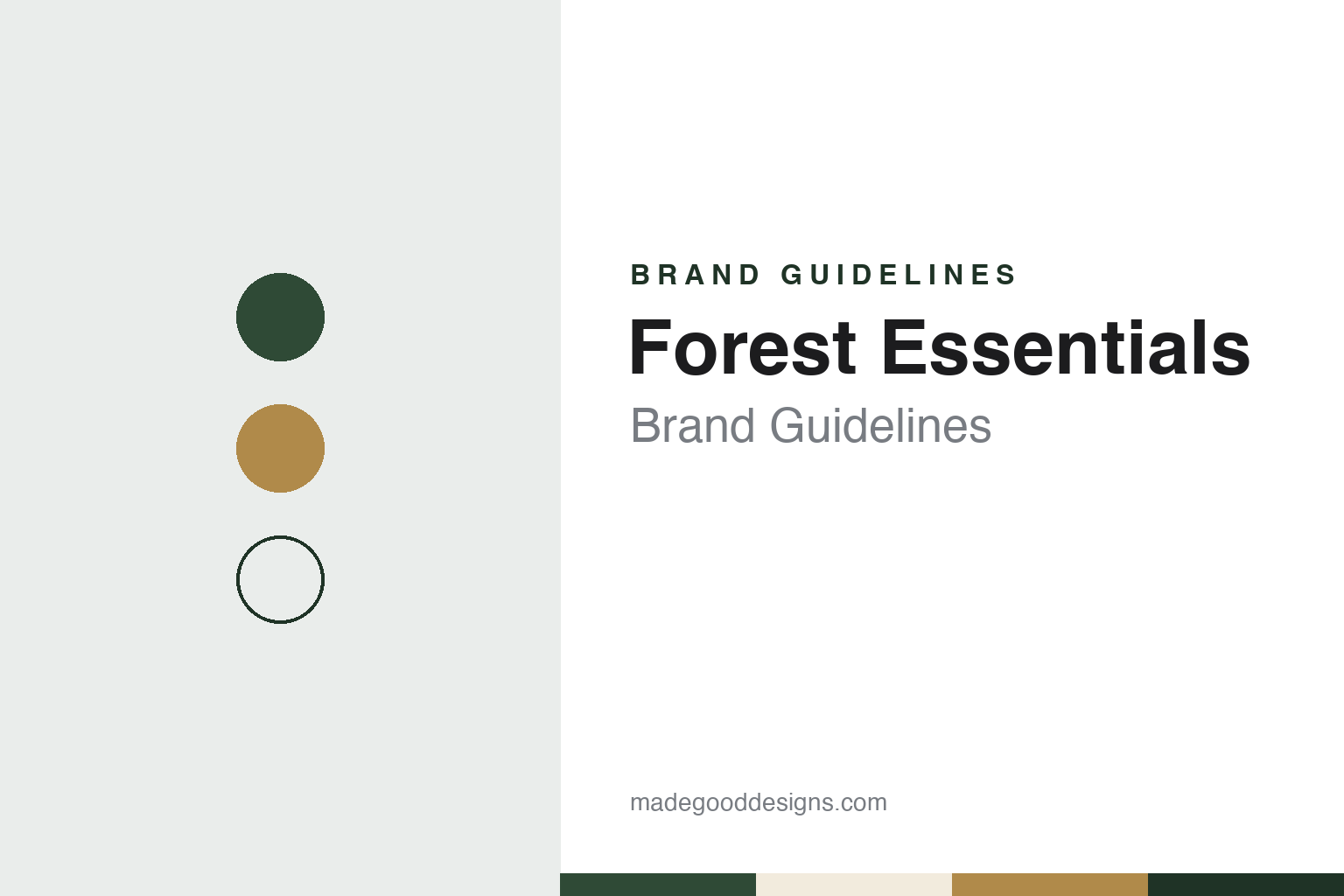
Forest Essentials Brand Guidelines
A Delhi label that grew through hotel bathrooms and its own shops.
Aa
Two constants: a deep green, parchment and brass palette and a classical serif register. Abstract homage — not a Forest Essentials product or mark; no pack, logo or label is reproduced.
Mountain Valley Springs
Handmade soaps, a Delhi hotel and a Khan Market shop.
Forest Essentials was started in New Delhi in 2000 by Mira Kulkarni. The Economic Times reported in August 2010 that she began the brand that year “first as a hobby,” working with vaids, traditional Ayurvedic practitioners, and with modern biochemists to make handmade soaps and cold-pressed oils. English Wikipedia says the earliest range was handmade soaps and candles. The company behind the label is Mountain Valley Springs, which Fortune India said in November 2014 Kulkarni had set up in 2000, and which Mint named in October 2021 as the business that runs Forest Essentials.
Its first customer, Kulkarni told The Economic Times, was the expatriate general manager of the Hyatt Regency in Delhi, at the end of 2002; he liked the soaps enough that they were later put into the hotel’s rooms. Hotels became a lasting channel for the brand. Fortune India counted more than 300 five-star hotels and spas supplied in 2014, and described how each chain stocked its own scented line: neem and aloe vera at the Taj hotels, saffron and honey at the Oberoi, bitter orange and cinnamon at the Hyatt, and honey and vanilla at the Four Seasons. By October 2021 Mint put the figure at about 500 luxury hotels and spas around the world.
The first shop opened in Delhi’s Khan Market in 2003, The Economic Times reported, and that shop was still described as the flagship by Fortune India eleven years later. By 2010 the paper counted 16 stores across seven cities, with production at two factories in Haridwar and one at Lodsi, in the hills of Uttarakhand. The same 2010 profile described Kulkarni’s son, Samrath Bedi, as looking after the brand’s global growth and her daughter, Divya, as working in retail operations. Kulkarni told the paper that the aim had been to give traditional formulations “a connotation of luxury.”
Colour
An American partner from 2008.
The brand’s ownership is a long story with The Estée Lauder Companies of New York. Fortune India recounted in November 2014 that Leonard Lauder, the group’s chairman emeritus, had visited the Khan Market flagship and met Kulkarni in March 2007, and that the group then proposed taking a fifth of the business. The minority investment was made in 2008; the magazine described it as Estée Lauder’s first investment in India, and noted that the group more often bought majority stakes or whole companies. In 2014 the same report said a second, larger stake was being negotiated. The Hindu BusinessLine reported in March 2026 that the holding had been raised to 49 percent in 2020.
Shops grew steadily in that period, and the counts below are each tied to their date. Fortune India reported 38 exclusive company-owned boutiques in 11 cities in November 2014. In October 2021 Mint reported that Mountain Valley Springs had opened 100 stores in India over two decades, all owned and operated by the company. In March 2026 The Hindu BusinessLine said the brand operated nearly 200 stores.
The move abroad began online. Mint reported in October 2021 that the United Kingdom was the brand’s first international market, following a launch through the British beauty retailer LookFantastic, and that its own website already shipped to 120 countries. Forbes India wrote in July 2026 that the online launch in the UK in 2021 was followed by the brand’s first standalone international store, in Covent Garden, London, in November 2022.
Where the products are made is documented in more than one place. The Economic Times named the factories at Haridwar and Lodsi in 2010, and English Wikipedia still lists the same two locations. Forbes India reported in July 2026 that the brand controls the whole chain from ingredient sourcing to manufacturing in its own facilities in India, a process the company calls “farm to bottle.”
Typography
Shops, counters and corporate owners.
India’s beauty and personal-care brands range from names that began inside old industrial groups to labels that started on their own websites. Lakmé was incorporated in December 1952 as a Tata company, according to Trent, the retailer that the original company became, and its brands passed to Hindustan Lever, now Hindustan Unilever, in 1998, Business Today reported. Dabur says on its corporate site that it started operations in Calcutta in 1884.
Some newer brands describe themselves as digital-first. Honasa Consumer, the owner of Mamaearth, calls itself a “digital-first house of brands” on its corporate website, and says Mamaearth began in 2016. Sugar Cosmetics sold only through its own website and a marketplace partner until 2017, Inc42 reported in 2020, before moving into general trade, large-format stores in malls and its own shops.
Shops and counters remain part of the picture. Sugar’s chief executive told the trade magazine Retail4Growth in 2023 that the brand used exclusive outlets, shop-in-shop counters and multi-brand stores, and that it changes its visual merchandising every year. Lakmé has tied its name to a runway since 2000, when the Fashion Design Council of India and IMG brought it in as title sponsor of a new fashion week, The Tribune reported in 2025.
This guide sets out what can be checked about each brand: when and where it began, who founded and owns it, which named product lines and campaigns it publishes, and how it presents itself in packs, logos and stores. Where a fact rests only on a company’s own pages, the text says so, and the palettes and typefaces shown are an unofficial interpretation rather than any brand’s own.
Aa
A classical serif for a label sold through its own shops and hotel rooms. (Specimen set in Cormorant Garamond, a serif STAND-IN; NOT the Forest Essentials logo.)
Forest Essentials
From a fifth to the whole company.
On 5 March 2026 Estée Lauder said it had entered into an agreement, subject to regulatory approvals, to buy the remaining 51 percent of Forest Essentials, The Hindu BusinessLine reported. The Economic Times’ BrandEquity site named Samrath Bedi as executive director in its report of the same announcement. In October 2026 WWD reported that Estée Lauder had acquired the remaining shares earlier in the year and now owned the brand outright, and quoted the group’s chief executive, Stéphane de La Faverie, describing Indian beauty as “the next wave” after Korean beauty.
That leaves a brand that has always been run from India now sitting inside an American group. Mint named Kama Ayurveda as a competitor in its 2021 report, and Forbes India noted in July 2026 that Kama, too, had gone to a European owner. Both brands supplied hotels before they had shops of their own, and both opened their first London stores within a year of each other, in 2022 and 2023.
For a design guide, Forest Essentials shows how a beauty brand can build its identity through its own shops and the bathrooms of other people’s hotels long before it opened a shop abroad. Compare Kama Ayurveda, another Delhi brand that began by supplying hotels, and Biotique, another Delhi beauty name. For this guide we use a deep forest green, parchment and a muted brass with a serif, an unofficial interpretation; no product or logo is reproduced.
Explore & save
Keep Forest Essentials’s identity on hand — save it to a board in the Made Good inspiration library.
Forest Essentials identity set
Pin the Forest Essentials deep green, parchment and brass palette and the classical serif register to your own board.
Source & notes
Frequently Asked Questions
What font can I use to match the Forest Essentials look?
This guide describes Forest Essentials’ type as “A classical serif for a label sold through its own shops and hotel rooms”. Its type specimen is set in Cormorant Garamond from Google Fonts as a stand-in; Cormorant Garamond is not Forest Essentials’ own lettering.
What colours are in the Forest Essentials palette?
This guide’s Forest Essentials palette is Deep forest green #2F4A36, Dark moss #1F3326, Parchment #F2EBDD, Muted brass #B08A4A and Clay rose #B9786A. The tones are the guide’s own unofficial interpretation, not official Forest Essentials hex codes.
When was Forest Essentials founded?
Forest Essentials was founded in 2000, in New Delhi, India.
Who founded Forest Essentials?
Forest Essentials was founded by Mira Kulkarni in 2000. This guide lists The Estée Lauder Companies (full ownership, 2026) as its owner.
Who owns Forest Essentials?
Forest Essentials is owned by The Estée Lauder Companies (full ownership, 2026).