Kama Ayurveda Brand Guidelines
A Delhi beauty brand started by a design studio.
Aa
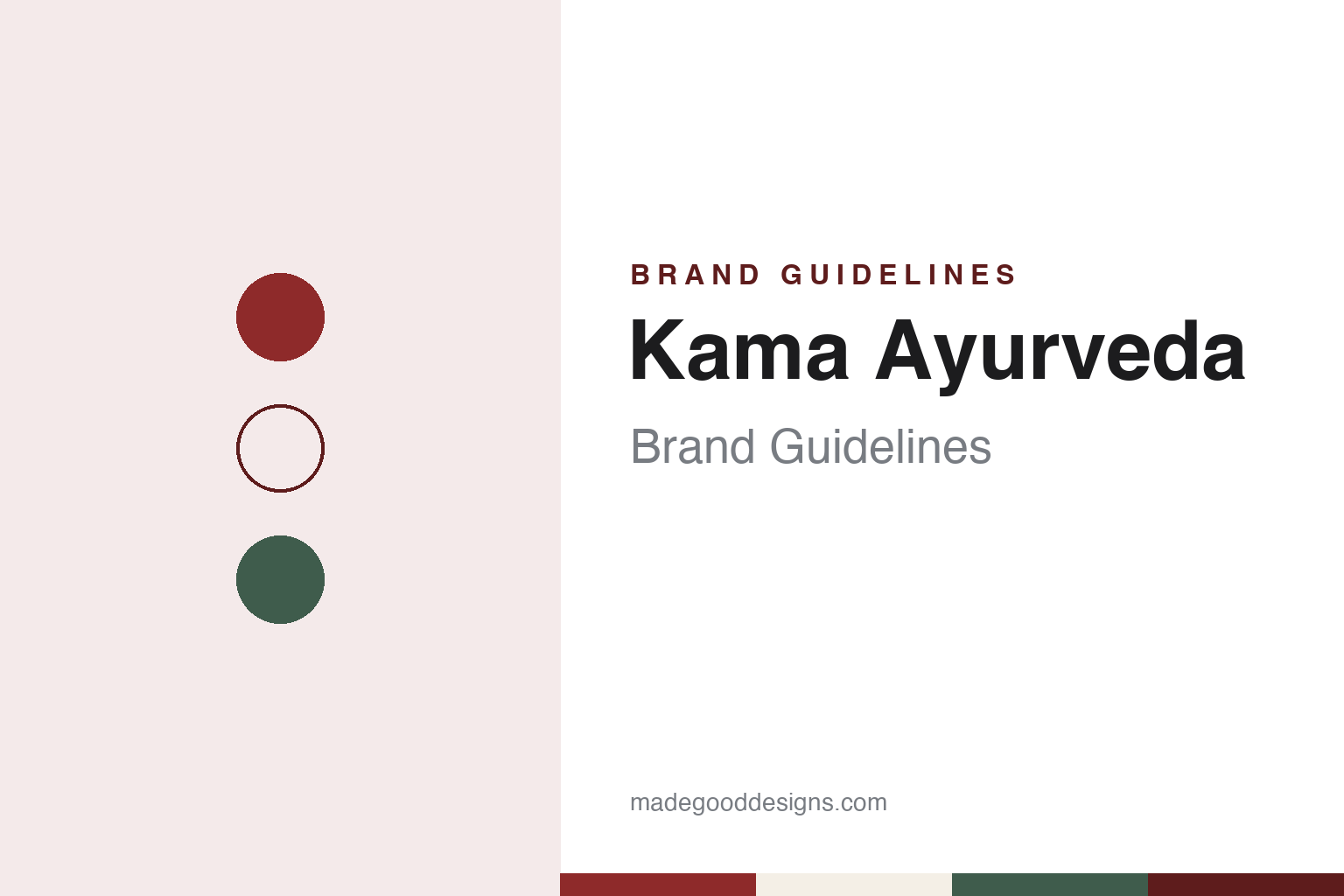
Two constants: a red, white and leaf green palette and a bookish serif register. Abstract homage — not a Kama Ayurveda product or mark; no pack, logo or shopfront is reproduced.
From a design studio
A packaging job that turned into a brand.
Kama Ayurveda grew out of a design studio. Mint reported in September 2021 that its co-founder Vivek Sahni, a graduate of the Parsons School of Design in New York, had started Vivek Sahni Design in 1993 with Dave Chang, designing logos, packaging and coffee-table books. The studio was asked to help rebrand the skincare products of the Khadi and Village Industries Commission, a project that ended with a flagship Khadi store in central Delhi in 2000. Sahni told the paper that the job began as gift packaging and grew into a wider look at the products inside the boxes, and that it took him to manufacturers and cooperatives across north India for almost two years.
That experience led to the idea of a new brand; Mint described Sahni in 2022 as its co-founder and chief executive. According to Mint, Sahni discussed it one evening with three friends, Chang, Rajshree Pathy and Vikram Goyal, and a few days later they visited the Arya Vaidya Pharmacy in Tamil Nadu, which became a partner for ingredients and finished products; the paper said the relationship was still running in 2021. Kama Ayurveda launched in 2002 with nine products. WWD, in August 2023, gave the same founding year and named Sahni as founder.
The first stockists were found through friends, Sahni told Mint: hotels, a beauty parlour, and the Good Earth store in Delhi’s Khan Market. By 2005 the brand was supplying toiletries to five-star hotels including The Oberoi and The Park. Sahni later stepped back from the design firm to work on Kama full time, the paper reported. The company had 22 employees at the start and more than 300 by 2021. Among its named products are Bringadi, a hair oil, and Kumkumadi, a night serum, which Mint described as two of its main sellers in 2021.
Colour
Counters first, then shops.
For its first ten years Kama Ayurveda sold only through shop-in-shops, The Hindu reported in September 2023. Its first standalone store opened in Khan Market, Delhi, in 2012. Mint described that shop in 2021 as a clean, old-fashioned room with a ceiling that leaves the drainage pipes exposed, and wrote that it looked much the same as it had a decade earlier, in keeping with the brand’s understated look.
Expansion followed outside investment. After funding from the private equity firm Lighthouse Funds in 2014, Mint reported, the brand began opening stores in other cities. Each count below carries its date. Mint said there were more than 40 stores in 2020; in August 2022 it reported 57 stores and about 70 shop-in-shop outlets with retailers such as Shoppers Stop; and in September 2023 The Hindu counted 64 stores across India and 75 shop-in-shops. Mint also reported in 2022 that about half of the brand’s online sales came through its own website and half through marketplaces such as Nykaa, and that the range had reached about 112 products.
Production moved in-house in part. Mint reported in August 2022 that Kama Ayurveda Pvt. Ltd had started production in July 2021 at its own two-acre factory in Coimbatore, in Tamil Nadu, alongside its long partnership with the Arya Vaidya Pharmacy.
Advertising arrived late. Sahni told Mint in 2021 that the brand had grown for years without an advertising budget, and that in 2021 it moved into newspaper front pages and billboards as well as social media, after rebuilding its website in 2020.
Typography
Shops, counters and corporate owners.
India’s beauty and personal-care brands range from names that began inside old industrial groups to labels that started on their own websites. Lakmé was incorporated in December 1952 as a Tata company, according to Trent, the retailer that the original company became, and its brands passed to Hindustan Lever, now Hindustan Unilever, in 1998, Business Today reported. Dabur says on its corporate site that it started operations in Calcutta in 1884.
Some newer brands describe themselves as digital-first. Honasa Consumer, the owner of Mamaearth, calls itself a “digital-first house of brands” on its corporate website, and says Mamaearth began in 2016. Sugar Cosmetics sold only through its own website and a marketplace partner until 2017, Inc42 reported in 2020, before moving into general trade, large-format stores in malls and its own shops.
Shops and counters remain part of the picture. Sugar’s chief executive told the trade magazine Retail4Growth in 2023 that the brand used exclusive outlets, shop-in-shop counters and multi-brand stores, and that it changes its visual merchandising every year. Lakmé has tied its name to a runway since 2000, when the Fashion Design Council of India and IMG brought it in as title sponsor of a new fashion week, The Tribune reported in 2025.
This guide sets out what can be checked about each brand: when and where it began, who founded and owns it, which named product lines and campaigns it publishes, and how it presents itself in packs, logos and stores. Where a fact rests only on a company’s own pages, the text says so, and the palettes and typefaces shown are an unofficial interpretation rather than any brand’s own.
Aa
A bookish serif for a brand that began in a design studio. (Specimen set in Libre Baskerville, a serif STAND-IN; NOT the Kama Ayurveda logo.)
Kama Ayurveda
A Barcelona owner and a striped London shop.
The Spanish fragrance and beauty group Puig, of Barcelona, first invested in Kama Ayurveda in 2019 for a minority stake, Mint reported in August 2022. On 14 September 2022 Cinco Días reported that Puig had completed the purchase of a majority stake, its third acquisition that year after the Swedish perfume house Byredo and the Latin American brand Loto del Sur, all three of them companies in which it already held a minority share. The paper said Kama then had 54 shops of its own in India. Puig did not give the value of the deal. In July 2026 Forbes India put Puig’s holding at 85 percent. English Wikipedia lists Kama Ayurveda among Puig’s brands alongside names such as Rabanne, Carolina Herrera, Charlotte Tilbury and Penhaligon’s.
Under its new owner the brand went abroad. In September 2023 The Hindu described its first shop outside India, a two-storey store with a red and white candy-stripe front in Notting Hill, London, with two treatment rooms and a floor given to tea; WWD gave its street as Westbourne Grove. The Hindu reported that the London shop displayed 32 products at the start, among them the Kumkumadi and Bringadi lines. Sahni told The Hindu that work on the London launch had begun in 2017 and that the UK was chosen as a test market because of its many nationalities.
For a design guide, Kama Ayurveda shows what happens when a packaging studio builds its own brand: a plain first shop with its pipes on show, years of growth before any advertising, and a striped shopfront for its debut abroad. Compare Forest Essentials, the Delhi brand Forbes India set beside it in 2026, and Biotique, which Mint dated to the 1990s. For this guide we use a deep stripe red, a warm white and a leaf green with a serif, an unofficial interpretation; no product or logo is reproduced.
Explore & save
Keep Kama Ayurveda’s identity on hand — save it to a board in the Made Good inspiration library.
Kama Ayurveda identity set
Pin the Kama Ayurveda red, white and leaf green palette and the bookish serif register to your own board.
Source & notes
Frequently Asked Questions
What font can I use to match the Kama Ayurveda look?
This guide describes Kama Ayurveda’s type as “A bookish serif for a brand that began in a design studio”. Its type specimen is set in Libre Baskerville from Google Fonts as a stand-in; Libre Baskerville is not Kama Ayurveda’s own lettering.
What colours are in the Kama Ayurveda palette?
This guide’s Kama Ayurveda palette is Stripe red #8E2A2A, Dark oxblood #5E1C1C, Shop white #F4EFE6, Leaf green #3F5C4C and Turmeric #C99A3B. The tones are the guide’s own unofficial interpretation, not official Kama Ayurveda hex codes.
When was Kama Ayurveda founded?
Kama Ayurveda was founded in 2002, in New Delhi, India.
Who founded Kama Ayurveda?
Kama Ayurveda was founded by Vivek Sahni, Dave Chang, Rajshree Pathy and Vikram Goyal in 2002.
Who owns Kama Ayurveda?
Kama Ayurveda is owned by Puig (majority since September 2022).