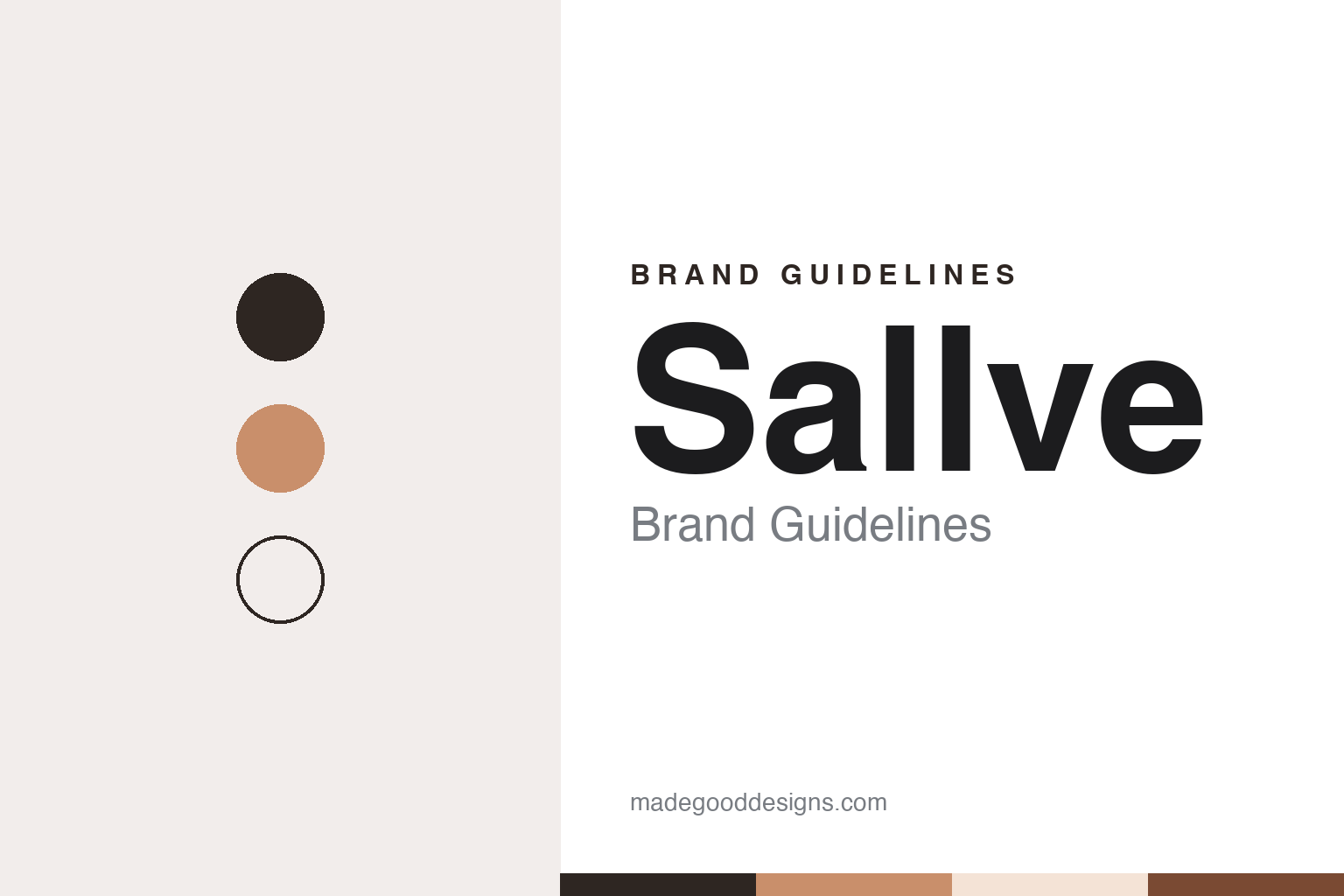
Sallve Brand Guidelines
A skin-care brand that talked to its customers before it had a product.
Aa
Two constants: a clay, pale apricot and sage palette and a rounded geometric sans register. Abstract homage — not a Sallve product or mark; no bottle, logo or pack is reproduced.
Four founders
A skin-care brand announced before it had a product.
Sallve is a São Paulo skin-care company announced in February 2019. Reporting that month, O Hoje and Marie Claire named four founders and their roles: Julia Petit as chief creative officer, Daniel Wjuniski as chief executive, Marcia Netto as chief digital officer and Juliana Shor as chief product officer. Both publications said the brand would be fully digital and that its products were still in testing and formulation, with a launch set within 2019.
The partnership was older than the announcement. Exame reported in May 2019 that Wjuniski and Netto, who had worked together at the health portal Minha Vida, went into partnership in August 2018; Shor, a former product manager at the O Boticário group and at L’Oréal, joined as third partner that October, and Petit joined in December to lead the creative team. Exame described the idea as Wjuniski’s wish to test a direct-to-consumer model that cut intermediaries out of the chain.
Petit came to the company from beauty content. Exame noted that she had published make-up tutorials since 2007 on her site Petiscos, and Consumidor Moderno wrote in June 2019 that the brand emerged after the end of that portal and a sabbatical year. Exame also reported that the founders did not intend to make Petit the face of the brand, even while it drew on her audience at launch.
Listening was built into the launch. In the three months between the announcement and the debut product, Exame reported, the company talked to prospective customers online and at in-person meetings. Marie Claire put the number of people heard by February at 5,000, and Consumidor Moderno said more than 10,000 answered a survey before the debut product was formulated. By May about 200,000 people had registered on the site and the Instagram account had more than 70,000 followers, according to Exame.
Colour
One product, then a range and a shop.
The debut product was the Hidratante Antioxidante, an antioxidant moisturiser in gel-serum form. Exame reported that pre-sale opened on 24 May 2019 and that regular sale through the company’s own online shop began on 8 June. Consumidor Moderno remarked that the product’s function is simply its name. After the pre-sale, a pop-up shop opened in São Paulo for one weekend, the same publication said.
Growth then came quickly. When Exame returned to the brand in November 2020, it reported that the opening stock of 5,000 units of the moisturiser had sold out in ten hours, that the company had had only three products at the start of that year, and that its launches included a toner, a lip moisturiser and a cleansing balm. The account had close to 360,000 Instagram followers and the company had reached 200,000 customers, Exame said, and new products were developed from conversations with the public.
The community stayed at the centre of the pitch. In August 2021 Exame put the brand’s Instagram following at more than 600,000, less than three years after it began, and quoted Petit calling the community the brand’s mirror: the team ran large quantitative surveys of its customers and met members of that community three to four times a week, lately by video call, to discuss the products and the brand.
Not every early launch went smoothly. In October 2019 Veja São Paulo reported that Sallve had announced a recall of its recently launched enzyme exfoliant, with every unit sold to be withdrawn and buyers refunded, including shipping costs.
The online-only model did not stay that way. By December 2022 the Brazil Journal reported that Sallve, which began only in e-commerce, was selling in more than 2,000 pharmacies belonging to chains such as RD, DPSP and Venâncio, and had a flagship store in the Pinheiros district of São Paulo.
Typography
Brazilian beauty, as the companies present it.
The Brazilian beauty brands in this group introduce themselves through a small set of fixed elements: a short brand name, a plain wordmark, and named lines that run across perfume, make-up and body care, so that a fragrance family or a lipstick range can carry its own name under the house name. O Boticário took its name from the Portuguese word for an apothecary and began in 1977 as a compounding pharmacy in Curitiba; in 2026 one of its franchise shops was refitted with an interior modelled on the old boticas.
The way the products are sold shapes how the brands appear. Some grew through franchise shops and kiosks in shopping centres, others through direct sales, in which representatives order from a catalogue or a service centre and sell to their own customers, and most now combine shops, sellers and online stores. Campaigns follow the same channels, from television spots for Dia dos Namorados to launches timed to a fixed date such as the lipstick day on 29 July.
Group ownership is common, and this guide describes it plainly, by date. Grupo Boticário was formed as a holding company in 2010 and has since launched or bought brands including Eudora, Quem Disse, Berenice? and Vult. Where a brand has passed to another owner, including an international cosmetics group, the entry gives the owner and the date of the deal; where a brand remains independent, the guide says so only where a dated source does.
Each entry draws on corporate pages for founders, owners and franchise networks, and on dated independent press for anything beyond the company’s own word. Product lines are named as the companies publish them; the guide does not describe what the products do, and the palettes and typefaces shown are an unofficial interpretation rather than any brand’s own.
Aa
A rounded geometric sans for a brand whose debut product was named for what it does. (Specimen set in Outfit, a sans STAND-IN; NOT the Sallve logo.)
Contém 1g
A make-up name from a bankrupt estate, relaunched.
Sallve’s move into make-up came through an older brand. The Brazil Journal reported in December 2022 that Sallve had bought Contém 1g, a make-up brand that grew mainly through franchises and direct sales, in October 2021 at an auction held for the bankrupt company’s estate. Contém 1g had filed for judicial recovery in 2018 and had since closed all of its more than 200 shops; Sallve bought only the brand, leaving aside assets such as factories. Wjuniski told the publication the deal was a step towards a “house of brands”.
The relaunched Contém 1g came back with about 50 products, sold online at first, the same report said. In November 2024 Mercado & Consumo reported that Contém 1g had opened its own exclusive kiosk at Shopping Ibirapuera in São Paulo. Until then the brand had appeared in physical retail through kiosks shared with Sallve, and it was also sold through the Panvel pharmacy chain and C&A stores, the publication said; the new kiosk offered virtual try-on and tablet tutorials alongside the full catalogue.
The two names now sit side by side in what Mercado & Consumo called Grupo Sallve: a skin-care brand that began online and in conversation with its customers, and a make-up label with a longer shop history that the group brought back to market.
For a design guide, Sallve shows a brand voice built before the product existed, a debut product named for what it does and a community treated as co-author of the range. Compare Boca Rosa Beauty, another Brazilian beauty brand built online, and Natura. For this guide we use clay, pale apricot and sage with a rounded sans, an unofficial interpretation; no product or logo is reproduced.
Explore & save
Keep Sallve’s identity on hand — save it to a board in the Made Good inspiration library.
Sallve identity set
Pin the Sallve clay, pale apricot and sage palette and the rounded geometric sans register to your own board.
Source & notes
Frequently Asked Questions
What font can I use to match the Sallve look?
This guide describes Sallve’s type as “A rounded geometric sans for a brand whose debut product was named for what it does”. Its type specimen is set in Outfit from Google Fonts as a stand-in; Outfit is not Sallve’s own lettering.
What colours are in the Sallve palette?
This guide’s Sallve palette is Ink brown #2E2622, Terracotta #7A4A33, Clay #C98F6B, Pale apricot #F4E3D6 and Sage #8FA08A. The tones are the guide’s own unofficial interpretation, not official Sallve hex codes.
Who founded Sallve?
Sallve was founded by Julia Petit, Daniel Wjuniski, Marcia Netto and Juliana Shor.