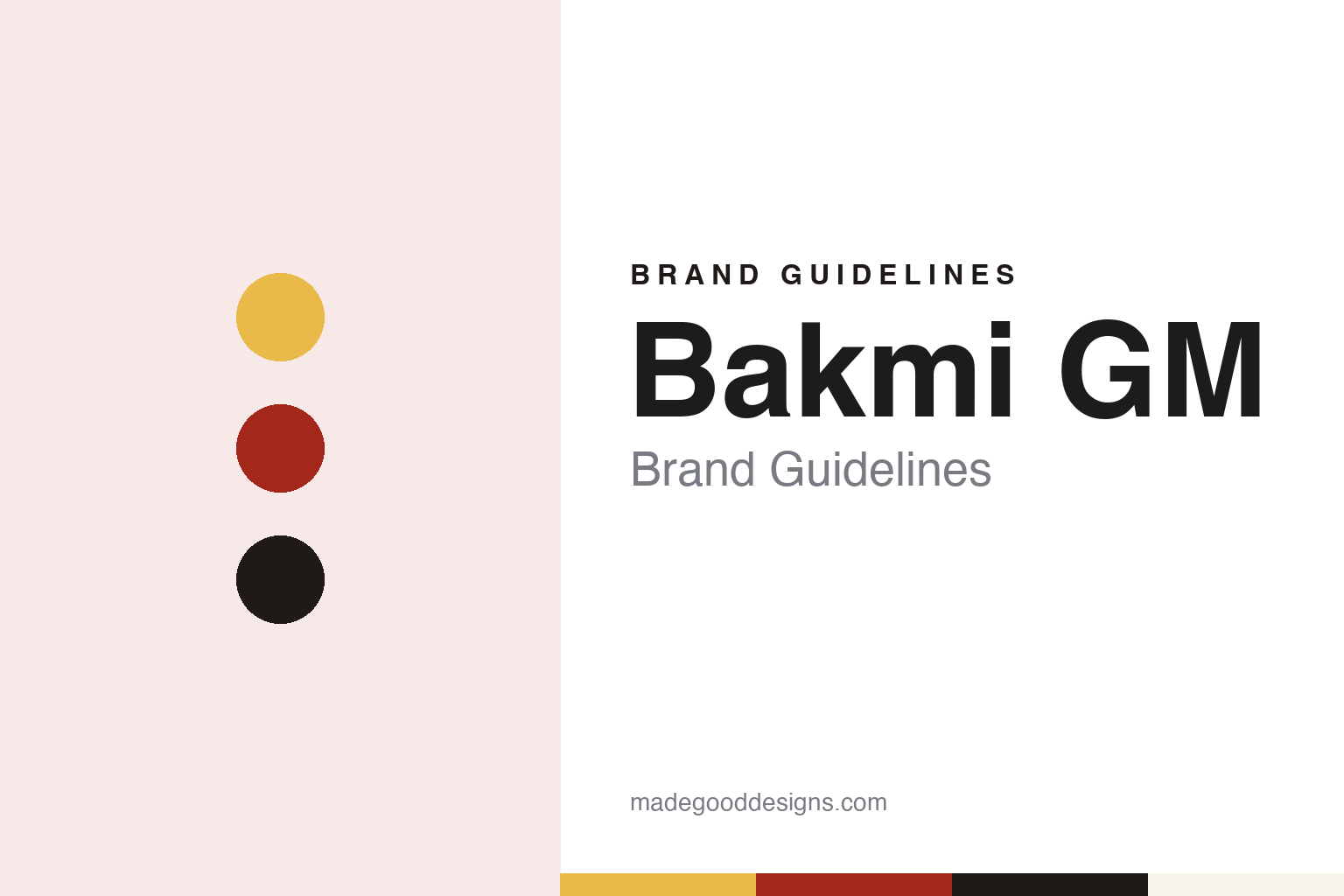
Bakmi GM Brand Guidelines
A 1959 Gajah Mada street stall and its two-letter name.
Aa
Two constants: a noodle yellow, chilli red and warm ink palette and a plain grotesque sans register. Abstract homage — not a Bakmi GM product or mark; no dish, logo or shopfront is reproduced.
Bakmi Gajah Mada
Five tables on a Jakarta street, 1959.
Bakmi GM began in 1959 as a noodle stall on Jalan Gajah Mada in central Jakarta, and its name is an abbreviation of that street: the restaurant was first called Bakmi Gajah Mada. The company’s own history names its founders as the married couple Tjhai Sioe and Loei Kwai Fong, and English Wikipedia gives the same names and year. JPNN reported in May 2017 that the business started as a roadside warung with room for only five dining tables, quoting a business-development director of the holding company who recalled that the customers kept coming.
The second location came twelve years after the first. Bakmi GM says its first branch opened in Melawai, in South Jakarta, in 1971, a date that English Wikipedia and detikFinance repeat. From there the chain grew mostly within the capital region. By May 2017, JPNN reported, it had about 50 branches and had spent 58 years trading in Jabodetabek, the Jakarta metropolitan area, before opening in Surabaya; a director of engineering and research told the paper that the company had studied the move for a long time because its raw ingredients had to be shipped a long way.
The restaurants are run by PT Griya Miesejati, which the company describes as the parent of Bakmi GM and which The Jakarta Post called the chain’s holding company in September 2019. That month the paper reported on the chain’s sixtieth anniversary and listed restaurants in Greater Jakarta, Bandung, Surabaya, Bali, Cikarang and Karawang. English Wikipedia adds that the Surabaya branches opened in 2017 and a branch in Denpasar, on Bali, in 2018, and gives a count of more than 50 locations with about 1,200 employees as of 2022.
Colour
Bakmi, pangsit and a house sauce.
The menu is built around bakmi, the Indonesian wheat-noodle dish, served in several forms. The company’s signature bowl is Bakmi Spesial GM, which it describes as its own noodles with pieces of chicken and mushroom in a special GM sauce, served with caisim greens and a savoury broth. English Wikipedia, citing Kompas in 2019, calls it the flagship product, and lists rice and chicken dishes and milk-tea drinks alongside the noodles; the encyclopedia also illustrates pangsit goreng, fried wontons, as one of the chain’s regular sides, and the company’s own menu pages add kwetiau, flat rice-noodle dishes, to the noodle range.
The company says it now offers more than 50 menu items and releases new products regularly, and that around 1,200 staff work in its service team. It also says it serves more than 30,000 customers a day, a figure The Jakarta Post repeated in 2019 as the chain’s own claim. Beyond dine-in and takeaway, its website lists delivery, a children’s menu, birthday packages, school field trips and a food truck, and English Wikipedia notes food trucks and takeout stalls among the chain’s formats.
CNN Travel placed the chain under its entry for bakmi goreng, fried noodles, describing bakmi as pencil-thin noodles that compete with rice in Indonesian meals and noting that vendors add their own spices for distinction. The company’s website groups its menu into noodle, kwetiau, à la carte, drinks, frozen and children’s sections, and its delivery page pitches the service at customers held up by traffic, rain and long working days.
Press coverage has tied the noodles to the city as much as to the company. In February 2016 CNN Travel, in a list of forty Indonesian foods, wrote that Bakmi Gajah Mada “garners a cult following” and pointed readers to a Bakmi GM restaurant on Jalan Sunda in central Jakarta. The original name has also stayed in print: The Jakarta Post still explained the chain as “formerly known as Bakmi Gajah Mada” in its 2019 anniversary report, and detikFinance did the same in 2024.
Typography
Shopfronts, menus and store networks.
Indonesian restaurant, bakery, noodle, donut and café chains meet most of their customers in a small number of settings: the shopping mall, the airport, the railway station, the shophouse row and, increasingly, the rest areas along the toll roads. In each of these the shopfront has to work from a distance. A single dominant colour, a short name and a sign that can be read across a food court often do more of the identity work than any printed material.
Inside, the menu board is where a brand is defined. Chains in this category tend to name their dishes and drinks plainly, whether a fried rice, a noodle bowl, a bento set, a filled bun or an iced tea, and to group them into sets and children’s packages. Packaging follows the same logic: takeaway boxes, cups and bags carry the name and colours out of the room, and delivery-only kitchens and kiosk formats now let a brand trade with little more than a counter and its packaging.
The store network is itself part of the story the companies tell. Corporate pages often present history as a sequence of openings, a first outlet in a new city or on a new island, a numbered milestone store, and a running count of outlets and cities across the archipelago and, for some chains, abroad. Those counts change quickly, so each one needs its date attached.
Ownership is described in different ways. Some chains are run by a single private company that keeps every outlet in its own hands; others grow through franchise or partnership networks, and some sit inside larger food and drink groups. Founders’ stories, the operating company’s name and the halal certification a chain holds are commonly set out on the corporate pages, and the guides that follow give each of them only as the sources state them.
Aa
A plain grotesque sans for a two-letter name. (Specimen set in Archivo, a sans STAND-IN; NOT the Bakmi GM logo.)
Bakmi GM
Two letters for a street name.
The business behind the restaurants is PT Griya Miesejati, which the chain’s own about page, read in November 2026, describes as the parent of the Bakmi GM restaurants.
The initials keep the founding address inside the name. GM stands for Gajah Mada, as the company and The Jakarta Post both explain, so the name of each branch, from Melawai to Surabaya and Denpasar, still refers to the street where the first five tables stood.
The chain marked its sixtieth year with an event called Bakmi GM Let’s 60 at Taman Mini Indonesia Indah in East Jakarta on 4 September 2019, Republika reported the next day, when it counted nearly 70 outlets across Jabodetabek, Bandung, Surabaya, Bali, Cikarang and Karawang. The paper described newer formats alongside the restaurants: delivery ordered through WhatsApp, outlets at airports and railway stations, the food truck, and BGM Grab and Go at Sudirman MRT station, a ready-to-eat counter where customers pick up packed food and drinks themselves and the chain provides only microwaves and tables. Menu additions named in that report included Krispi Chips Salted Egg and Long Life Noodles.
For a design guide, Bakmi GM shows how an abbreviation can carry a founding address through more than six decades of expansion. Compare HokBen, another Jakarta restaurant chain built around a single cuisine, and Indomie, the Indonesian instant-noodle brand. For this guide we use a noodle yellow, a chilli red and a warm ink with a sans, an unofficial interpretation; no product or logo is reproduced.
Explore & save
Keep Bakmi GM’s identity on hand — save it to a board in the Made Good inspiration library.
Bakmi GM identity set
Pin the Bakmi GM noodle yellow, chilli red and warm ink palette and the plain grotesque sans register to your own board.
Source & notes
Frequently Asked Questions
What font can I use to match the Bakmi GM look?
This guide describes Bakmi GM’s type as “A plain grotesque sans for a two-letter name”. Its type specimen is set in Archivo from Google Fonts as a stand-in; Archivo is not Bakmi GM’s own lettering.
What colours are in the Bakmi GM palette?
This guide’s Bakmi GM palette is Noodle yellow #E9B949, Chilli red #A3271B, Warm ink #1F1A17, Broth amber #C9832E and Rice paper #FAF5EA. The tones are the guide’s own unofficial interpretation, not official Bakmi GM hex codes.
When was Bakmi GM founded?
Bakmi GM was founded in 1959 (as Bakmi Gajah Mada), in Jakarta, Indonesia.
Who founded Bakmi GM?
Bakmi GM was founded by Tjhai Sioe and Loei Kwai Fong in 1959 (as Bakmi Gajah Mada).


