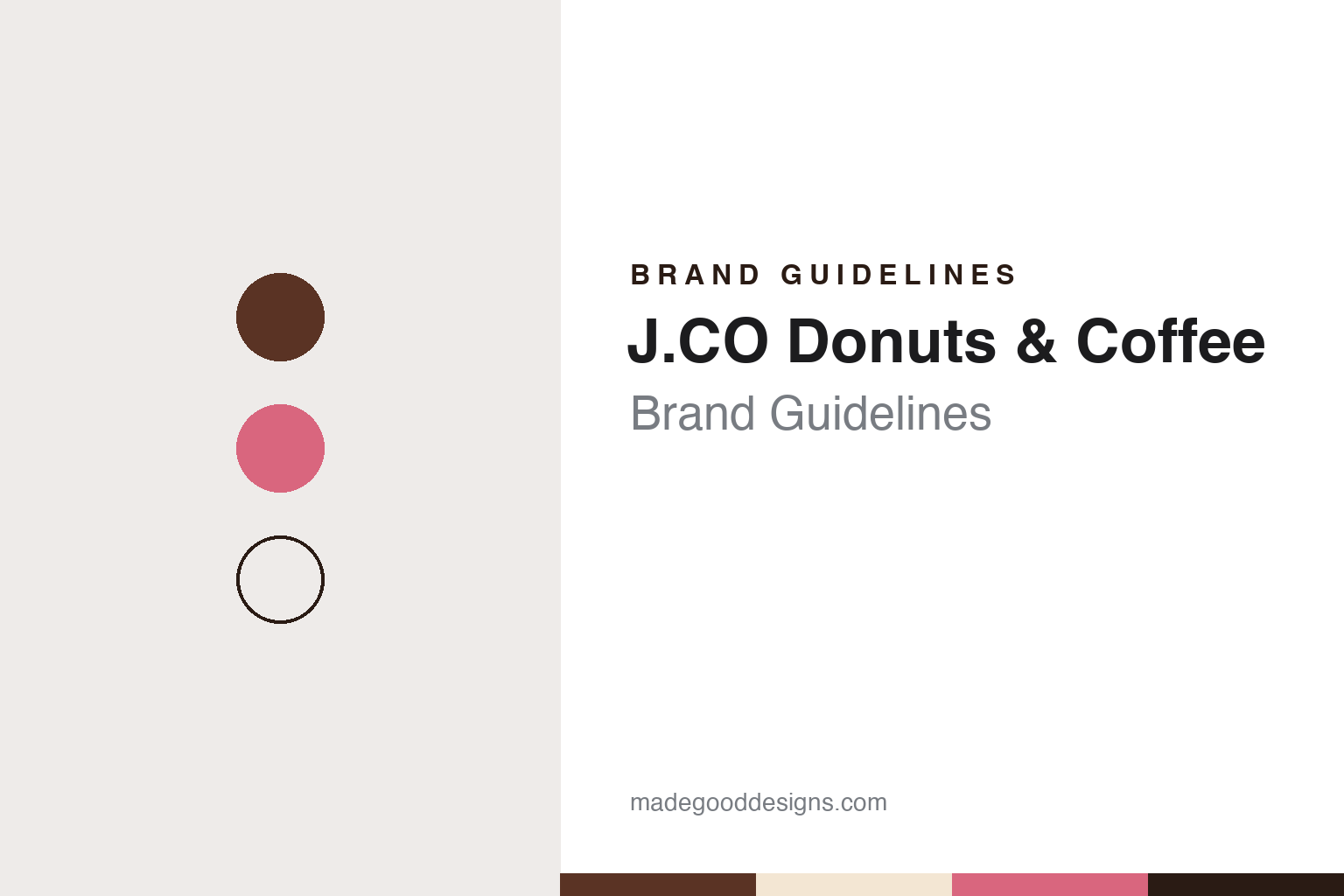
J.CO Donuts & Coffee Brand Guidelines
Johnny Andrean’s 2005 donut and coffee chain from Tangerang.
Aa
Two constants: a chocolate, berry glaze and almond cream palette and a Geometric sans register. Abstract homage — not a J.CO product or mark; no donut, logo or shopfront is reproduced.
A salon owner’s donut shop
Johnny Andrean moves from hair to donuts.
J.CO Donuts & Coffee is an Indonesian chain of donut and coffee shops founded in 2005 by Johnny Andrean, a businessman who had built a chain of hair salons from the 1980s. detikFinance reported in May 2024 that Andrean, who comes from Singkawang in West Kalimantan, set up his salon business in Jakarta before moving into food, and that he brought the Singapore bakery franchise BreadTalk to Indonesia in 2003; those Indonesian BreadTalk shops now trade as MAKO, the same report said. Indonesian Wikipedia says J.CO is owned by the Johnny Andrean Group.
Accounts of the opening differ in detail. CNBC Indonesia, in articles of June and November 2023 drawing on Muhammad Ma’ruf’s 2010 book 50 Great Business Ideas from Indonesia, dates the first shop to 26 July 2005 at Supermal Karawaci in Tangerang, west of Jakarta, while noting that another source gives 26 June 2005. The company’s own milestones page says its first store opened in June 2005, “as a result of many years of research & development.” Kompas.com in 2022 and detikFinance in 2024 each gave 2006 in passing, while a February 2026 history in Fortune Indonesia kept the July 2005 date.
The site of that shop was chosen with a market in mind. CNBC Indonesia wrote that Andrean aimed at well-off, upper-middle-class customers and picked a mall set among Lippo Group offices and close to Universitas Pelita Harapan, the university in Karawaci. Before J.CO arrived, the same articles said, Indonesia’s donut market had been led for two decades by Dunkin’ Donuts, which opened its first Jakarta shop in 1985; an earlier American donut stand had appeared only briefly, at the Djakarta Fair of 1968.
Colour
Open kitchens and punning names.
J.CO’s format borrowed from several places. According to CNBC Indonesia, Andrean had taken a donut-making course in the United States and modelled J.CO’s donuts on the soft, light American style, with fillings and toppings that became the chain’s trademark. Fortune Indonesia wrote in February 2026 that he had first wanted to bring an American donut franchise to Indonesia, but was not satisfied with its ingredients and production, and instead combined ideas of his own: a shop look inspired by Japan, a European way of serving, and imported ingredients. Both outlets describe an open kitchen, which lets customers watch the donuts being fried and finished; CNBC Indonesia called it a Japanese-style concept.
The menu leans on wordplay. When the chain reached Manila in March 2012, The Philippine Star described its Alcapone donut, a ring topped with white chocolate and almond slivers, as its signature, alongside names that play on film stars and landmarks, such as Avocado di Caprio and Mona Pisa, and the miniature J.Pops. The paper noted that the café had “this Venetian feel” rather than an Asian one. Kompas.com in 2022 listed Black Jack, Chocolate Rainbow, Glazzy and Snow White among its donuts.
Coffee is the other half of the name. The company says it uses only Arabica beans, with single origins from Colombia and Ethiopia and a house blend from Sumatra’s Lintong, Gayo and Mandheling growing areas, roasted to a medium level. Its Indonesian site also lists sandwiches, yogurt and cronuts, and links to a separate J.CO Reserve label. Indonesian Wikipedia says that in Indonesia many J.CO shops opened beside BreadTalk outlets, the bakery franchise run by the same owner.
Typography
Design and documentation.
Indonesian restaurant, bakery, noodle, donut and café chains meet most of their customers in a small number of settings: the shopping mall, the airport, the railway station, the shophouse row and, increasingly, the rest areas along the toll roads. In each of these the shopfront has to work from a distance. A single dominant colour, a short name and a sign that can be read across a food court often do more of the identity work than any printed material.
Inside, the menu board is where a brand is defined. Chains in this category tend to name their dishes and drinks plainly, whether a fried rice, a noodle bowl, a bento set, a filled bun or an iced tea, and to group them into sets and children’s packages. Packaging follows the same logic: takeaway boxes, cups and bags carry the name and colours out of the room, and delivery-only kitchens and kiosk formats now let a brand trade with little more than a counter and its packaging.
The store network is itself part of the story the companies tell. Corporate pages often present history as a sequence of openings, a first outlet in a new city or on a new island, a numbered milestone store, and a running count of outlets and cities across the archipelago and, for some chains, abroad. Those counts change quickly, so each one needs its date attached.
Ownership is described in different ways. Some chains are run by a single private company that keeps every outlet in its own hands; others grow through franchise or partnership networks, and some sit inside larger food and drink groups. Founders’ stories, the operating company’s name and the halal certification a chain holds are commonly set out on the corporate pages, and the guides that follow give each of them only as the sources state them.
Aa
A clean geometric sans for a chain with an English name. (Specimen set in Outfit, a sans STAND-IN; NOT the J.CO logo.)
J.CO
From Karawaci to Riyadh.
The chain went abroad within a few years. The company’s milestones list Malaysia in 2007, Singapore in 2008, the Philippines in 2012, Hong Kong in 2016, which it marks as its tenth anniversary, and Saudi Arabia in 2018. Fortune Indonesia placed the first Malaysian shop at Aeon Bukit Indah in Johor Bahru and the Saudi shops in Riyadh. In the Philippines the brand came through a local partner: The Philippine Star reported in March 2012 that Contemporain Foods Inc. had brought it to the country, opening at The Strip in SM Megamall, after its president approached Andrean.
Store counts come from the company. In June 2023 CNBC Indonesia, citing the J.CO website, gave 275 shops in Indonesia, 44 in the Philippines, 17 in Malaysia, five in Saudi Arabia and three each in Singapore and Hong Kong. As of November 2026, the website spoke of more than 300 stores worldwide and invited franchise enquiries country by country, with training and store design included in its process. The company says its dough went through years of trials before the 2005 launch.
J.CO is often taken for a foreign brand. CNBC Indonesia and detikFinance both ran pieces explaining that it is Indonesian, and Kompas.com, which placed it in 2022 on a list of fifteen well-known bakeries in Indonesia alongside BreadTalk, the South Korean Tous Les Jours and Roti’O, noted that its modern style led many people to assume it came from abroad. The English name and the American-style donut sit alongside Indonesian ownership and a Sumatran coffee blend.
For a design guide, J.CO Donuts & Coffee shows how a home-grown chain can build an international look from borrowed parts: open kitchens, punning product names and European-styled cafés. Compare Roti’O, another Jakarta bakery chain built around one signature bake, and Kopi Kenangan, an Indonesian coffee chain that has also gone abroad. For this guide we use a chocolate brown, a berry glaze and an almond cream with a sans, an unofficial interpretation; no product or logo is reproduced.
Explore & save
Keep J.CO Donuts & Coffee’s identity on hand — save it to a board in the Made Good inspiration library.
J.CO identity set
Pin the J.CO chocolate, berry glaze and almond cream palette and the Geometric sans register to your own board.
Source & notes
Frequently Asked Questions
What font can I use to match the J.CO Donuts & Coffee look?
This guide describes J.CO Donuts & Coffee’s type as “A clean geometric sans for a chain with an English name”. Its type specimen is set in Outfit from Google Fonts as a stand-in; Outfit is not J.CO Donuts & Coffee’s own lettering.
What colours are in the J.CO Donuts & Coffee palette?
This guide’s J.CO Donuts & Coffee palette is Glaze chocolate #5A3324, Espresso #2A1B14, Almond cream #F3E6D3, Berry glaze #D9667E and Paper #FAF7F2. The tones are the guide’s own unofficial interpretation, not official J.CO Donuts & Coffee hex codes.
When was J.CO Donuts & Coffee founded?
J.CO Donuts & Coffee was founded in 2005, in Supermal Karawaci, Tangerang.
Who founded J.CO Donuts & Coffee?
J.CO Donuts & Coffee was founded by Johnny Andrean in 2005.