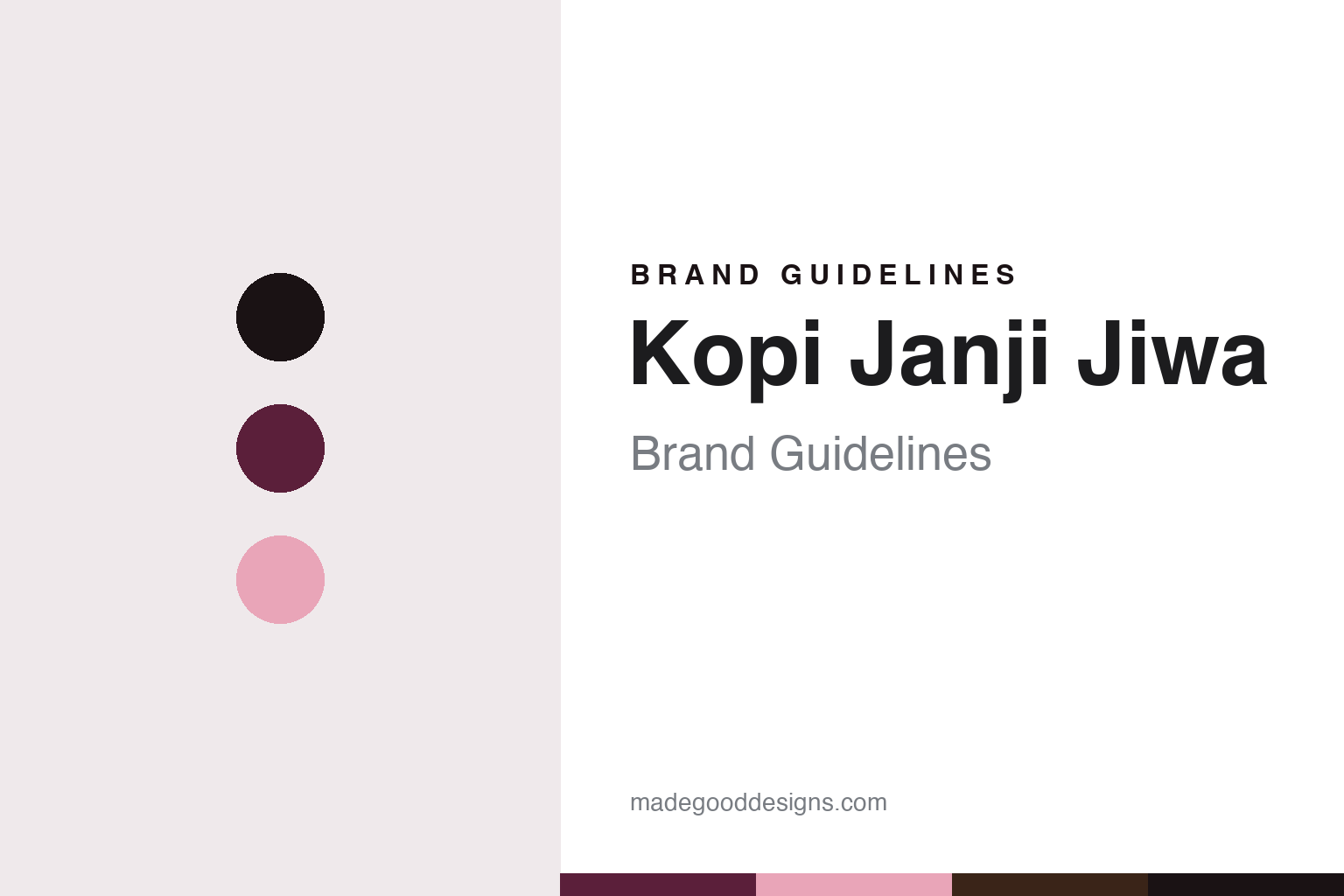
Kopi Janji Jiwa Brand Guidelines
A 2018 ITC Kuningan kiosk and the Jiwa Group family.
Aa
Two constants: a Kopi Janji Jiwa plum, pink and roast brown palette and a Rounded sans register. Abstract homage — not a Kopi Janji Jiwa product or mark; no cup, logo or sign is reproduced.
Jakarta, 2018
A grab-and-go kiosk at ITC Kuningan.
Kopi Janji Jiwa is a Jakarta coffee chain founded in 2018 by Billy Kurniawan. In Indonesian, kopi means coffee, janji means promise and jiwa means soul. English Wikipedia gives the founding date as 15 May 2018; Warta Ekonomi, in a September 2020 profile, placed the start in the middle of that year. Before coffee, English Wikipedia says, Kurniawan ran a bubble tea shop called Calais.
The chain began small. Its earliest outlet was a kiosk at ITC Kuningan, a shopping centre in South Jakarta, and the Warta Ekonomi profile said it sold only about 10 to 20 cups a day at the start. The format was grab-and-go: a counter for takeaway coffee rather than a sit-down café. Kurniawan told the magazine that once an outlet showed heavy traffic, the business had to keep investing in better equipment so that customers were not let down.
Growth came through partnership outlets. By the end of 2019 the chain had about 700 outlets, and in June 2020, at its second anniversary, the company said it had more than 800 in over 100 cities, Warta Ekonomi reported. The company calls its outlets “jilid”, the Indonesian word for a volume of a book, a usage reported by Warta Ekonomi in 2020 and by Kontan in 2022. Marketing leaned on social media and on collaborations with local brands, Kurniawan told Warta Ekonomi, which kept spending low.
Delivery apps were part of the model early. Kurniawan said orders came through GrabFood and GoFood as well as over the counter, and in 2020 the group added its own ordering app, Jiwa+, which English Wikipedia writes as JIWA+ and describes as built around the grab-and-go concept.
Colour
One coffee brand, then toast, tea and burgers.
The parent company is Jiwa Group; English Wikipedia names the operating company as PT Luna Boga Narayan. Kopi Janji Jiwa was its starting brand. Jiwa Toast, a toast chain, followed in 2019, and Jiwa Tea in 2020, according to Katadata and Kontan; English Wikipedia adds Burger Geber, a burger brand launched in 2023. English Wikipedia says the brands are often combined under one roof, with older outlets carrying one, two or three of them and newer ones all four.
In November 2021 Jiwa Group raised funding from the venture firms Openspace Ventures and Capsquare Asia Partners, Katadata reported; the amount was not disclosed. At that time the group said it had more than 50 products and nearly 1,000 outlets across Indonesia, and Kurniawan credited social-media engagement and food-delivery services for its growth.
In March 2022 Kontan reported that the group had more than 1,000 outlets in 100 cities, of which more than 900 were Kopi Janji Jiwa and more than 300 Jiwa Toast, with Jiwa Tea present in ten cities. The same report said all of the group’s outlets had received halal certification from MUI and the BPJPH, Indonesia’s halal product assurance agency. The group had just announced a collaboration with the mobile game Mobile Legends. Kontan also reported that stores with seating and delivery, such as the group’s Kemang X outlet in Jakarta, where that press conference was held, cost a different amount to open from takeaway-only counters, with the outlay depending on location, size and format.
Counts have moved since. English Wikipedia, citing the company’s website, gives more than 600 Kopi Janji Jiwa outlets in over 100 cities as of February 2025.
Typography
Design and documentation.
Indonesian restaurant, bakery, noodle, donut and café chains meet most of their customers in a small number of settings: the shopping mall, the airport, the railway station, the shophouse row and, increasingly, the rest areas along the toll roads. In each of these the shopfront has to work from a distance. A single dominant colour, a short name and a sign that can be read across a food court often do more of the identity work than any printed material.
Inside, the menu board is where a brand is defined. Chains in this category tend to name their dishes and drinks plainly, whether a fried rice, a noodle bowl, a bento set, a filled bun or an iced tea, and to group them into sets and children’s packages. Packaging follows the same logic: takeaway boxes, cups and bags carry the name and colours out of the room, and delivery-only kitchens and kiosk formats now let a brand trade with little more than a counter and its packaging.
The store network is itself part of the story the companies tell. Corporate pages often present history as a sequence of openings, a first outlet in a new city or on a new island, a numbered milestone store, and a running count of outlets and cities across the archipelago and, for some chains, abroad. Those counts change quickly, so each one needs its date attached.
Ownership is described in different ways. Some chains are run by a single private company that keeps every outlet in its own hands; others grow through franchise or partnership networks, and some sit inside larger food and drink groups. Founders’ stories, the operating company’s name and the halal certification a chain holds are commonly set out on the corporate pages, and the guides that follow give each of them only as the sources state them.
Aa
A rounded sans — a mark redrawn around the coffee cherry. (Specimen set in Outfit, a sans STAND-IN; NOT the Kopi Janji Jiwa logo.)
Pinky
A new logo, a larger store.
Janji Jiwa changed its look at its fifth anniversary. At a Jakarta press event on 15 September 2023, Warta Ekonomi reported, Kurniawan, described as chief executive and co-founder of Jiwa Group, introduced a new logo called “Pinky”, which the company said took its cue from the coffee cherry and its purple and red tones. The same event introduced a larger store format with seating and self-ordering through the Jiwa+ app at five sites: Equity Tower in Jakarta’s SCBD business district, the Sudirman and Palmerah commuter-rail stations, Summarecon Mal Serpong and Fatmawati hospital. Kurniawan linked the larger format to customers returning to stores to meet and socialise. The event also added quick meals such as noodles, rice and snacks, and JOE (Jiwa Origin Espresso), a single-origin coffee series.
The anniversary also launched Kopi Sejuta Jiwa, coffee sold from electric bicycles. Kurniawan said 54 bikes were running in West and South Jakarta at the launch, Warta Ekonomi reported; Kontan’s MomsMoney site gave about 50, selling three coffee and three non-coffee cold drinks, and said the name came from the phrase “sejuta umat”, meaning something for everyone.
The store idea went further in 2025. In September 2025 Kontan reported that Janji Jiwa Culture, a format Kurniawan called a “house of good vibes” aimed at Generation Z, had opened about 20 outlets across Indonesia, with Wi-Fi and power sockets for customers who stay rather than take away.
For a design guide, Kopi Janji Jiwa shows how a kiosk brand can grow into a family of names that share one word, Jiwa, and then redraw its mark around the coffee cherry. Compare Kopi Kenangan, another Jakarta coffee chain, founded in 2017, and Es Teh Indonesia, a franchise tea chain founded in 2018. For this guide we use a coffee-cherry plum, a soft pink and a roast brown with a sans, an unofficial interpretation; no product or logo is reproduced.
Explore & save
Keep Kopi Janji Jiwa’s identity on hand — save it to a board in the Made Good inspiration library.
Kopi Janji Jiwa identity set
Pin the Kopi Janji Jiwa plum, pink and roast brown palette and the Rounded sans register to your own board.
Source & notes
Frequently Asked Questions
What font can I use to match the Kopi Janji Jiwa look?
This guide describes Kopi Janji Jiwa’s type as “A rounded sans — a mark redrawn around the coffee cherry”. Its type specimen is set in Outfit from Google Fonts as a stand-in; Outfit is not Kopi Janji Jiwa’s own lettering.
What colours are in the Kopi Janji Jiwa palette?
This guide’s Kopi Janji Jiwa palette is Coffee-cherry plum #5B1F3A, Roast brown #3A2418, Cherry pink #E9A5B8, Ink #1A1214 and Milk paper #FAF5F2. The tones are the guide’s own unofficial interpretation, not official Kopi Janji Jiwa hex codes.
When was Kopi Janji Jiwa founded?
Kopi Janji Jiwa was founded in 2018, in Jakarta, Indonesia.
Who founded Kopi Janji Jiwa?
Kopi Janji Jiwa was founded by Billy Kurniawan in 2018.
Who owns Kopi Janji Jiwa?
Kopi Janji Jiwa is owned by Jiwa Group. Kopi Janji Jiwa is known for Grab-and-go coffee, Jiwa Toast, Jiwa+.


