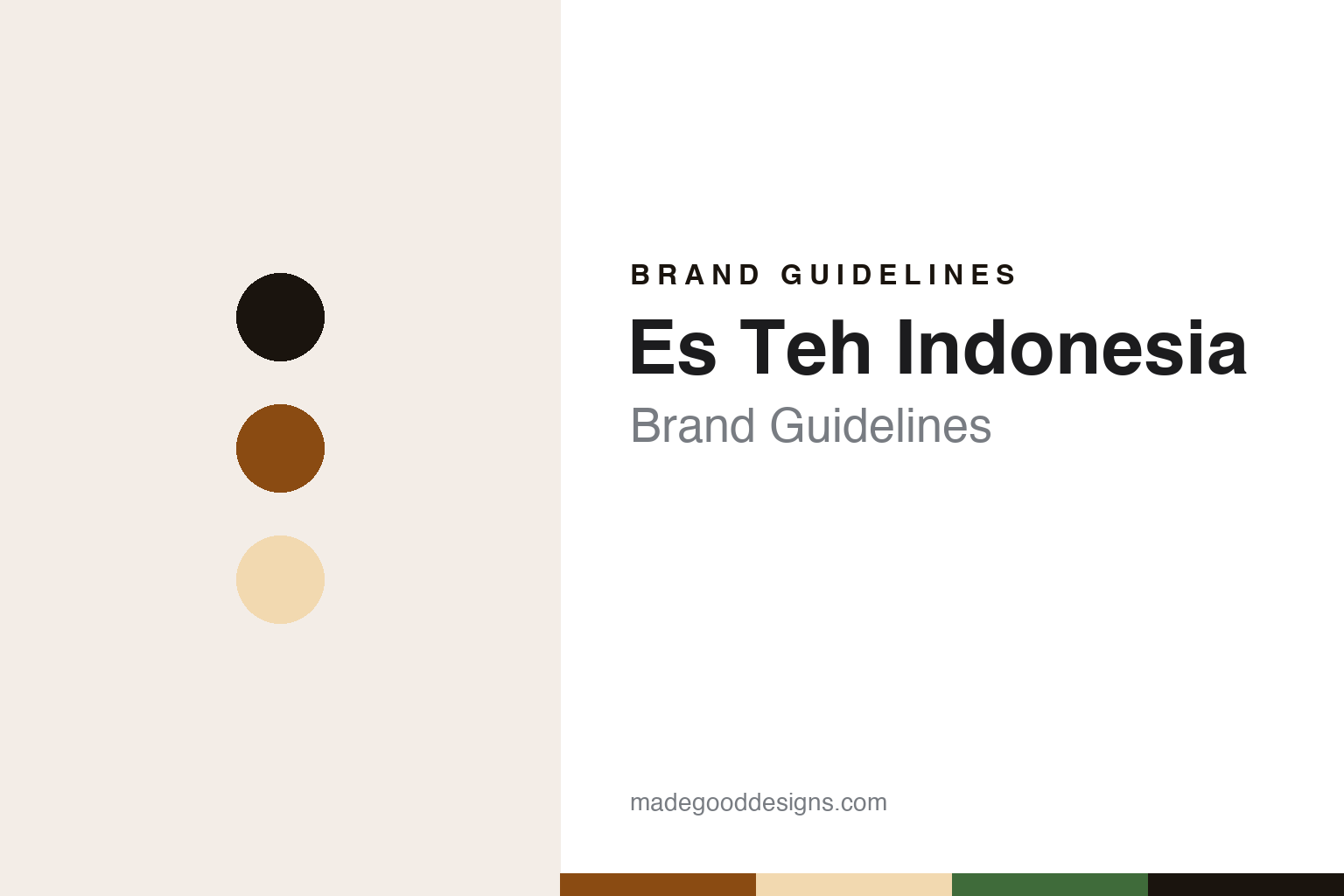
Es Teh Indonesia Brand Guidelines
A 2018 Kemang Village booth turned iced-tea franchise.
Aa
Two constants: an Es Teh Indonesia tea amber and leaf green palette and a Sturdy sans register. Abstract homage — not an Es Teh Indonesia product or mark; no cup, logo or sign is reproduced.
A booth, 2018
From an exhibition stand to a franchise.
Es Teh Indonesia is a franchise chain of iced-tea drinks founded in 2018 by Haidhar Wurjanto; “es teh” is Indonesian for iced tea. The company writes its name both as Es Teh Indonesia and as Esteh Indonesia, and its operating company appears in the press as PT Esteh Indonesia Makmur. Katadata described the founder in 2022 as a management graduate of IPB, the agricultural university in Bogor.
It started at an exhibition. In an interview with detikFinance published in June 2021, Wurjanto said the business began in 2018 with very little capital, buying equipment and a simple booth at a fair; Katadata and detikFood both placed that booth at Kemang Village, a mall in South Jakarta. Sales at the fair were encouraging enough, he told detikFinance, for him to open a permanent outlet at Blok M Square, also in South Jakarta.
Wurjanto had been in business for years before that. He told detikFinance he started selling mobile phone credit as a secondary-school student in 2007, then tried Japanese food, crêpes and fried-rice carts, not all of them successful. By 2021 the paper listed him as behind several food and drink names, including Momo Milk, Foresthree, Raindear Coffee and Cakekinian, as well as Es Teh Indonesia.
The idea, he told the paper, was to focus on one drink. He said tea was what people drank most after water, and that iced tea regularly appeared among the five items customers ordered most; Es Teh Indonesia was built to concentrate on it.
Colour
Hundreds of partner outlets.
Growth came through franchising. A busy early outlet was in Bogor, Wurjanto told detikFinance, and after it the company began opening branches with partners. By June 2021 it had 250 branches, the paper reported. In August 2021 the news agency Antara reported a new branch on Jalan Achmad Adnawijaya in Bogor as roughly its 300th, with about 70 per cent of outlets on Java and the rest on other islands. Wurjanto told detikFinance that many franchise partners were people who had lost office jobs and were looking for a business of their own.
He also described what growth demanded. Not every business needs many branches, he told the paper; what matters is delivering on the vision and promise made to customers. As the company grew, he said, the hard part was recruiting good staff and bringing a larger team around one aim.
Counts in 2022 varied by source. In September 2022 detikFood put the chain at about 500 outlets, while Katadata, citing the company’s website that month, gave more than 945, split 68 per cent on Java and 32 per cent elsewhere. The menu, as Katadata described it, combined iced tea with milk, matcha, chocolate and other flavours across 22 variants; detikFood also mentioned fruit flavours.
Leadership changed in mid-2022. On 14 July 2022 PT Esteh Indonesia Makmur announced on Instagram that Nagita Slavina, a public figure, had joined as chief executive and become a shareholder, taking the role from Wurjanto, detikFood and detikFinance reported. The announcement played on two Indonesian acronyms: the company joked that it had become a “BUMN”, which it spelled out as a business owned by Nagita, and that its staff were now “PNS”, Nagita Slavina’s employees. Wurjanto continued to be described as the founder. The next day, detikFood reported, the company told followers that all its staff had received an incentive bonus.
Social media has been a large part of the brand’s voice. In January 2022, when videos of people drinking jumbo servings of iced tea spread on TikTok, the company posted its own versions on Instagram, drinking from a water-cooler bottle and an oversized plastic bag, detikFood reported.
Typography
Design and documentation.
Indonesian restaurant, bakery, noodle, donut and café chains meet most of their customers in a small number of settings: the shopping mall, the airport, the railway station, the shophouse row and, increasingly, the rest areas along the toll roads. In each of these the shopfront has to work from a distance. A single dominant colour, a short name and a sign that can be read across a food court often do more of the identity work than any printed material.
Inside, the menu board is where a brand is defined. Chains in this category tend to name their dishes and drinks plainly, whether a fried rice, a noodle bowl, a bento set, a filled bun or an iced tea, and to group them into sets and children’s packages. Packaging follows the same logic: takeaway boxes, cups and bags carry the name and colours out of the room, and delivery-only kitchens and kiosk formats now let a brand trade with little more than a counter and its packaging.
The store network is itself part of the story the companies tell. Corporate pages often present history as a sequence of openings, a first outlet in a new city or on a new island, a numbered milestone store, and a running count of outlets and cities across the archipelago and, for some chains, abroad. Those counts change quickly, so each one needs its date attached.
Ownership is described in different ways. Some chains are run by a single private company that keeps every outlet in its own hands; others grow through franchise or partnership networks, and some sit inside larger food and drink groups. Founders’ stories, the operating company’s name and the halal certification a chain holds are commonly set out on the corporate pages, and the guides that follow give each of them only as the sources state them.
Aa
A sturdy sans — a plain name for a plain drink. (Specimen set in Rubik, a sans STAND-IN; NOT the Es Teh Indonesia logo.)
Es Teh Indonesia
Tea, milk and palm sugar.
By 2025 the founder was again named as chief executive. A release from Indonesia’s Ministry of Creative Economy, dated 18 September 2025, reported a meeting with the company and described him, as Haidhar Hibatullah Wurjanto, as CEO. The company’s delegation, the release said, included a co-founder serving as chief financial officer and members of its board of commissioners. Wurjanto told the ministry that, in his view, tea had been left behind as coffee trends rose.
The same release gave a dated count: 600 outlets as of 2025, the farthest in Sorong, in the Papua region, with a presence in 191 cities across 33 provinces and 532 business owners as partners. It described the products as tea-based drinks made from a blend of tea, milk and palm sugar.
Es teh is the everyday Indonesian name for the drink, and the company pairs it with the name of the country, in two spellings. Unrelated businesses use similar words: the esteh.id domain, for example, belongs to Esteh Creative, a web and app agency with no link to the tea chain.
For a design guide, Es Teh Indonesia shows how a franchise can build a brand on the plainest possible name, the name of the drink, and spread it across hundreds of partner outlets. Compare Teh Botol Sosro, Indonesia’s bottled jasmine tea, and Kopi Janji Jiwa, a Jakarta coffee chain also founded in 2018. For this guide we use a tea amber, a palm-sugar brown and a leaf green with a sans, an unofficial interpretation; no product or logo is reproduced.
Explore & save
Keep Es Teh Indonesia’s identity on hand — save it to a board in the Made Good inspiration library.
Es Teh Indonesia identity set
Pin the Es Teh Indonesia tea amber and leaf green palette and the Sturdy sans register to your own board.
Source & notes
Frequently Asked Questions
What font can I use to match the Es Teh Indonesia look?
This guide describes Es Teh Indonesia’s type as “A sturdy sans — a plain name for a plain drink”. Its type specimen is set in Rubik from Google Fonts as a stand-in; Rubik is not Es Teh Indonesia’s own lettering.
What colours are in the Es Teh Indonesia palette?
This guide’s Es Teh Indonesia palette is Tea amber #8A4B12, Palm-sugar brown #4A2A12, Leaf green #3F6B3A, Ink #1A140E and Ice paper #F8F5EE. The tones are the guide’s own unofficial interpretation, not official Es Teh Indonesia hex codes.
When was Es Teh Indonesia founded?
Es Teh Indonesia was founded in 2018, in Jakarta, Indonesia.
Who founded Es Teh Indonesia?
Es Teh Indonesia was founded by Haidhar Wurjanto in 2018.