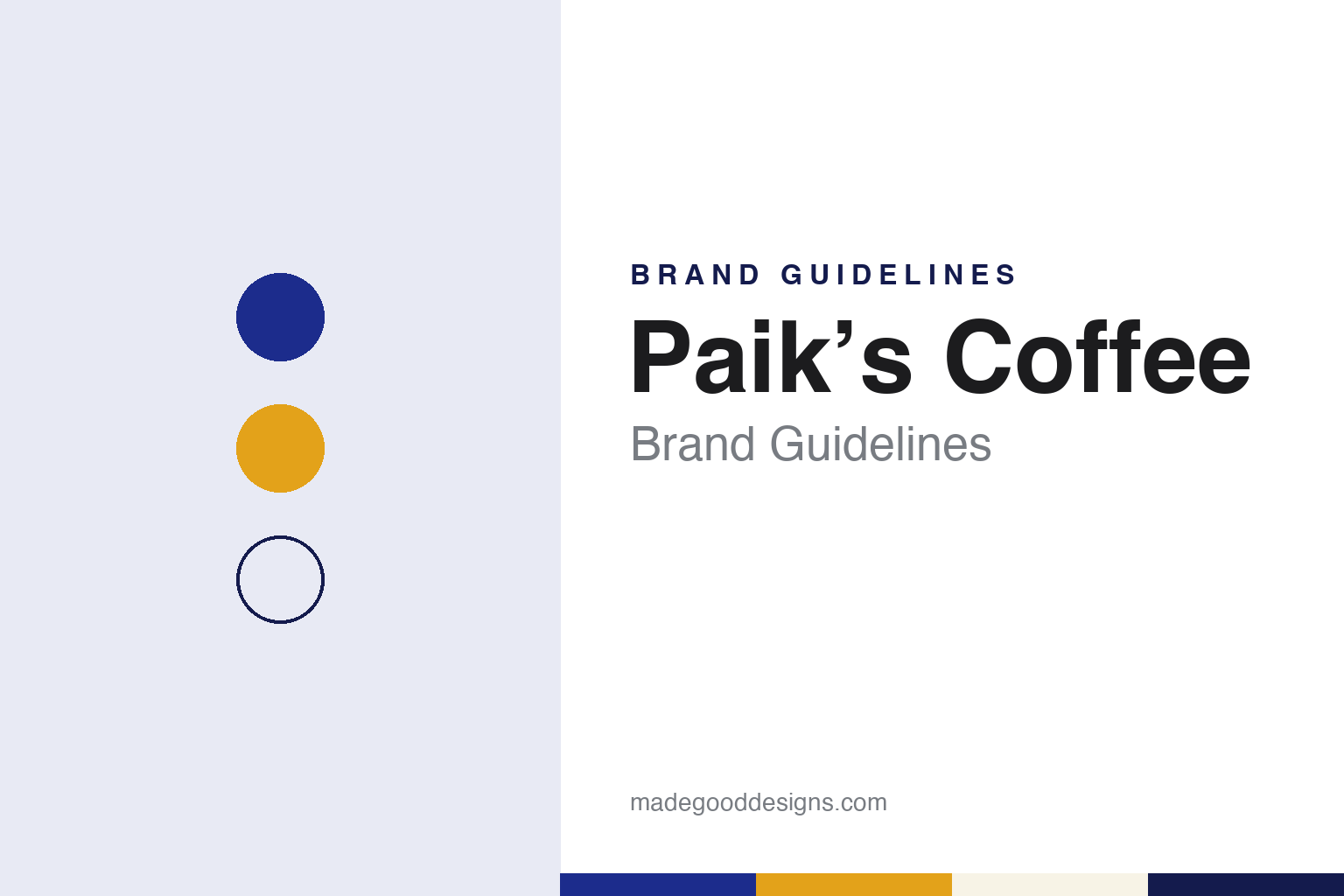
Paik’s Coffee Brand Guidelines
A 2006 Nonhyeon café, blue and yellow, and a 2026 redraw.
Aa
Two constants: a blue and yellow palette and a rounded sans register. Abstract homage — not a Paik’s Coffee product or mark; no portrait, cup or logo is reproduced.
Nonhyeon, 2006
One small café in a Seoul food alley.
Paik’s Coffee, known in Korean as Ppaekdabang (빽다방), began as a single café in Seoul’s Nonhyeon-dong in 2006, the news agency Newsis reported in January 2022. The café stood in a food alley lined with restaurants run by Paik Jong-won, founder of the food-service company Theborn Korea, at the entrance to his Wonjo Ssambap restaurant. According to Newsis, the café’s owner was struggling with the parking congestion the busy restaurants caused and asked him to take the shop over, and he agreed.
The signature drink came from that first shop. Newsis says the founder wanted a large serving of the instant “mix coffee” he liked, and the result was the Wonjo Coffee, or “original coffee,” which the agency credits with building the brand. The company’s website still lists it among its signature drinks, described as an upgraded mix coffee, next to an Americano, a café latte and the Ashot-chu, a peach iced tea with an added espresso shot. It also sells a blended-ice line called Paikscino and a condensed-milk latte.
The parent company is older than the café. The Korea Times reported in November 2024 that Theborn Korea was founded in 1994 and grew around casual dining, desserts, coffee and other drinks, and that it ran more than 2,900 stores in Korea under 25 franchise brands, among them Hong Kong Banjum, Saemaul Restaurant and Paik’s Coffee. The Asia Business Daily reported in September 2024 that the group also sells processed foods and sauces and runs a hotel, The Born Hotel, on Jeju. Theborn Korea’s shares began trading on the KOSPI on 6 November 2024, The Korea Times reported.
Colour
Three names, one face, two colours.
The name took three attempts. Newsis traces the logo history: the shop first traded as Wonjo Bucks, with a playful mark; in 2007 it became Wonjo Coffee, with a logo showing the founder wearing angel wings; and in 2008 it took the name Ppaekdabang, with a logo of the founder in a Vietnamese-style conical hat. Over the following years, the agency says, that jokey drawing was gradually softened into the warmer portrait of the founder that became the face of the brand’s signboards.
The word in the name matters too. The Korea Times explained in July 2026 that “dabang” is an older Korean term for a traditional coffee house, and that the company described keeping it as a deliberate choice, a way to carry an everyday Korean coffee culture abroad. The paper describes Paik’s Coffee as a low-cost coffee franchise.
Colour has been as steady as the name. The brand-identity page on the company’s website names two core colours, Paik’s Blue and Paik’s Yellow — a strong, saturated blue and a warm amber yellow — backed by a family of secondary creams, caramel browns, light blues and pale yellows. The same page shows a wordmark that can be set in Korean and English, horizontally or vertically, and a separate symbol mark.
The network grew fast. World Coffee Portal reported in May 2024 that the chain opened more than 300 stores in South Korea in 2023 to pass 1,400 outlets. By the first quarter of 2026, The Asia Business Daily reported in June 2026, Theborn Korea’s business report counted 1,835 Paik’s Coffee stores, 1,833 of them franchised and two run directly, which made up more than 60 per cent of all the group’s franchise stores. Newsis reported that the chain launched a mobile app in 2020 for ordering, payment and loyalty stamps.
Typography
Design and documentation.
South Korea’s café, bakery and quick-meal chains present themselves first through the street. Most are franchise networks, so a shopfront, a cup and a menu board have to look the same in thousands of places run by different owners. When the Korea Times reported in January 2025 that one coffee chain’s rebrand was on hold, the reason it gave was franchisees’ reluctance to pay for new store fittings: in a franchise system, a new look is also a shared bill.
Menus carry much of the identity. The chains in this group name their dishes and drinks rather than describing them in general terms, and abroad they lean on Korean flavours: dalgona lattes, sikhye, roasted sweet potato, injeolmi and black sesame cakes, misutgaru drinks and street snacks such as hotteok and bungeoppang, according to press reports on their stores in Malaysia, Laos and the United States. Cakes, toast, porridge, lunchboxes and burgers each give a chain its own signature.
Ownership is described plainly in the companies’ own pages and in the business press. Some chains belong to large food groups, some to private equity funds and some to individual owners; a single brand can pass through several of these in two decades. Store counts are published by the companies and repeated by the press with dates, and the numbers change quickly in a market the Korea Times described as split between premium and budget tiers.
Expansion abroad takes two main forms in these reports: a master franchise, in which a local partner runs the stores, or a subsidiary that runs them directly. This guide sets out what can be checked about each brand: who founded it, who owns it now, how its stores and menus present it at home and abroad, and which facts rest only on the company’s own word.
Aa
A friendly rounded sans for a takeout-counter brand. (Specimen set in Nunito, a rounded sans STAND-IN; NOT the Paik’s Coffee logo.)
Paik’s DABANG
A redrawn sign for the 20th year.
The brand was redrawn for its 20th year. The Asia Business Daily reported on 2 June 2026 that test signboards carrying a candidate new identity had gone up on 27 May at two branches, in Jeonju and at Naksan Beach in Yangyang, after a briefing at which franchise owners gave their views on several candidates; the paper reported that removing the founder’s face from the signboards was among the options under review, and the company said it was still weighing them. On 7 July 2026, The Korea Times reported, the company unveiled the result: Korean-language signage gave way to a logo in English script reading Paik’s DABANG, with a “P” shaped like a coffee bean, a softened typeface and a brighter palette.
The new identity went abroad first in Tokyo. The Korea Times reported in August 2026 that Paik’s Coffee opened its first store in Shimbashi on 6 August 2026, followed by a second in Kanda, the first stores to use the redesigned identity outside Korea. The Tokyo shops are built around takeout for office workers, with separate ordering and pickup areas, Japan-only drinks made with matcha and kinako, a roasted soybean flour, and a local Paik’s Coffee LAB for product development and staff training. On 8 September 2026, The Asia Business Daily reported, Theborn Korea announced a ten-year master franchise agreement with a Taiwanese company.
For a design guide, Paik’s Coffee shows how a founder’s portrait and two bright colours can carry a low-cost chain, and how a chain can redraw its sign for customers abroad. Compare Compose Coffee, another Korean coffee chain, and Hollys Coffee, which kept its red crown through a change of name. For this guide we use an ink blue, a mustard yellow and milk white with a rounded sans, an unofficial interpretation; no product or logo is reproduced.
Explore & save
Keep Paik’s Coffee’s identity on hand — save it to a board in the Made Good inspiration library.
Paik’s Coffee identity set
Pin the Paik’s Coffee blue, yellow and milk palette and the rounded sans register to your own board.
Source & notes
Frequently Asked Questions
What font can I use to match the Paik’s Coffee look?
This guide describes Paik’s Coffee’s type as “A friendly rounded sans for a takeout-counter brand”. Its type specimen is set in Nunito from Google Fonts as a stand-in; Nunito is not Paik’s Coffee’s own lettering.
What colours are in the Paik’s Coffee palette?
This guide’s Paik’s Coffee palette is Ink blue #1C2C8C, Mustard #E3A21A, Deep ink #141B4D, Sky wash #B4CBEB and Milk #F7F3E6. The tones are the guide’s own unofficial interpretation, not official Paik’s Coffee hex codes.
When was Paik’s Coffee founded?
Paik’s Coffee was founded in 2006, in Nonhyeon-dong, Seoul. Paik’s Coffee is known for Wonjo Coffee, Ashot-chu, Paikscino.