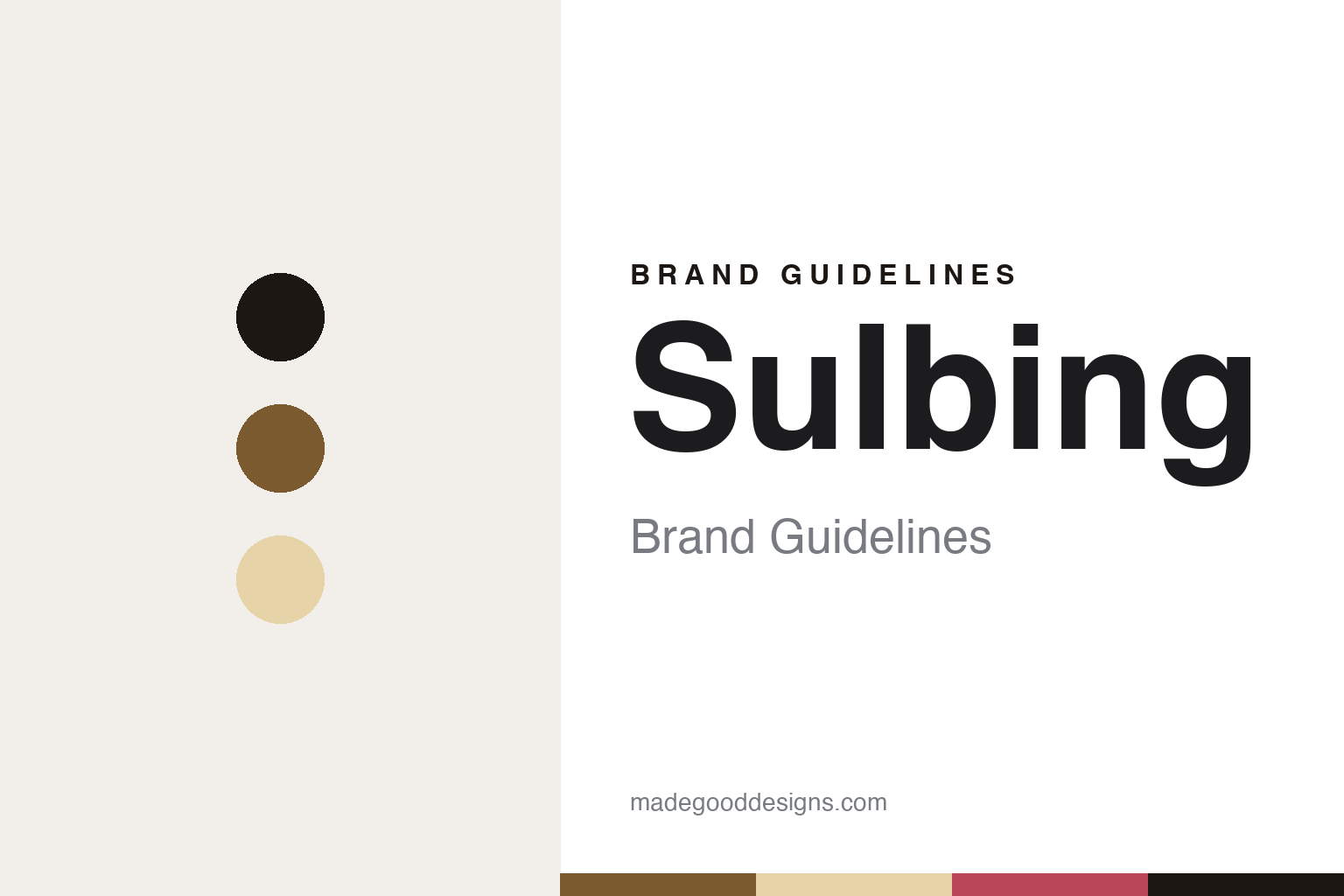
Sulbing Brand Guidelines
Injeolmi bingsu from a 2013 Nampo-dong café in Busan.
Aa
Two constants: a Sulbing soybean, rice-cake cream and strawberry palette and a Rounded sans register. Abstract homage — not a Sulbing product or mark; no bowl, logo or sign is reproduced.
Nampo-dong
A rice-cake café that became a bingsu chain.
Sulbing is a South Korean dessert café chain built around bingsu, the Korean shaved-ice dessert. It began in Busan. The Asia Business Daily reported in July 2020 that the founder, Jung Sun-hee, opened a fusion rice-cake café called Siru in 2010; English Wikipedia spells it Siroo. It was there, the paper wrote, that she developed the dishes that later became the chain’s signatures, Injeolmi Sulbing and Injeolmi Honey Bread.
In 2013 the business was rebranded as Sulbing and refocused on shaved ice, and in April 2013 it opened its first store in Nampo-dong, the shopping district near Busan’s old port, The Asia Business Daily reported. The Korea JoongAng Daily, writing in August 2015, also dated the café’s debut to 2013 in Nampo-dong and said it had changed the look of bingsu in Korea by updating a traditional summer dessert. The name itself reads as “snow ice”: Korean Wikipedia’s article on ice gives the Sino-Korean word seolbing as the term for ice formed from snow.
The dish that carried the brand was different from the older red-bean style. In place of plain ice, Sulbing shaved frozen milk, and in place of sweet red beans it used roasted soybean powder and chewy pieces of injeolmi rice cake, The Asia Business Daily wrote. The Korea JoongAng Daily described the frozen milk as shaved “like snowflakes” and singled out a second item, Injeolmi Toast, in which a slice of rice cake sits between two pieces of bread like cheese.
Franchising followed fast. The Asia Business Daily reported that Sulbing grew to more than 400 franchise stores in under a year, and English Wikipedia says the chain had more than 490 stores in South Korea by 2014. Sulbing added a delivery service in 2018, English Wikipedia says.
Colour
Strawberry, mango, black sesame and toast.
Sulbing built its menu outward from the injeolmi bowl. By 2020, The Asia Business Daily reported, the chain offered more than twenty kinds of bingsu depending on the branch, among them Strawberry Sulbing, Black Sesame Sulbing, Cheese Sulbing and Apple Mango Cheese Sulbing, with variations on the injeolmi bowl itself using caramel sauce or brown sugar syrup. The paper noted that seasonal side dishes and, more recently, savoury plates such as spaghetti and fried rice had helped the chain trade through the colder months, when shaved ice sells less readily.
The unofficial palette in this guide takes its cue from the dish as the press has described it: pale shaved milk, a warm soybean powder and fruit toppings such as strawberry and mango. Sulbing does not publish a public brand manual, and its typeface and colour values are not documented in the sources used here.
The chain looked abroad early. The Asia Business Daily wrote in July 2020 that Sulbing then ran overseas stores in eight countries, including Thailand, Cambodia and Canada. In Australia, QSR Media reported in June 2022 that the brand, operated locally by Double Nine Group, had been in Melbourne since 2019 and was opening a takeaway-focused store at Melbourne Central on 23 June 2022. The same report put Sulbing at more than 500 franchises in South Korea, with international stores in China, the Middle East and Australia.
Sulbing’s menu names are part of its identity. Most of the bowls named by The Asia Business Daily in 2020 carry the brand name as a suffix, so “Injeolmi Sulbing” or “Strawberry Sulbing” names both the dish and the café.
Typography
Design and documentation.
South Korea’s café, bakery and quick-meal chains present themselves first through the street. Most are franchise networks, so a shopfront, a cup and a menu board have to look the same in thousands of places run by different owners. When the Korea Times reported in January 2025 that one coffee chain’s rebrand was on hold, the reason it gave was franchisees’ reluctance to pay for new store fittings: in a franchise system, a new look is also a shared bill.
Menus carry much of the identity. The chains in this group name their dishes and drinks rather than describing them in general terms, and abroad they lean on Korean flavours: dalgona lattes, sikhye, roasted sweet potato, injeolmi and black sesame cakes, misutgaru drinks and street snacks such as hotteok and bungeoppang, according to press reports on their stores in Malaysia, Laos and the United States. Cakes, toast, porridge, lunchboxes and burgers each give a chain its own signature.
Ownership is described plainly in the companies’ own pages and in the business press. Some chains belong to large food groups, some to private equity funds and some to individual owners; a single brand can pass through several of these in two decades. Store counts are published by the companies and repeated by the press with dates, and the numbers change quickly in a market the Korea Times described as split between premium and budget tiers.
Expansion abroad takes two main forms in these reports: a master franchise, in which a local partner runs the stores, or a subsidiary that runs them directly. This guide sets out what can be checked about each brand: who founded it, who owns it now, how its stores and menus present it at home and abroad, and which facts rest only on the company’s own word.
Aa
A rounded sans — soft letters for a snowy dessert. (Specimen set in Nunito, a sans STAND-IN; NOT the Sulbing logo.)
UCK Partners
A private-equity owner and a push abroad.
Sulbing changed hands in 2023. Chosun Biz reported in February 2025 that the Korean private-equity firm UCK Partners had acquired 90% of Sulbing’s management rights in 2023. The same report described Sulbing as a bingsu franchise established in 2013 and put the network at about 600 stores across South Korea as of February 2025. Under its new owner, the paper wrote, the company recruited Kim Ui-yeol as chief executive and in 2024 created a new post to head its overseas business, filling it with an executive from Kyochon’s parent company, Kyochon F&B.
UCK Partners came to Sulbing with experience in Korean drinks and dessert brands. The Asia Business Daily reported in May 2024 that the firm had built up holdings in the milk tea brand Gong cha, in Sulbing and in the Gangneung specialty coffee company Terarosa, and that it had earlier taken Gong cha from a Korean franchise holder to a business with stores in many countries before selling a majority stake in 2019.
The overseas network has continued to shift. In July 2026 the company told The Asia Business Daily that it ran five stores in the United States, two in California and one each in Colorado, Arizona and Texas, the most recent opening in Tempe, Arizona, in June 2026, and that it had set up a US subsidiary in 2025 to support franchising there. The company also said it had opened a store on 4 July 2026 at the Central Northville shopping mall in Nonthaburi, near Bangkok, and that its US menu included non-dairy bingsu while its South-East Asian stores sold single-serving bowls.
For a design guide, Sulbing shows how a single regional dish, a milk-ice bingsu dusted with soybean powder and rice cake, can become a national franchise and a menu system in its own right, with the brand name repeated in every bowl’s title. Compare it with Tous les Jours, a Korean bakery chain with stores abroad, and A Twosome Place, another Korean café chain. For this guide we use soybean brown, rice-cake cream and a strawberry red with a rounded sans, an unofficial interpretation; no product or logo is reproduced.
Explore & save
Keep Sulbing’s identity on hand — save it to a board in the Made Good inspiration library.
Sulbing identity set
Pin the Sulbing soybean, rice-cake cream and strawberry palette and the Rounded sans register to your own board.
Source & notes
Frequently Asked Questions
What font can I use to match the Sulbing look?
This guide describes Sulbing’s type as “A rounded sans — soft letters for a snowy dessert”. Its type specimen is set in Nunito from Google Fonts as a stand-in; Nunito is not Sulbing’s own lettering.
What colours are in the Sulbing palette?
This guide’s Sulbing palette is Soybean powder #7A5A2E, Rice-cake cream #E6D3A8, Strawberry #B8475A, Ink #1C1712 and Snow white #FAF8F4. The tones are the guide’s own unofficial interpretation, not official Sulbing hex codes.
When was Sulbing founded?
Sulbing was founded in 2013 (as Sulbing), in Busan, South Korea.
Who founded Sulbing?
Sulbing was founded by Jung Sun-hee in 2013 (as Sulbing).
Who owns Sulbing?
Sulbing is owned by UCK Partners (90%) (since 2023). Sulbing is known for Injeolmi Sulbing, Injeolmi Toast.