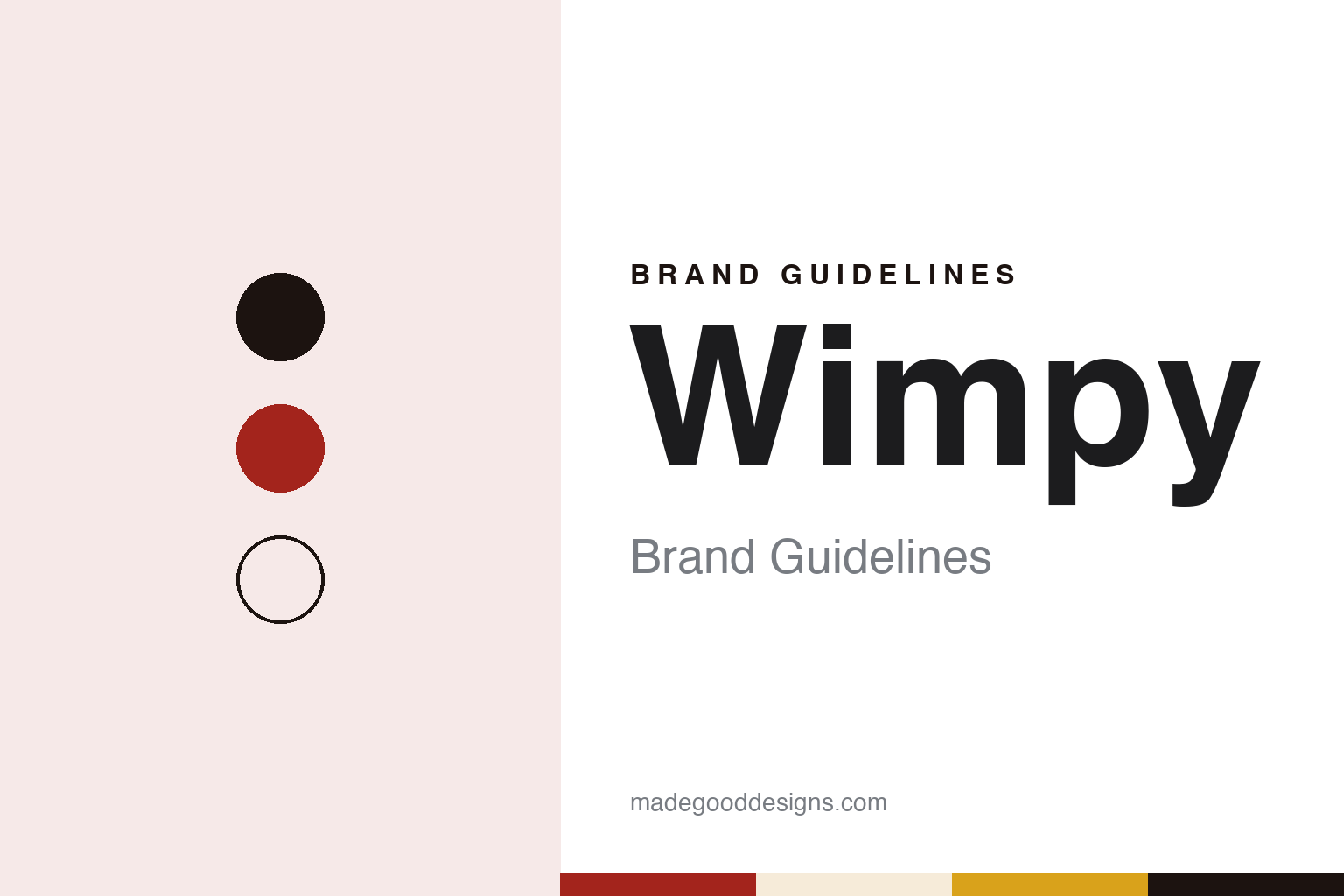
Wimpy Brand Guidelines
A 1934 Indiana grill, a 1954 London bar and a South African owner.
Aa
Two constants: a Wimpy grill red, mustard and cream palette and a Bold diner sans register. Abstract homage — not a Wimpy product or mark; no menu item, logo or sign is reproduced.
Wimpy Grills
An Indiana grill named after a cartoon character.
Wimpy began in the United States. English Wikipedia says Edward Gold opened the first restaurant in Bloomington, Indiana, in 1934, under the name Wimpy Grills, and that the name came from J. Wellington Wimpy, the hamburger-loving character in E. C. Segar’s Popeye cartoons. Edinburgh Live gave the same origin in a January 2023 history piece. Gold reached Chicago in 1936, after opening units in five other Midwestern cities, and by 1947 the Chicago Tribune counted 26 units, English Wikipedia says, citing the paper.
The American chain never grew large, and it did not last. English Wikipedia, citing a 1978 Chicago Tribune article, says only seven American locations remained by 1977 and that the chain then disappeared from the United States, because nobody bought the rights to the name there. The Wimpy that trades today descends from the licence Gold sold abroad.
That licence went to J. Lyons and Co., the London caterer, in 1954. English Wikipedia says the first “Wimpy Bar” opened that year inside the Lyons Corner House on Coventry Street, in London’s West End, as a fast-food counter within a traditional restaurant, and that it did well enough for Lyons to open separate Wimpy restaurants serving hamburger meals. In 1957 Gold’s Chicago company and Lyons formed a joint company, Wimpy’s International, to franchise the name in the rest of the world; Lyons later took full control of that international licensing, which it and its successors ran from Britain through Wimpy International Ltd.
Growth was quick. By 1970, English Wikipedia says, the business had more than 1,000 restaurants in 23 countries. Edinburgh Live described the classic British Wimpy as a table-service restaurant where diners ate from plates with real knives and forks, and recalled the Edinburgh openings on Queensferry Street and Frederick Street in the 1960s. Franchises reached France in 1961, the Netherlands in 1963, Australia in 1964 and Colombia in 1976, among other countries, English Wikipedia says; those national chains have all since closed.
Colour
Lyons, United Biscuits, Grand Metropolitan.
The British business changed hands several times. In July 1977 it was acquired by United Biscuits, and in 1978 the company introduced Mr Wimpy, a mascot dressed as an exaggerated beefeater, English Wikipedia says. Edinburgh Live reported in 2023 that two flagship Wimpy restaurants opened on Princes Street in Edinburgh in 1984 and were handed over to Burger King in the early 1990s.
McDonald’s opened its first British restaurant in 1974, and by the end of the 1980s Wimpy was converting some table-service restaurants to counter service, English Wikipedia says. When United Biscuits sold its restaurant division in 1989, the buyer was Grand Metropolitan, now part of Diageo, which had bought Burger King the year before; there were 381 British locations at the time of the sale, and Grand Metropolitan began converting the counter-service sites to Burger King. In February 1990 the remaining 216 table-service restaurants were bought in a management buyout backed by 3i, and a second management buyout, backed by the Bank of Scotland, followed in May 2002, when there were about 300 restaurants in the United Kingdom and Ireland.
The Daily Mirror reported in October 2017 that Wimpy had once had about 500 restaurants across Britain and that about 80 remained, and it recalled two menu names from the chain’s heyday: the Bender in a Bun, a curled frankfurter, and the Brown Derby dessert. English Wikipedia gives 61 British restaurants as of January 2025. The British operator is named on the Wimpy UK website as Wimpy Restaurants Group Limited.
Typography
Design and documentation.
Burger, custard and chicken chains usually present themselves through a small set of fixed things: the name over the door, the shape of the building, the colours on the sign and the packaging, and a short list of named menu items that travel from one restaurant to the next. In the United States many of these chains began as a single family stand. Freddy’s opened in Wichita, Kansas, in 2002 under its founders’ father’s name, and Runza began in Lincoln, Nebraska, in 1949 with a sandwich that gave the company its name.
The menus are often the clearest part of the identity. A chain may be organised around one dish, as Runza is around its beef-and-cabbage bread pocket, or around a pairing, as Freddy’s was when its full name joined frozen custard and steakburgers with an ampersand. Smash burgers, biscuits, fried chicken and flame-grilled chicken play the same role for other chains in this group, in the United States, Singapore and South Africa, and each company publishes its own list of signature items.
Ownership varies widely. Some chains in this guide remain family businesses and say so on their corporate pages; others have passed to private-equity firms or to listed restaurant groups that run several brands at once. Where a chain has changed hands, the dates and buyers here come from trade press and company announcements, and any deal not completed is described as pending.
The restaurant networks are reported in the companies’ own terms: franchised or company-run, regional or international, counted on a stated date. Some chains say they keep close to home by choice, while others publish franchise maps that reach other countries. This guide gives those counts with their dates and sources, and treats colours and typefaces as an unofficial interpretation unless a source documents them.
Aa
A bold diner sans — the register of a grill sign. (Specimen set in Archivo Black, a sans STAND-IN; NOT the Wimpy logo.)
Wimpy
A South African chain since 1967.
The South African story runs separately. English Wikipedia says Wimpy International opened the first South African restaurant in Durban in 1967; Wimpy South Africa’s own history page places it in Murchies Passage and says 1,000 people visited on opening day. The South African restaurants were sold to Bakers SA in the late 1970s, and in 1987 Bakers sold them to Pleasure Foods, then known as Juicy Lucy SA, English Wikipedia says. Steers Holdings — the group now called Famous Brands — bought Pleasure Foods, and with it the South African Wimpy licence, in August 2003.
Then the ownership reversed direction. On 27 February 2007, English Wikipedia says, Famous Brands announced that it had acquired Wimpy UK, making the South African group the parent of the whole franchise system; its article on Famous Brands describes the 2007 deal as a majority stake. Worldwide franchising has since been run from Johannesburg. Famous Brands, founded in 1960 as Steers and listed on the JSE, brought back in Britain the logo Wimpy UK had used from the 1960s to the 1980s, to bring the two countries’ branding into line, and from November 2009 began refitting its then 170 British restaurants in the style of American diners, English Wikipedia says. Moneyweb reported in May 2026 that Famous Brands houses 15 restaurant brands, among them Steers, Debonairs Pizza, Wimpy and Mugg & Bean.
Most Wimpy restaurants are now in South Africa. English Wikipedia, citing Famous Brands figures, gives 451 there as of February 2025, against 61 in Britain. Wimpy South Africa’s history page says the chain partnered with Mobil, now Engen, in the 1980s to put restaurants on the road, added Wimpy Relish to its burgers in the 1990s and opened its 500th restaurant, at The Grove, in 2011. The Kuwaiti group Americana has run Wimpy restaurants in Kuwait since 1970, and opened them in Cairo in 2021 and Abu Dhabi in December 2022, English Wikipedia says.
For a design guide, Wimpy shows how one name can carry two national identities — a British table-service grill and a South African family restaurant — and how a revived logo can pull them back together. Compare Steers, its Famous Brands stablemate, and Burger King, which took over many British Wimpy sites. For this guide we use a grill red, a mustard yellow and warm cream with a bold sans, an unofficial interpretation; no product or logo is reproduced.
Explore & save
Keep Wimpy’s identity on hand — save it to a board in the Made Good inspiration library.
Wimpy identity set
Pin the Wimpy grill red, mustard and cream palette and the Bold diner sans register to your own board.
Source & notes
Frequently Asked Questions
What font can I use to match the Wimpy look?
This guide describes Wimpy’s type as “A bold diner sans — the register of a grill sign”. Its type specimen is set in Archivo Black from Google Fonts as a stand-in; Archivo Black is not Wimpy’s own lettering.
What colours are in the Wimpy palette?
This guide’s Wimpy palette is Grill red #A3241C, Griddle brown #1C1310, Bun cream #F6EBD9, Mustard #D9A21B and Paper #FBF7F0. The tones are the guide’s own unofficial interpretation, not official Wimpy hex codes.
When was Wimpy founded?
Wimpy was founded in 1934 (as Wimpy Grills), in Bloomington, Indiana.
Who founded Wimpy?
Wimpy was founded by Edward Gold in 1934 (as Wimpy Grills).
Who owns Wimpy?
Wimpy is owned by Famous Brands, since 2007. This guide dates Wimpy to 1934 (as Wimpy Grills), in Bloomington, Indiana.