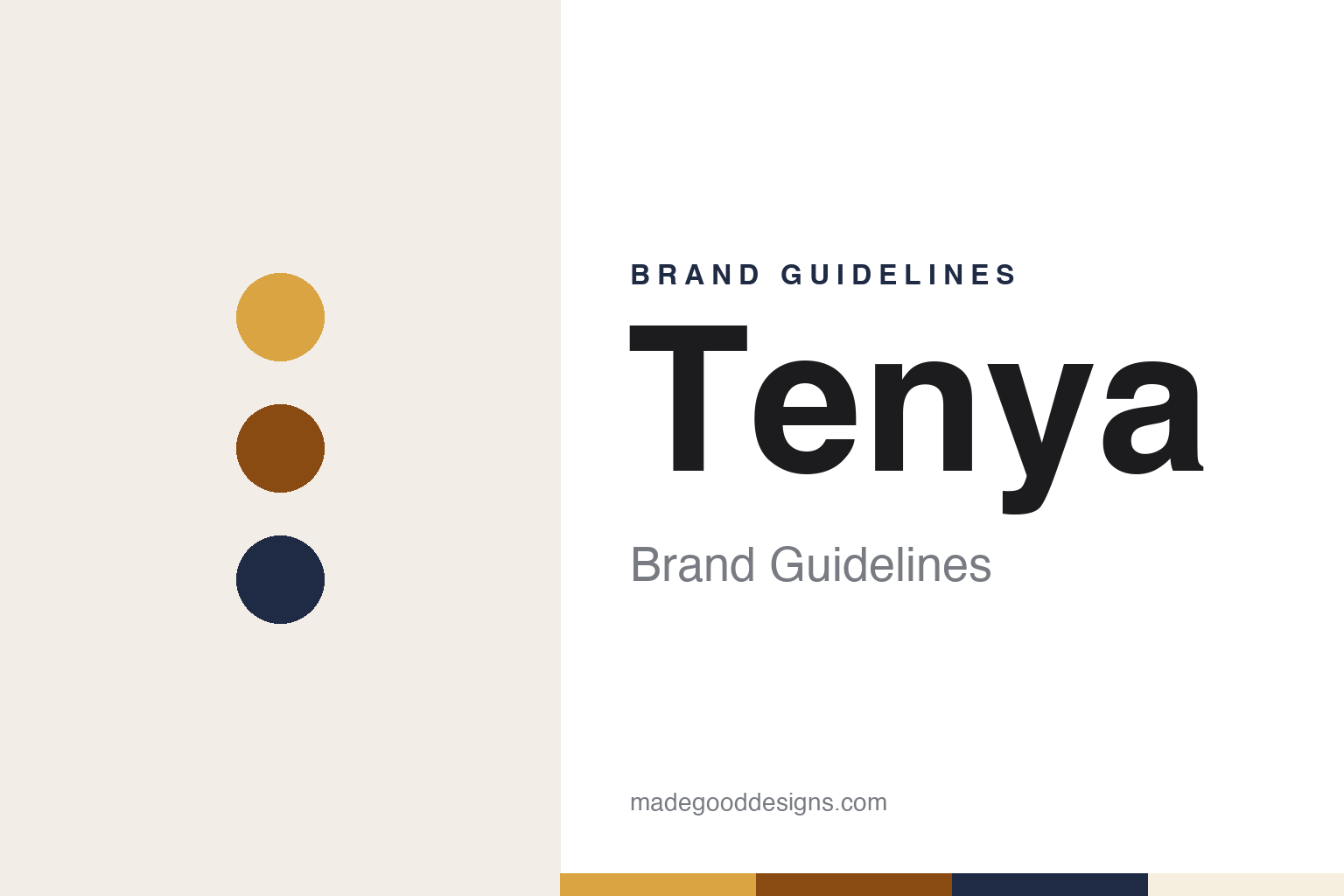
Tenya Brand Guidelines
The tendon counter that opened under Tokyo Station in 1989.
Aa
Two constants: a tempura gold, tare brown and ink blue palette and a brush-era serif register. Abstract homage — not a Tenya product or mark; no logo, sign or menu is reproduced.
Under Tokyo Station
A tendon counter in the Yaesu underground mall.
Tenya, written in full as Tendon Tenya, opened its first store in September 1989 in the Yaesu underground shopping mall beneath Tokyo Station, according to the history published by its owner, Royal Holdings. The weekly Shukan Post, revisiting that store in October 2017, placed the opening in the middle of Japan’s bubble economy. A Tenya spokesperson told the magazine that the company had been looking for a site worthy of the first store of the 100-outlet national chain it had in mind, and chose Yaesu, at the main entrance to the capital, for its size and its crowds. Customers queued from the first day, the magazine reported, and takeaway demand was strong from the outset: the shop had prepared 50 boxed meals for opening day and still ran short.
The business behind it was Ten Corporation, set up in 1989, ITmedia Business Online reported in August 2016. Japanese Wikipedia says the chain’s founder, Iwashita Yoshio, had been one of the founding members of McDonald’s in Japan, and that he set out to do for tempura what conveyor-belt restaurants had done for sushi. The key was equipment: Japanese Wikipedia says a conveyor fryer was developed for the chain, so that a bowl of tempura over rice could be made quickly without a specialist tempura chef at every counter.
The same source notes a detail of the chain’s graphics: although the first store was in Yaesu, in-store lettering and the demonstration loop on the ordering pads carry the words “ASAKUSA TOKYO,” because Ten Corporation was based in Asakusa. The Shukan Post piece also recorded a habit that predates a later fashion for quick, cheap drinking at restaurant counters: at the Yaesu store, many customers ate quickly at lunch and came back in the evening to drink with their tempura.
Colour
Royal Holdings, from 2006.
Tenya changed hands in stages. Royal Holdings, the Fukuoka-based restaurant group behind the Royal Host family restaurants, made Ten Corporation a consolidated subsidiary in June 2006, its company history says, and Japanese Wikipedia says this followed tender offers in 2006 and 2010. ITmedia Business Online reported that Ten Corporation had been a wholly owned subsidiary of Royal Holdings since 2010.
Under Royal, the chain widened its reach. Tenya had grown mostly through company-run stores in the Tokyo area; it began recruiting franchisees in 2013 with a view to a national network, ITmedia reported. In August 2016 the same article counted 152 company-run stores, 28 franchised stores and 11 abroad, 191 in all, in 17 prefectures, with overseas stores in Indonesia, Thailand and the Philippines. Royal Holdings dates the first franchised store in Southeast Asia to October 2013, and records Tenya passing 200 stores at home and abroad in December 2016.
The corporate shell changed again in January 2021. Royal Holdings’ history says the Royal Host operating company absorbed Ten Corporation and another subsidiary, R&K Food Service, and renamed itself Royal Food Service. That company now runs Royal Host, Tendon Tenya, Shakey’s and Sizzler, among other restaurants, and is owned by Royal Holdings, according to its company page dated March 2026. Tenya’s English web pages divide its locations into Tokyo and a group covering Sapporo, Nagoya and Osaka.
Typography
Category context.
Japan’s restaurant and food chains cover a wide spread of formats: takeaway bento shops, tempura and set-meal counters, family restaurants, ramen and champon chains, takoyaki stands, burger shops and yakiniku grills. Most present themselves first through the shopfront. A sign over the door, a colour that can be read from across the street and a short name, often written in both Latin letters and Japanese script, do much of the work of telling passers-by what is sold inside.
Menus carry the rest. Chains tend to describe themselves by named dishes rather than by abstract promises: a standard bowl, a set meal, a takeaway box, a seasonal special that changes through the year. Menu boards, printed menus, ordering screens and ticket machines repeat those names, and many chains publish their menus online as well, so the dish names themselves become part of the identity.
Store networks are another way these companies describe themselves. Corporate pages and annual histories list store counts, prefectures and the year a chain opened in a new region or country, and many chains mix company-run stores with franchised ones. Some brands operate abroad directly, others through joint ventures or local franchise partners, and the overseas store design and menu can differ from those at home.
Ownership is often layered. A single chain may sit inside a larger restaurant group, alongside sister brands with their own names and looks, and some brand names have changed when a franchise arrangement ended or a parent company reorganised. Corporate pages usually set out the founders, the operating company, the owner and the franchise network, and those pages, read alongside dated press reports, are a useful record of how each chain came to look the way it does today.
Aa
A brush-era serif, chosen to echo menu boards and noren. (Specimen set in Shippori Mincho, a serif STAND-IN; NOT the Tenya logo.)
Bowls, sets and seasonal tempura
A menu built on three standard bowls.
The menu has stayed close to its start. Japanese Wikipedia names three bowls as standards since the chain opened: the original Tenya tendon, with prawn, squid, kisu whiting, aubergine and green beans; a deluxe version with two prawns, lotus root, pumpkin and green beans; and a vegetable tendon. Each comes with miso soup. The same tempura can be ordered on a separate plate as a tempura set meal with rice, dipping sauce and a side dish, or with soba or udon, and pieces can be added one at a time; seasonal bowls made with Japanese produce change through the year. Japanese Wikipedia says that after joining Royal, Tenya tried more unusual bowls before returning to its standards.
Japanese Wikipedia also says the tempura flour has been developed with the Nisshin Flour group since the chain began, and that the frying oil is a vegetable oil made to order by the Nisshin OilliO group; Tenya’s website links to Nisshin OilliO. Takeaway remains a large part of the format: tendon in boxes, tempura assortments for one or two, single pieces, noodles and Tenya’s own sauce. Each month the chain runs Tenya Week, a week of offers on its takeaway deluxe tendon that includes the 18th, Japanese Wikipedia says.
As of October 2026, Japanese Wikipedia lists 147 stores in 17 prefectures, still mostly in and around Tokyo, with a return to Osaka in 2023 and a first store in Kōchi in 2025, plus two upmarket Tempura Tenya restaurants. It lists 20 stores abroad, in Indonesia, the Philippines, Hong Kong and Singapore, and says Tenya left Thailand in 2025. Besides company-run and franchised stores, the group runs Tenya counters at expressway service areas and airports through Royal Contract Service.
For a design guide, Tenya shows how one dish, a fixed set of toppings and a station-mall counter can carry a chain for more than three decades under two owners. Compare Royal Host, its sister chain under Royal Food Service, and Marugame Seimen, which also serves tempura with noodles. For this guide we use a tempura gold, a tare brown and an ink blue with a serif, an unofficial interpretation; no product or logo is reproduced.
Explore & save
Keep Tenya’s identity on hand — save it to a board in the Made Good inspiration library.
Tenya identity set
Pin the Tenya tempura gold, tare brown and ink blue palette and the brush-era serif register to your own board.
Source & notes
Frequently Asked Questions
What font can I use to match the Tenya look?
This guide describes Tenya’s type as “A brush-era serif, chosen to echo menu boards and noren”. Its type specimen is set in Shippori Mincho from Google Fonts as a stand-in; Shippori Mincho is not Tenya’s own lettering.
What colours are in the Tenya palette?
This guide’s Tenya palette is Tempura gold #D9A441, Tare brown #8A4B12, Ink blue #1F2A44, Batter cream #F6EFDF and Bowl lacquer #5A1E14. The tones are the guide’s own unofficial interpretation, not official Tenya hex codes.
When was Tenya founded?
Tenya was founded in September 1989, in Yaesu, Tokyo. Tenya is known for Tendon, tempura set meals, takeaway tempura.
Who owns Tenya?
Tenya is owned by Royal Holdings (via Royal Food Service) (since 2006).