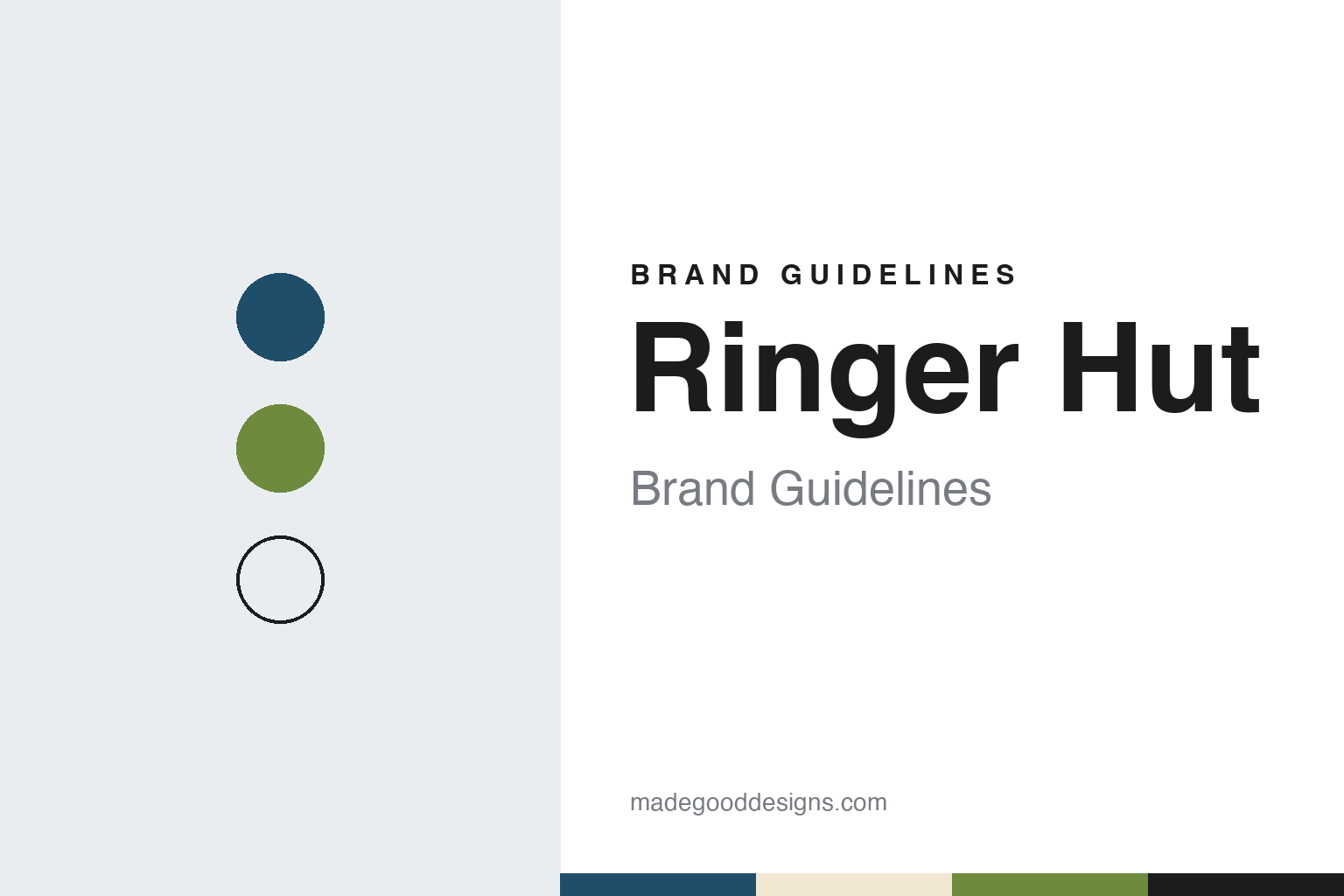
Ringer Hut Brand Guidelines
Nagasaki champon named for a harbour-town merchant.
Aa
Two constants: a harbour blue, cabbage green and broth cream palette and a harbour serif register. Abstract homage — not a Ringer Hut product or mark; no logo, sign or menu is reproduced.
Hamakatsu
A tonkatsu shop in Kajiya-machi.
Ringer Hut grew out of a pork-cutlet restaurant. On 22 July 1962 the tonkatsu shop Hamakatsu opened in Kajiya-machi, Nagasaki, the company’s history says. Japanese Wikipedia names its founders as the Yonehama brothers, led by the eldest and including Kazuhide, the fourth brother, who later led the company as chairman. The business was incorporated in March 1964, and in November 1968 it opened a local-cuisine annex that became Shippoku Hamakatsu, a restaurant for Nagasaki’s shippoku banquet food.
The chain that now carries the Ringer Hut name began on 13 August 1974, when the company opened, in Shukumachi, Nagasaki, the first branch of a chain built around “Nagasaki chanmen,” the dish now sold as Nagasaki champon, and gyoza. That shop still trades as the Ringer Hut Nagasaki Shukumachi branch, the company says. A plant in Tosu, Saga prefecture, followed in December 1977 to prepare food for the shops, and a Tokyo office in February 1979; the first branch in the Kantō region, the chain’s 37th opening, came in Yono, Saitama, in September 1979. Nagasaki sara udon joined the menu in March 1981.
In August 1982 the company, then called Hamakatsu, renamed itself Ringer Hut. Japanese Wikipedia explains the name: it takes the surname of Frederick Ringer, a British businessman active in Nagasaki from the last years of the Edo period into the early Meiji era, and adds “hut,” for a small house, chosen as a bright, pleasant-sounding word. Hamakatsu lives on as the group’s tonkatsu chain: Japanese Wikipedia says a Hakata Hamakatsu opened in Fukuoka in 1976, the company dates its 100th tonkatsu shop to February 2006, and in 2016 the shops took a new logo and the older written form of the name, Tonkatsu Hamakatsu.
Colour
Champon, sara udon and gyoza.
The menu rests on two Nagasaki noodle dishes. Champon is a thick-noodle soup topped with vegetables, pork and seafood; sara udon is a plate of noodles under a thick sauce; gyoza sit alongside both. In January 2018 Fukuoka Now described Ringer Hut as a 646-outlet chain across Japan, known for Nagasaki-style champon, and reported a “My Champon” service at six shops that let diners choose their own toppings, noodles, soups and sizes. A larger bowl with extra vegetables, Yasai Tappuri Champon, went on sale in October 2009, the company says.
The company ties its menu to Japanese farms. Its history says that in October 2009 every Ringer Hut restaurant switched to domestically grown vegetables, that the gyoza fillings became fully domestic in September 2013, and that in September 2020 the chain moved all its wood-ear mushrooms to ones carrying organic JAS certification.
Much of the food is prepared in the company’s own plants. Ringer Hut lists four factories: Saga, opened in 1983; Fuji Oyama in Shizuoka, opened in 1988; Kyoto, in Kyōtanabe, bought in 2018 and running from 2019; and Ōmura in Nagasaki. In September 2023 it absorbed Miyata, a pickles maker that Japanese Wikipedia places in the group. Since 2014 a subsidiary, Ringer Foods, has handled sales outside the restaurants.
The dishes have also reached supermarket shelves. In September 2025 GIGAZINE tasted two Acecook cup noodles made with Ringer Hut, a Nagasaki champon and a spicy “Pirikara” champon, ahead of their release on 29 September 2025, and found the pair close to the restaurant soups.
Typography
Design and documentation.
Japan’s restaurant and food chains cover a wide spread of formats: takeaway bento shops, tempura and set-meal counters, family restaurants, ramen and champon chains, takoyaki stands, burger shops and yakiniku grills. Most present themselves first through the shopfront. A sign over the door, a colour that can be read from across the street and a short name, often written in both Latin letters and Japanese script, do much of the work of telling passers-by what is sold inside.
Menus carry the rest. Chains tend to describe themselves by named dishes rather than by abstract promises: a standard bowl, a set meal, a takeaway box, a seasonal special that changes through the year. Menu boards, printed menus, ordering screens and ticket machines repeat those names, and many chains publish their menus online as well, so the dish names themselves become part of the identity.
Store networks are another way these companies describe themselves. Corporate pages and annual histories list store counts, prefectures and the year a chain opened in a new region or country, and many chains mix company-run stores with franchised ones. Some brands operate abroad directly, others through joint ventures or local franchise partners, and the overseas store design and menu can differ from those at home.
Ownership is often layered. A single chain may sit inside a larger restaurant group, alongside sister brands with their own names and looks, and some brand names have changed when a franchise arrangement ended or a parent company reorganised. Corporate pages usually set out the founders, the operating company, the owner and the franchise network, and those pages, read alongside dated press reports, are a useful record of how each chain came to look the way it does today.
Aa
A calm Japanese serif for a harbour-town noodle house. (Specimen set in Shippori Mincho, a serif STAND-IN; NOT the Ringer Hut logo.)
Ringer Hut
From Nagasaki to Shinagawa.
The company counts its openings, and the counter kept climbing. Its 100th shop opened in Fukuoka in June 1985, it listed on the Fukuoka Stock Exchange that October, and it joined the Osaka exchange in 1987 and the second section of the Tokyo Stock Exchange in July 1998, the company says. The shares moved to the first sections in Tokyo and Osaka in February 2000 and to Tokyo’s Prime market in April 2022. The Kansai and Chūkyō regions got their first branches in 1994; Japanese Wikipedia dates the first Tōhoku branch, in Natori, and the first Hokkaido branch, in Sapporo, to 2010, and the 1,000th opening, at Haneda Airport’s Terminal 1, came in September 2019.
Management followed the growth east. In April 2012 Fukuoka Now reported that Ringer Hut was closing its Fukuoka head office by the end of June to centralise in Tokyo, where its expansion was then focused; the company dates the move of its group head office to Shinagawa to July 2012. Its registered head office remains in Nagasaki. Since September 2006 the listed company has been a holding company, with Ringer Hut Japan running the champon chain and Hamakatsu the tonkatsu chain, Japanese Wikipedia says.
Abroad, the company’s history records openings in Qingdao, China, in November 2002; in Bangkok in April 2010, through a joint venture with Nichirei Foods; in Saratoga, California, in March 2011, under a franchise with Ringer Hut America; and in Hawaii and Hong Kong in 2012 and 2013. At home it renewed the Ringer Hut logo in November 2015 and the Hamakatsu logo in April 2016. In July 2023 it closed the original Hamakatsu shop in Kajiya-machi because the building had aged, and Japanese Wikipedia says the flagship reopened in 2024 in the Amu Plaza building at JR Nagasaki Station.
For a design guide, Ringer Hut shows how a regional dish and a borrowed harbour-town surname can carry one noodle soup across a whole country. Compare Hidakaya, another Japanese noodle chain, and Marugame Seimen, the udon chain. For this guide we use harbour blue, cabbage green and a broth cream with a serif, an unofficial interpretation; no product or logo is reproduced.
Explore & save
Keep Ringer Hut’s identity on hand — save it to a board in the Made Good inspiration library.
Ringer Hut identity set
Pin the Ringer Hut harbour blue, cabbage green and broth cream palette and the harbour serif register to your own board.
Source & notes
Frequently Asked Questions
What font can I use to match the Ringer Hut look?
This guide describes Ringer Hut’s type as “A calm Japanese serif for a harbour-town noodle house”. Its type specimen is set in Shippori Mincho from Google Fonts as a stand-in; Shippori Mincho is not Ringer Hut’s own lettering.
What colours are in the Ringer Hut palette?
This guide’s Ringer Hut palette is Harbour blue #1F4E6B, Cabbage green #6E8B3D, Broth cream #F1E7D2, Ink #1A1C1E and Paper #F8F7F3. The tones are the guide’s own unofficial interpretation, not official Ringer Hut hex codes.
When was Ringer Hut founded?
Ringer Hut was founded in 1962 (Hamakatsu); champon chain 1974, in Nagasaki, Japan.
Who founded Ringer Hut?
Ringer Hut was founded by the Yonehama brothers in 1962 (Hamakatsu); champon chain 1974.


