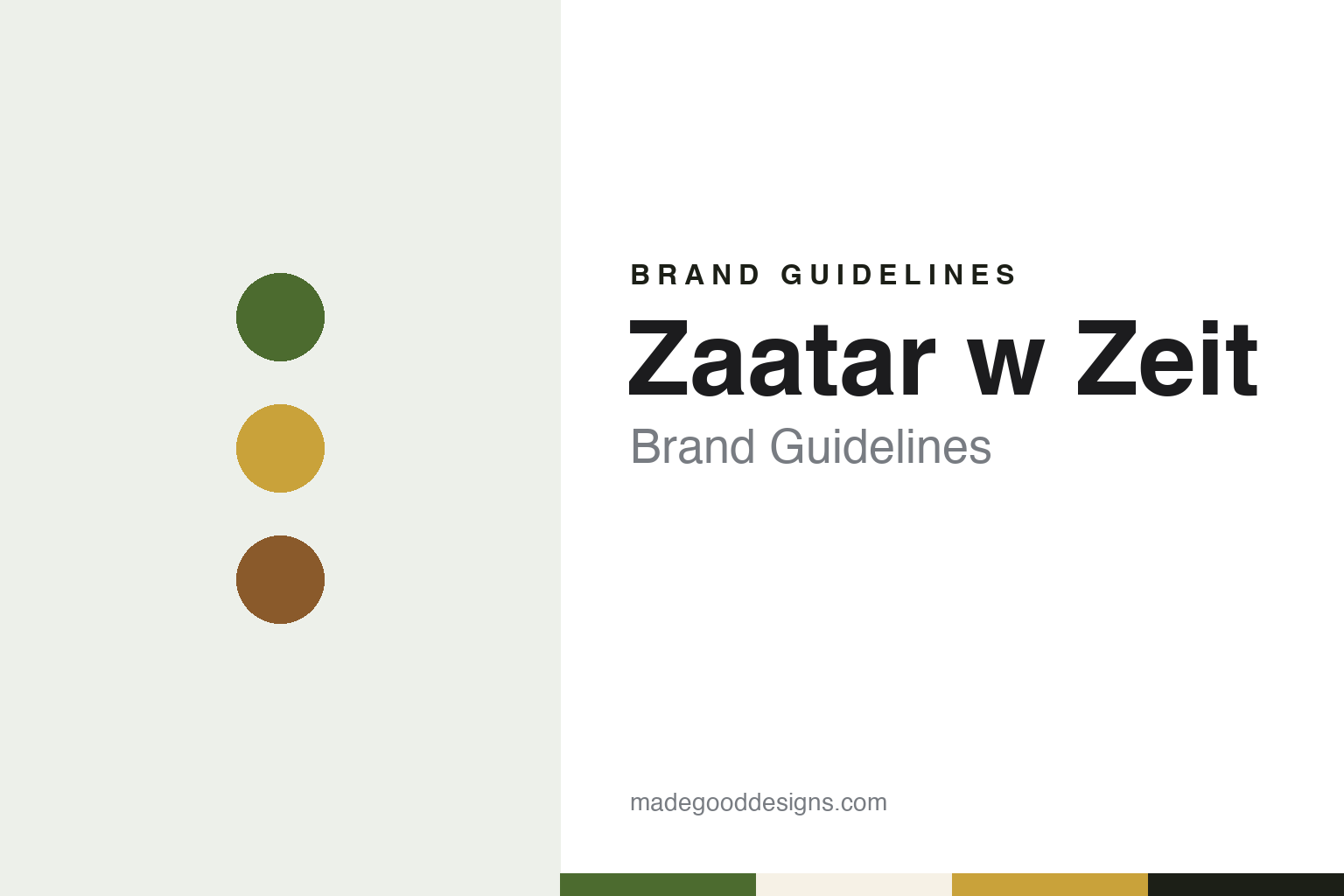
Zaatar w Zeit Brand Guidelines
The Lebanese manakish chain founded in 1999.
Aa
Two constants: a thyme green and olive-oil gold palette and a rounded modern sans register. Abstract homage — not a Zaatar w Zeit product or mark; no logo, sign or packaging is reproduced.
Thyme and oil
A small bakery-diner in Lebanon, 1999.
Zaatar w Zeit is a Lebanese chain of casual restaurants that began in 1999. English Wikipedia describes it as a commercial brand of the Lebanese company Breakfast & Co. S.A.L., and Hospitality News Middle East used the same description in November 2019. English Wikipedia places the headquarters, central kitchen and warehouses at Jeita, near Zouk Mosbeh in Lebanon. The same source gives the name in Arabic script as زعتر وزيت.
The name is a recipe. Za’atar is the Levantine herb blend used on the flatbread called manakish, and zeit is olive oil; the Georgia Straight of Vancouver explained the pairing in December 2019 as za’atar “with cold-pressed olive oil”. According to the Lebanese news site the961, writing in August 2022, the business started in 1999 as a small diner selling dough-based items baked in a traditional Lebanese wood oven.
The menu grew from there. In December 2018 the company’s general manager told Hospitality News Middle East that the business had started with the mankousheh, the single round of topped flatbread, and had since added wraps, skillets, salads and desserts. A year later the Georgia Straight still called the manousheh, a traditional Lebanese breakfast, the chain’s signature dish, and listed the toppings from za’atar to the white brined cheese known as akkawi.
Colour
A leaf, a droplet and a Z.
The brand’s current mark dates from 2011, when the branding agency Pearlfisher created a new visual identity for the chain with a “bolder contemporary look and feel”, English Wikipedia says. It quotes Pearlfisher’s creative partner Jonathan Ford describing the logo as a link between the thyme and the oil, “the leaf and the droplet”, which together form a distinctive “Z” within the negative space. The name is usually set in lower case in the company’s own styling, English Wikipedia notes.
The rooms carry the same story in words and materials. When the chain opened its first North American branch in Vancouver in December 2019, the Georgia Straight described a sleek, airy space lit through a floor-to-ceiling front window, with communal tables and traditional Lebanese tilework on parts of the floor. A line painted on the wall read: “If zaatar is the heart of Lebanese cuisine, zeit is no doubt the soul.” The paper added that much of the trade was grab-and-go counter service, with plenty of seating as well.
The Georgia Straight reported that the chain’s marketing manager and its chef had come to Vancouver from Lebanon for the opening. The Vancouver menu followed the Lebanese one closely. Wraps were baked to order on a choice of flatbreads, including thin white, oat, multigrain and spinach, with fillings such as halloumi, shawarma, baked falafel and chicken tawouk, the paper reported. Dips included labneh and several kinds of hummus, and the drinks list included Lebanese coffee served in a traditional pot.
Hospitality News Middle East had reported in November 2019 that the Vancouver branch was the company’s own initiative rather than a franchise, and that it combined dine-in and grab-and-go formats. The magazine said the chain’s marketing team chose the city for its mixed population and food scene, and that shipping the main ingredients to Canada was among the challenges of running a branch so far from Lebanon.
Typography
Design and documentation.
The fast-food chains of Saudi Arabia, the United Arab Emirates and Lebanon include several that began as a single restaurant in one city. ALBAIK dates itself to a Jeddah chicken shop opened in 1974 and took its present name in 1986; Kudu opened its first sandwich counter in Riyadh in April 1988. Their histories are told in two places: the companies’ own “our story” pages, and the business press of the Gulf and beyond.
What the companies publish about themselves is often bilingual: ALBAIK’s and Kudu’s websites, for example, run in English and Arabic, with the name set in Latin capitals. Menus are presented by named dishes and meals rather than by price lists: fried-chicken meals and garlic sauce, made-to-order sandwiches and burgers, shawarma wraps, falafel, man’oushe flatbreads and mixed grills, depending on the chain. Open kitchens, drive-throughs, food-court counters and petrol-station units appear as formats in their own right.
Restaurant networks are often counted by the companies themselves, so the numbers change with the date of the page. Expansion abroad often runs through partners: ALBAIK entered the UAE in 2021 with an Abu Dhabi operator, and Kudu opened its first franchise outside Saudi Arabia, in Kuwait, in 2026. Ownership can change too: Kudu passed from family ownership to private-equity investors in 2015 and to a regional investment group in 2022.
This guide sets out what can be checked about each chain — who founded it, who owns it, where it trades and which dishes it names — and attributes what rests only on the company’s word. The palettes and typefaces shown are unofficial interpretations, and no logo, sign or packaging is reproduced.
Aa
A rounded modern sans for a lower-case name. (Specimen set in Outfit, a sans STAND-IN; NOT the Zaatar w Zeit logo.)
Zaatar w Zeit
From Lebanon to the Gulf and beyond.
Outside Lebanon, the chain grew mainly through franchise partners. English Wikipedia says the food group Cravia has operated its franchises in the United Arab Emirates and Saudi Arabia. In September 2013, Images RetailME reported that Wraps Arabia, a joint venture between the UAE-based Cravia Holding and the Saudi Health Food Company, an affiliate of the Al Rajhi Group, had opened the first Zaatar w Zeit branch in Saudi Arabia, in Riyadh.
By December 2018 the brand was trading in Lebanon, Kuwait, Jordan, the UAE, Saudi Arabia and Qatar, Hospitality News Middle East reported. In November 2019 the same magazine counted 20 outlets in Lebanon and more than 70 elsewhere in the Middle East, including 20 in the UAE. In August 2022 the961 reported a new branch at Cairo Festival City Mall in Egypt and listed Canada, Saudi Arabia, Egypt, Kuwait, Qatar, the UAE and Lebanon among its markets. In March 2025 Restaurant India reported that the Indian group Passion Cuisine had opened the first Zaatar w Zeit outlet in Mumbai, with a menu of manakish such as za’atar, jebneh and lahmeh bi ajjine alongside wraps, skillets and salads. That report gave the chain’s size as 26 branches in Lebanon and about 70 across the rest of the region.
Within the UAE, English Wikipedia notes that a number of outlets open around the clock. In Lebanon, the961 wrote in 2022 that the chain had branches in many of the country’s cities, and the Vancouver team told Hospitality News Middle East in 2019 that the branch there was aimed at students, office workers, tourists and food lovers rather than only at the Lebanese community.
For a design guide, Zaatar w Zeit shows how a logo can be drawn from the ingredients in a brand’s own name, so that the mark and the menu explain each other. Compare Kababji and Malak Al Tawouk, two other Lebanese restaurant chains. For this guide we use a thyme green and an olive-oil gold with an oven-crust brown and a rounded sans, an unofficial interpretation; no product or logo is reproduced.
Explore & save
Keep Zaatar w Zeit’s identity on hand — save it to a board in the Made Good inspiration library.
Zaatar w Zeit identity set
Pin the Zaatar w Zeit thyme green and olive-oil gold palette and the rounded modern sans register to your own board.
Source & notes
Frequently Asked Questions
What font can I use to match the Zaatar w Zeit look?
This guide describes Zaatar w Zeit’s type as “A rounded modern sans for a lower-case name”. Its type specimen is set in Outfit from Google Fonts as a stand-in; Outfit is not Zaatar w Zeit’s own lettering.
What colours are in the Zaatar w Zeit palette?
This guide’s Zaatar w Zeit palette is Thyme green #4C6B2F, Olive oil gold #C9A23A, Oven crust #8A5A2B, Flour white #F6F1E6 and Ink #1C1F17. The tones are the guide’s own unofficial interpretation, not official Zaatar w Zeit hex codes.
When was Zaatar w Zeit founded?
Zaatar w Zeit was founded in 1999, in Lebanon. Zaatar w Zeit is known for Za’atar manakish, wraps, skillets.


