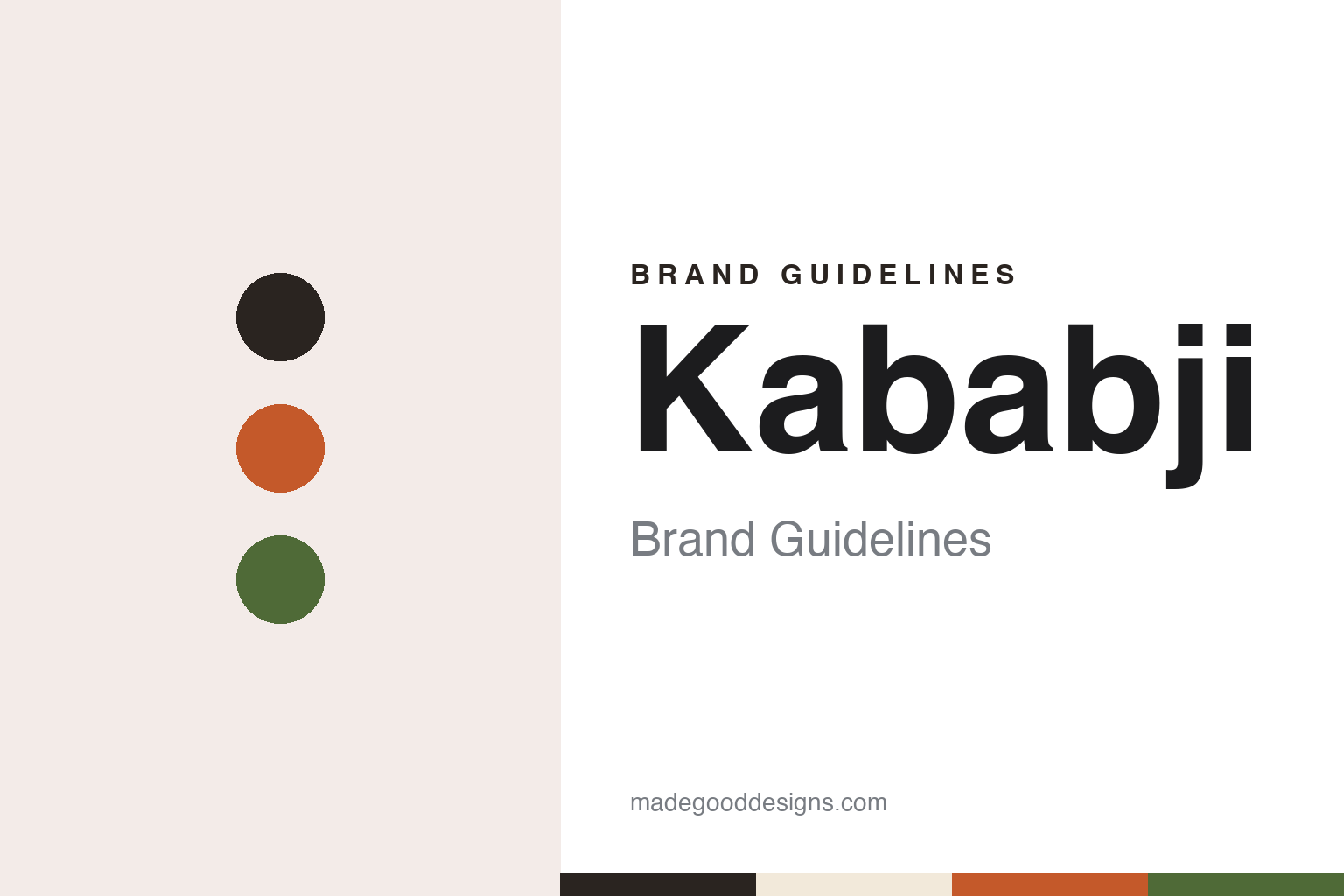
Kababji Brand Guidelines
The Beirut charcoal grill chain founded in 1993.
Aa
Two constants: a charcoal, ember and parsley palette and a warm grill serif register. Abstract homage — not a Kababji product or mark; no logo, sign or packaging is reproduced.
Beirut, 1993
A grill restaurant that became a chain.
Kababji is a Lebanese grill restaurant chain that began in Beirut in 1993. The year comes from the company and is repeated in dated trade coverage: the Gulf retail title RetailME wrote in May 2023 that Kababji had opened its first restaurant in Beirut in 1993, and the UAE trade magazine Hotel & Catering gave the same year in January 2024. The founder is Toufic Khoueiri, who addressed guests as founder at the opening of a new branch in Baabda in October 2014, according to the Lebanese food site NoGarlicNoOnions.
At that opening Khoueiri described Kababji as “a traditional Lebanese and Mediterranean fast casual dining concept.” The Baabda branch, which opened on 23 October 2014, was also where the chain unveiled a new image, NoGarlicNoOnions reported, with stations set up through the restaurant to show guests its ingredients and its way of taking food from the grill to the table. By then the brand was about twenty years old, and the report described a menu that had changed over the years alongside the look.
In Lebanon the chain is built on branches in Beirut and its suburbs along the coast and in the hills above it. The company’s Lebanese website, read in November 2026, lists seven: Ashrafieh, Hamra, Jal el Dib, Kaslik, Hazmieh, Mtayleb and Sin el Fil. The same site splits its online presence between a Lebanese and a UAE edition, publishes separate dine-in, express and delivery menus, and takes orders through a short hotline number and an app.
Colour
A fund in 2014, a Gulf franchise in 2015.
The ownership changed in 2014. The Lebanese business publication Business News reported in November 2014 that Khoueiri, then chief executive, said he had sold 70 percent of the company’s shares to a fund called Kababji Investment Company. The fund was structured by Lucid Investment Corporation, a Lebanese financial firm, and the money was raised together with MedSecurities, the brokerage subsidiary of BankMed. Negotiations began in 2012 and the deal was completed by mid-2014, the publication reported. At the time the chain had just opened outlets in Hazmieh and in Downtown Beirut.
The Gulf came next. Kababji’s Middle East master franchisee is eathos, a food and beverage company based in Dubai that writes its name in lower case. RetailME reported in May 2023 that eathos opened its first franchised Kababji in Dubai in 2015. In February 2016 the same title reported two full-service restaurants trading at Dubai Marina Promenade and Al Ghurair Centre, and said the first Kababji Express outside Lebanon, a fast-service counter format, would go into the food court of The Galleria on Al Maryah Island in Abu Dhabi. By May 2023, RetailME reported, that Galleria counter had been turned into a casual dine-in restaurant, the second such Kababji in Abu Dhabi.
Gulf News reviewed the Dubai restaurants in July 2016 under the headline “Kababji Grill sure knows its grills,” describing a Lebanese chain “with a legacy of more than 20 years” and branches in Dubai Marina and Al Rigga. Its reviewer singled out fattoush and moutabel, hummus topped with beef and pine nuts, the Raheb salad of charcoal-grilled eggplant with tomato, pepper and parsley, and a mixed grill with “a gentle smokiness.” In January 2024 Hotel & Catering reported a fifth UAE branch, on The Beach at Jumeirah Beach Residence, with an open charcoal grill and a brick oven placed in view of diners and a breakfast menu of manakeesh. In the Gulf coverage the restaurants trade as Kababji Grill or Kababji Lebanese Grill.
Typography
How the region’s chains present themselves.
The fast-food chains of Saudi Arabia, the United Arab Emirates and Lebanon include several that began as a single restaurant in one city. ALBAIK dates itself to a Jeddah chicken shop opened in 1974 and took its present name in 1986; Kudu opened its first sandwich counter in Riyadh in April 1988. Their histories are told in two places: the companies’ own “our story” pages, and the business press of the Gulf and beyond.
What the companies publish about themselves is often bilingual: ALBAIK’s and Kudu’s websites, for example, run in English and Arabic, with the name set in Latin capitals. Menus are presented by named dishes and meals rather than by price lists: fried-chicken meals and garlic sauce, made-to-order sandwiches and burgers, shawarma wraps, falafel, man’oushe flatbreads and mixed grills, depending on the chain. Open kitchens, drive-throughs, food-court counters and petrol-station units appear as formats in their own right.
Restaurant networks are often counted by the companies themselves, so the numbers change with the date of the page. Expansion abroad often runs through partners: ALBAIK entered the UAE in 2021 with an Abu Dhabi operator, and Kudu opened its first franchise outside Saudi Arabia, in Kuwait, in 2026. Ownership can change too: Kudu passed from family ownership to private-equity investors in 2015 and to a regional investment group in 2022.
This guide sets out what can be checked about each chain — who founded it, who owns it, where it trades and which dishes it names — and attributes what rests only on the company’s word. The palettes and typefaces shown are unofficial interpretations, and no logo, sign or packaging is reproduced.
Aa
A warm serif for a grill house. (Specimen set in Fraunces, a serif STAND-IN; NOT the Kababji logo.)
Kababji
Charcoal, bread and three formats.
Kababji’s visible identity is the grill itself. Across the dated coverage the same elements return: a charcoal grill in sight of the room, bread baked on site, mezze served beside grilled meat, and a format that stretches from a sit-down restaurant to an express counter and a delivery menu. The company’s own website, read in November 2026, describes “a vibrant open-kitchen and grill setting” with charcoal grills, mezze and freshly baked bread, which matches what Hotel & Catering described at the Jumeirah Beach Residence branch in 2024.
The Baabda opening of October 2014 is the documented moment when the look changed. Twenty years after the first restaurant, the chain said it was modernising its image, its restaurants and its offering, NoGarlicNoOnions reported, and Khoueiri said the aim was to keep up with trends and with customers’ habits while remaining a traditional Lebanese concept. Khoueiri presented the branch as one of several changes being applied across the network.
The result is a two-centre brand. At home it is a network of branches around Beirut, from Hamra and Ashrafieh to Kaslik and Mtayleb. In the Emirates it is a franchise run by eathos since 2015, with full restaurants in malls and on the waterfront and Kababji Express as the smaller counter format. Counts move with each opening: as of January 2024 the UAE business had five branches, according to Hotel & Catering, and as of November 2026 the Lebanese website listed seven branches in Lebanon. The name stays the same across both, while in the trade coverage of their openings the Gulf restaurants appear as Kababji Grill or Kababji Lebanese Grill.
For a design guide, Kababji shows how one Lebanese grill name can be carried across dine-in rooms, food-court counters and delivery menus in two countries. Compare Zaatar w Zeit, another Beirut chain that grew beyond Lebanon, and Barbar, another Beirut restaurant name in this series. For this guide we use charcoal, ember, parsley green and flatbread cream with a serif, an unofficial interpretation; no product or logo is reproduced.
Explore & save
Keep Kababji’s identity on hand — save it to a board in the Made Good inspiration library.
Kababji identity set
Pin the Kababji charcoal, ember and parsley palette and the warm grill serif register to your own board.
Source & notes
Frequently Asked Questions
What font can I use to match the Kababji look?
This guide describes Kababji’s type as “A warm serif for a grill house”. Its type specimen is set in Fraunces from Google Fonts as a stand-in; Fraunces is not Kababji’s own lettering.
What colours are in the Kababji palette?
This guide’s Kababji palette is Charcoal #2A2420, Ember #8A3816, Parsley green #4F6A37, Flatbread cream #F2E9DA and Paper #FAF6F0. The tones are the guide’s own unofficial interpretation, not official Kababji hex codes.
When was Kababji founded?
Kababji was founded in 1993, in Beirut, Lebanon. Kababji is known for Charcoal grills, mezze, Kababji Express.
Who founded Kababji?
Kababji was founded by Toufic Khoueiri in 1993. Kababji is known for Charcoal grills, mezze, Kababji Express.


