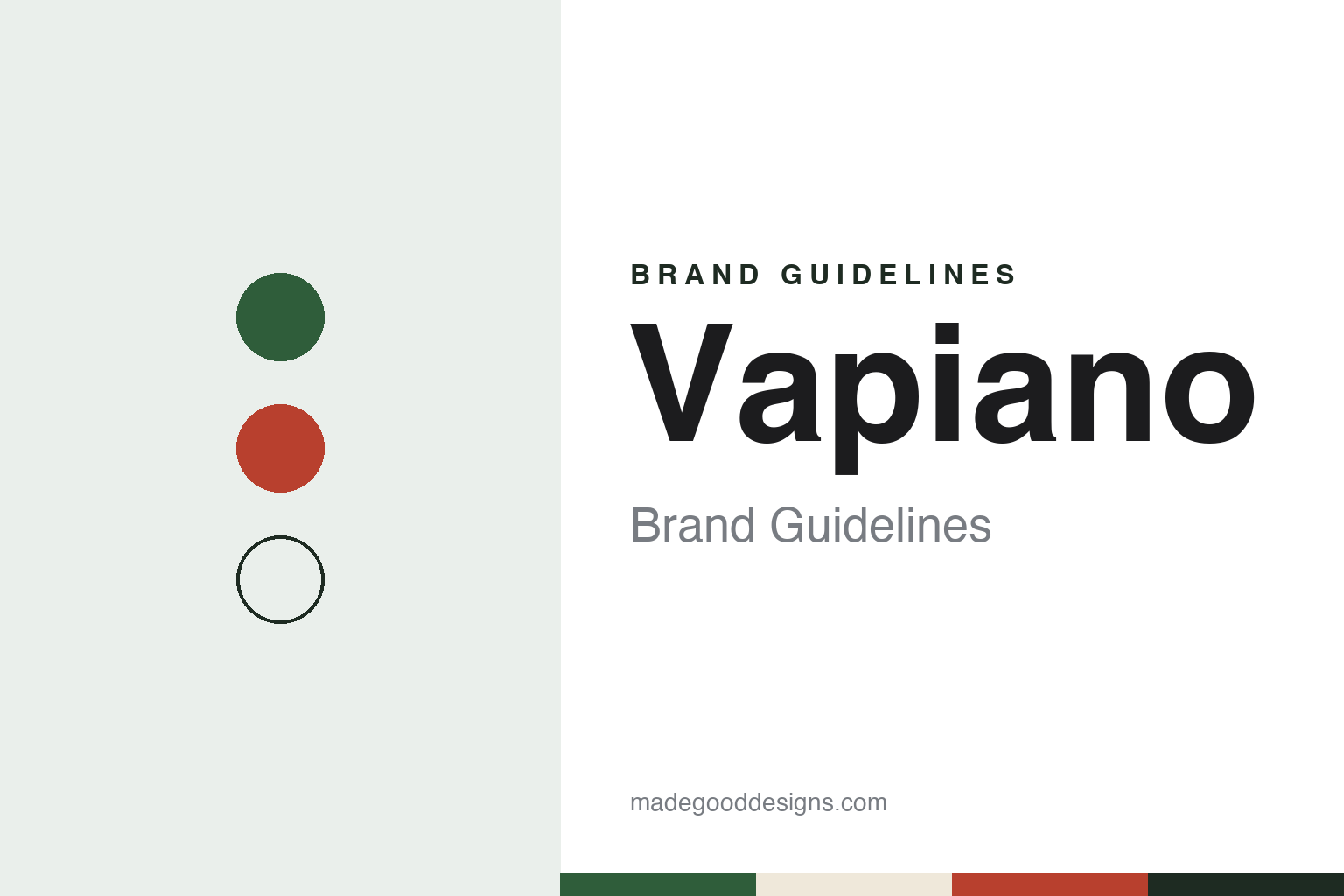
Vapiano Brand Guidelines
The Hamburg pasta counter named after a slow Italian proverb.
Aa
Two constants: a basil, tomato and semolina palette and a clean sans register. Abstract homage — not a Vapiano product or mark; no logo, menu or interior is reproduced.
Hamburg, 2002
A made-up word from an old proverb.
Vapiano began in Hamburg. The first restaurant opened on 22 October 2002, the company says, in the city’s Neustadt district, where English Wikipedia says Mark Korzilius opened it. A month later the business was entered in the commercial register as a German joint-stock company called Mark’s AG; it took the name Vapiano AG at the end of 2003, according to English and German Wikipedia. The interior was designed by the South Tyrolean architect and designer Matteo Thun, German Wikipedia says.
The name is invented. The company says the word “doesn’t actually exist” and that it was built from the Italian proverb Chi va piano, va sano e va lontano, the Italian cousin of “slow and steady.” German Wikipedia breaks it into va, “goes,” and piano, “slowly.” When the German daily Die Welt wrote about the first restaurant in 2002, it described a mix of pasta place, pizzeria, lounge and bar on an Italian model, as German Wikipedia quotes it. Self-service sat at the centre of the idea, and English Wikipedia notes that the company avoided the label fast food.
The Hamburg format was copied quickly. Restaurants followed in Düsseldorf in 2004 and in Frankfurt, Nuremberg and Munich in 2005, and at the end of 2005 the head office moved from Hamburg to Bonn, alongside a new restaurant there. From 2006 the company opened abroad, in Belgium, Austria and Turkey among other places, and worked more and more with franchise partners. English Wikipedia counts more than 30 restaurants in 2008 and about 60 by the end of 2009; the 100th opened in Vienna in 2011. The company became Vapiano SE in September 2008. Its consolidated accounts for 2014 listed 152 restaurants under the brand, 62 of them in Germany, according to English and German Wikipedia. In June 2017 the shares were listed on the Prime Standard segment of the Frankfurt Stock Exchange, German Wikipedia says.
Colour
Concrete floors, long tables, an olive tree.
Vapiano’s identity lives as much in the room as in the logo. English and German Wikipedia list the same recurring elements: a long service counter, exposed-concrete floors, large wooden tables, basket lamps and Italian tile decoration, with a green wall of real plants in newer restaurants. Each restaurant also has an olive tree and pots of herbs, basil and rosemary among them. Restaurants sit mostly in city centres or office districts, and in 2014 the first free-standing Vapiano building went up in Fürth, English Wikipedia says.
The service model was part of the look. Guests were handed a chip card at the door that recorded every dish and drink; the food was cooked in front of them at the counter, they carried it to a table of their choice, and they paid on the way out. German Wikipedia says that since 2021 guests can order from staff, at terminals or on their own phones, with food brought to the table. The franchisor’s website today describes ordering and paying by QR code in many restaurants, and says the guest journey “has evolved from the original chip card.”
The menu is built around pasta. The company says it offers about 14 fresh pasta dishes, with shapes from fusilli and campanelle to linguine and tagliatelle made in each restaurant every day, and it singles out Gamberetti e Spinaci and Carbonara by name, alongside pizza, antipasti, salads and desserts. Germany has gone its own way. In June 2021 Tageskarte, citing WirtschaftsWoche, reported that pizza would leave the German menus in favour of pinsa, a flatbread with a longer-rested dough, with more vegetarian and vegan dishes. On 1 July 2021 Hogapage reported that the pinsa dough was made centrally in Vapiano’s own workshop in Hildesheim, and that 48 German restaurants had been open again since 22 June.
The same Hogapage report showed a reworked Munich restaurant in the Fünf Höfen arcade as “interior concept 3.0”: more space between tables, lounges, bars, open kitchens and pasta workshops, in natural materials and natural tones, with Frankfurt, Stuttgart and Osnabrück named as the next restaurants to be refitted.
Typography
European chains, home and abroad.
Europe’s restaurant chains grew up close to home and then went abroad. The pasta, grill, buffet, pizza, tapas and burger brands in this round come from Germany, France, Spain, Finland and Sweden, and most of them present themselves first through the room: the shopfront, the sign over the door, the counter and the way a guest orders. Vapiano built its look from a long service counter, wooden tables, basket lamps and pots of herbs, and Wienerwald was known for decades for rustic dining rooms built around roast chicken.
Menus are the second layer of identity. The companies name their signature dishes on their own websites, from fresh pasta shapes to grilled chicken, pizza, small sandwiches and burgers, and they change them when they relaunch: Vapiano’s German restaurants swapped pizza for pinsa in 2021, and the new Wienerwald added bowls and vegetarian dishes after its return.
Most of these brands grow through franchising, and their corporate pages explain founders, owners and franchise networks in their own words. Restaurant and country counts change quickly, so this guide gives each one with the date and source it comes from, and separates what independent press reports from what a company says about itself.
Ownership changes are part of the story. Several chains in this group have been sold between families, investors and larger restaurant groups, and some have gone through insolvency: Wienerwald in 1982 and again in the 2000s, Vapiano in 2020. Each guide sets out those events plainly, with dates and outcomes, and says what trades under the name today.
Aa
A clean sans for a counter-service room. (Specimen set in DM Sans, a sans STAND-IN; NOT the Vapiano logo.)
Insolvency and after
Sold in parts, then rebuilt by franchise.
The listed company did not survive 2020. On 20 March 2020 Vapiano SE announced that it was unable to pay its debts after nearly all of its more than 230 restaurants worldwide had closed, including all 55 group-run restaurants in Germany, Hogapage reported that day. Early in April the company applied to the local court in Cologne to open insolvency proceedings, and the proceedings opened with effect from 1 June 2020, Tageskarte reported. The Austrian subsidiary applied for its own restructuring in Vienna on 9 April 2020, German Wikipedia says.
The business was then sold in parts. In late May 2020 a group of investors led by Mario C. Bauer, a former Vapiano board member, bought the restaurants in France and Luxembourg, and on 2 June 2020 the creditors’ committee approved the sale of the main part of the German business, covering 30 Vapiano-run restaurants, to a consortium he led, Tageskarte reported. Its partners, according to the same report, included the Dutch Van der Valk family, one of Vapiano’s early international franchise partners; Henry McGovern, founder of the restaurant operator AmRest; Sinclair Beecham, a co-founder of Pret A Manger; and Gregor Gerlach, an early investor whom Tageskarte calls one of Vapiano’s founders.
In Germany the brand went to a regional operator. A week later Tageskarte, citing the trade magazine Foodservice, reported that the Hildesheim restaurant operator Delf Neumann, whose Gastro & Soul group also runs the Cafe Del Sol restaurants, would run the roughly 30 company-run German restaurants and act as master franchisor for Germany, looking after its 25 franchisees. German Wikipedia names VAP Marketing GmbH of Hildesheim as the company that bought parts of the insolvent estate and carries on the concept.
The international brand is run as a franchise system. The vapiano.com privacy notice names Vapiano Franchising s.r.o., based in Prague, as the controller of enquiries, and as of November 2026 its homepage said the brand had grown to more than 155 restaurants since 2002 and listed countries from Australia, Chile and Colombia to Finland, Saudi Arabia, Spain and the UK. Its 2026 news pages announced restaurants at the Mammut centre in Budapest and at Arkan Plaza in Cairo.
For a design guide, Vapiano shows how a restaurant brand can be carried by a room: counter, concrete, timber, herbs and a made-up Italian word. Compare Pret A Manger, whose co-founder joined the 2020 consortium, and Wienerwald, another German restaurant brand rebuilt after insolvency and now run from Hildesheim. For this guide we use basil green, tomato red and semolina cream with a sans, an unofficial interpretation; no product or logo is reproduced.
Explore & save
Keep Vapiano’s identity on hand — save it to a board in the Made Good inspiration library.
Vapiano identity set
Pin the Vapiano basil, tomato and semolina palette and the clean sans register to your own board.
Source & notes
Frequently Asked Questions
What font can I use to match the Vapiano look?
This guide describes Vapiano’s type as “A clean sans for a counter-service room”. Its type specimen is set in DM Sans from Google Fonts as a stand-in; DM Sans is not Vapiano’s own lettering.
What colours are in the Vapiano palette?
This guide’s Vapiano palette is Basil green #2F5D3A, Herb ink #1E2B22, Pomodoro red #B8402E, Semolina cream #EFE8DA and Concrete grey #BDB8AE. The tones are the guide’s own unofficial interpretation, not official Vapiano hex codes.
When was Vapiano founded?
Vapiano was founded in 2002, in Hamburg, Germany. Vapiano is known for Fresh pasta, open kitchens, long counters.
Who founded Vapiano?
Vapiano was founded by Mark Korzilius (first restaurant) in 2002.


