Wienerwald Brand Guidelines
The Munich roast-chicken house that went from 1,600 restaurants to a fresh start.
Aa
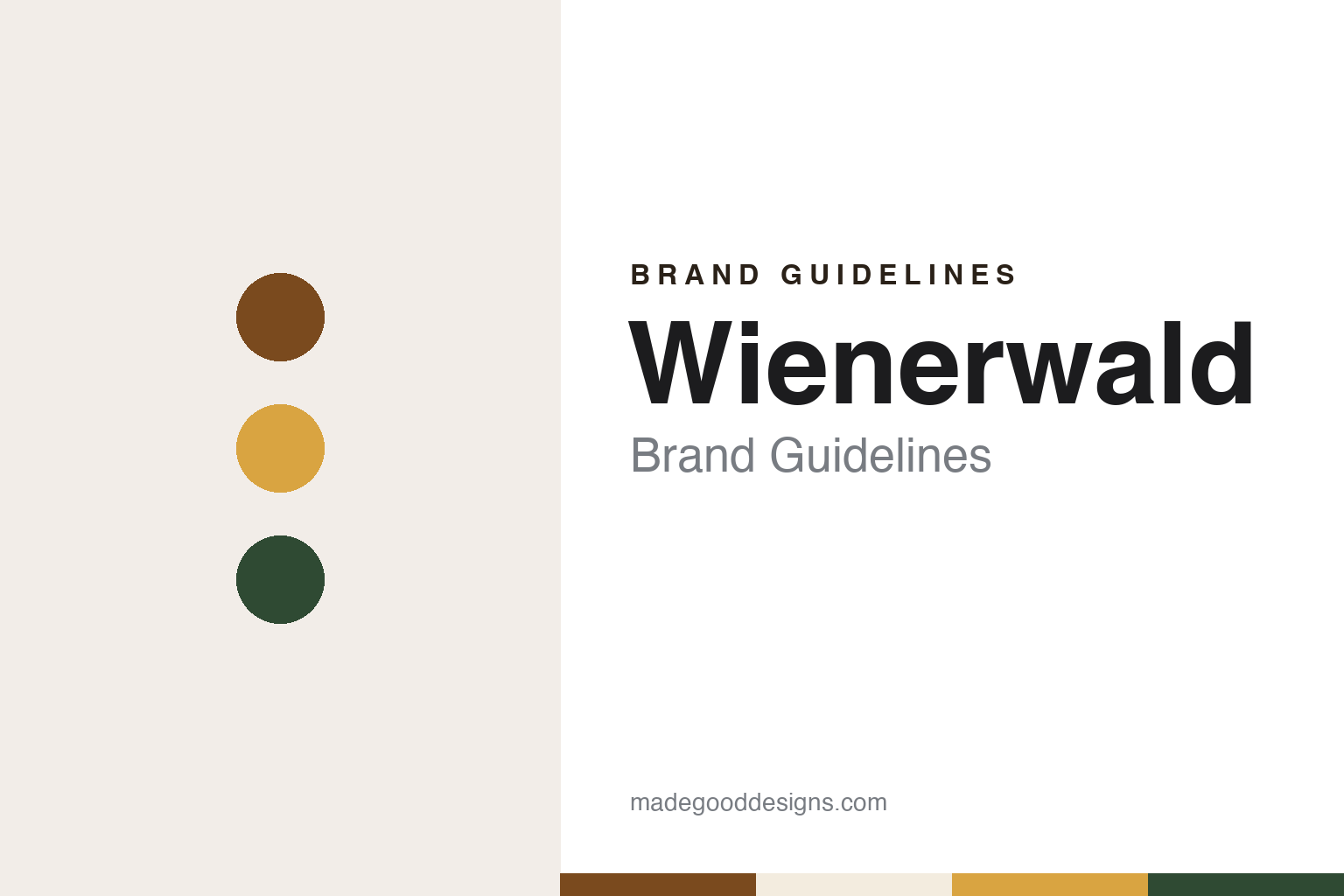
Two constants: a roast brown, forest green and gold palette and a warm serif register. Abstract homage — not a Wienerwald product or mark; no logo, sign or interior is reproduced.
Munich, 1955
A Linz restaurateur and a roast chicken.
Wienerwald began in Munich in 1955. Its founder, Friedrich Jahn, was a restaurateur from Linz, English Wikipedia says, and German Wikipedia places his first restaurant in Munich’s Amalienstraße, trading first as the “Linzer Stube” and then as the “Weinstube zum Wienerwald.” The name means the Vienna Woods, the wooded hills on the edge of the Austrian capital. The dish that carried the chain was roast chicken, the Hendl of southern German and Austrian menus, alongside schnitzel and similar dishes, according to English Wikipedia.
The early restaurants set the tone. German Wikipedia says every branch had a rustic interior and served mainly southern German food, and it ties the chain’s fame to an advertising line that is still printed on the brand’s website today: “Heute bleibt die Küche kalt, wir gehen in den Wienerwald”, roughly “the kitchen stays cold today, we’re going to the Wienerwald.” For a design reader that line is the brand in a sentence: the restaurant as a night off from cooking at home.
Growth was fast and mostly funded by debt. By 1978 the chain had about 700 restaurants in Germany and Austria alone and some 1,600 worldwide with almost 30,000 staff, German Wikipedia says, figures the trade site Tageskarte repeated in 2023. Restaurants and franchises were concentrated in Europe but also reached the Netherlands, the United States, Japan, Australia and South Africa. Around the restaurants Jahn built a wider group: Tourotel and Wienerwald hotels, the kitchen-equipment maker WIWA and the tour operator Jahn Reisen, according to German Wikipedia.
The United States became the costliest step. In 1978 Wienerwald bought the Lum’s chain of 273 restaurants, English Wikipedia says, and German Wikipedia adds a stake in the pancake chain IHOP the same year. English Wikipedia says the company struggled to present itself in the US as a chicken restaurant at all, because American customers read the name as a promise of hot dogs.
Colour
Insolvency, decline and a franchise shell.
The group collapsed in the summer of 1982. On 27 August 1982 Wienerwald-Holding AG filed for insolvency in Switzerland, and on 30 August Wienerwald GmbH in Germany and other group companies followed, according to German Wikipedia; the 880 restaurants in the United States had to be sold, and Jahn Reisen went to the airline LTU the same year. English Wikipedia says the chain recovered afterwards but never regained its former size.
The Austrian and German businesses then went separate ways. In 1986 Jahn sold all the Austrian Wienerwald restaurants to a different owner, English Wikipedia says, and from then on Wienerwald Austria and Wienerwald Germany were distinct companies under the same name.
In Germany the decline came in stages. Wienerwald AG, with 38 restaurants of its own and about 50 franchised ones, applied for insolvency again in 2003; the proceedings ended in 2005, German Wikipedia says, and the company relaunched as “Wienerwald Express”: self-service with seating corners and quick counters instead of table service, alpine styling and folk music, plus a home-delivery service called hendl@home. On 2 April 2007 it applied for insolvency a third time, at the Munich local court. On 1 June 2007 two of Jahn’s daughters bought the brand rights out of the estate, and a new Wienerwald Franchise GmbH, which ran no restaurants itself, signed new franchise contracts with 42 existing restaurants, according to German Wikipedia.
A redesign followed in 2010, when the brand look, interiors and menu were refreshed and delivery and chicken trucks were added. Abroad, a franchise partner opened more than 20 restaurants in Turkey from 2009, nearly all in Istanbul, and two opened in Bucharest in 2011; all of them have since closed, German Wikipedia says. At the end of 2017 the chain had 23 restaurants in Germany, most densely in Bavaria, three in Greater Cairo and one each in Budapest and Dubai, according to English Wikipedia. By early 2022 there were 12 sites, five of them in Munich; a remaining Munich restaurant took another name in mid-2023, and the last Hanover restaurant traded as Wienerwald until the end of 2023, when its right to the name ran out, according to German Wikipedia.
Typography
European chains, home and abroad.
Europe’s restaurant chains grew up close to home and then went abroad. The pasta, grill, buffet, pizza, tapas and burger brands in this round come from Germany, France, Spain, Finland and Sweden, and most of them present themselves first through the room: the shopfront, the sign over the door, the counter and the way a guest orders. Vapiano built its look from a long service counter, wooden tables, basket lamps and pots of herbs, and Wienerwald was known for decades for rustic dining rooms built around roast chicken.
Menus are the second layer of identity. The companies name their signature dishes on their own websites, from fresh pasta shapes to grilled chicken, pizza, small sandwiches and burgers, and they change them when they relaunch: Vapiano’s German restaurants swapped pizza for pinsa in 2021, and the new Wienerwald added bowls and vegetarian dishes after its return.
Most of these brands grow through franchising, and their corporate pages explain founders, owners and franchise networks in their own words. Restaurant and country counts change quickly, so this guide gives each one with the date and source it comes from, and separates what independent press reports from what a company says about itself.
Ownership changes are part of the story. Several chains in this group have been sold between families, investors and larger restaurant groups, and some have gone through insolvency: Wienerwald in 1982 and again in the 2000s, Vapiano in 2020. Each guide sets out those events plainly, with dates and outcomes, and says what trades under the name today.
Aa
A warm serif for a roast-chicken house. (Specimen set in Fraunces, a serif STAND-IN; NOT the Wienerwald logo.)
The Harz restart
New owners, a new room and two restaurants.
The current Wienerwald is a new start in Lower Saxony. The brand rights passed in 2020 to a Hildesheim property developer, Tageskarte reported in November 2023; planning for the interior, kitchen, brand look, menus and website began at the same time, and building work on the first new restaurant started in spring 2022. That restaurant opened on 1 November 2023 in Torfhaus in the Harz mountains, next to a 65-metre wooden observation tower that opened the same day, before about 220 invited guests. Tageskarte wrote that the new Wienerwald had nothing left of the alpine folk charm of earlier decades. German Wikipedia names the Family Brands Operations Company of Hildesheim as the company that took over the brand.
A second restaurant followed in Hildesheim, on the Hohnsensee lake, in premises previously used by another restaurant; its operating company belongs to the Hildesheim-based Lüder group, Tageskarte reported on 3 June 2025. The menu keeps grilled chicken at its centre but adds bowls and vegetarian and vegan dishes, and leaves out pork, according to the same report. Hogapage reported on 10 July 2025 that the opening celebration took place on 3 July with about 220 guests, that the chicken-centred menu drew on ideas from the television chef Frank Rosin, and that the building has an open layout over two levels, a large glass front and a new timber terrace.
The company’s own pages carry the same tone. As of November 2026 the website lists two restaurants, Torfhaus and Hildesheim, names Wienerwald Holding GmbH in Hildesheim in its legal notice, and offers the Wienerwald Bowl, breakfast at Torfhaus and private events; its copy speaks to guests informally, with “Du” throughout.
The Austrian company is a separate story. Bankruptcy proceedings over the Vienna-based Wienerwald restaurant company were opened on 5 August 2025 on a creditor’s application, and about two months later the court ordered the business closed, the Vienna local news site MeinBezirk reported on 26 September 2025; two city-centre restaurants had already shut. The German brand says on its website that it is not affected by the Austrian insolvency.
For a design guide, Wienerwald shows how a name, a dish and an advertising line can outlast several companies. Compare KFC, another chain built on chicken, and Vapiano, a German restaurant brand rebuilt after its own insolvency. For this guide we use roast brown, forest green and a warm gold with a serif, an unofficial interpretation; no product or logo is reproduced.
Explore & save
Keep Wienerwald’s identity on hand — save it to a board in the Made Good inspiration library.
Wienerwald identity set
Pin the Wienerwald roast brown, forest green and gold palette and the warm serif register to your own board.
Source & notes
Frequently Asked Questions
What font can I use to match the Wienerwald look?
This guide describes Wienerwald’s type as “A warm serif for a roast-chicken house”. Its type specimen is set in Fraunces from Google Fonts as a stand-in; Fraunces is not Wienerwald’s own lettering.
What colours are in the Wienerwald palette?
This guide’s Wienerwald palette is Roast brown #7A4A1E, Forest green #2F4A33, Hendl gold #D9A441, Timber dark #2A2118 and Linen #F3ECDF. The tones are the guide’s own unofficial interpretation, not official Wienerwald hex codes.
When was Wienerwald founded?
Wienerwald was founded in 1955, in Munich, Germany. Wienerwald is known for Roast chicken (Hendl), franchise restaurants.
Who founded Wienerwald?
Wienerwald was founded by Friedrich Jahn in 1955. Wienerwald is known for Roast chicken (Hendl), franchise restaurants.