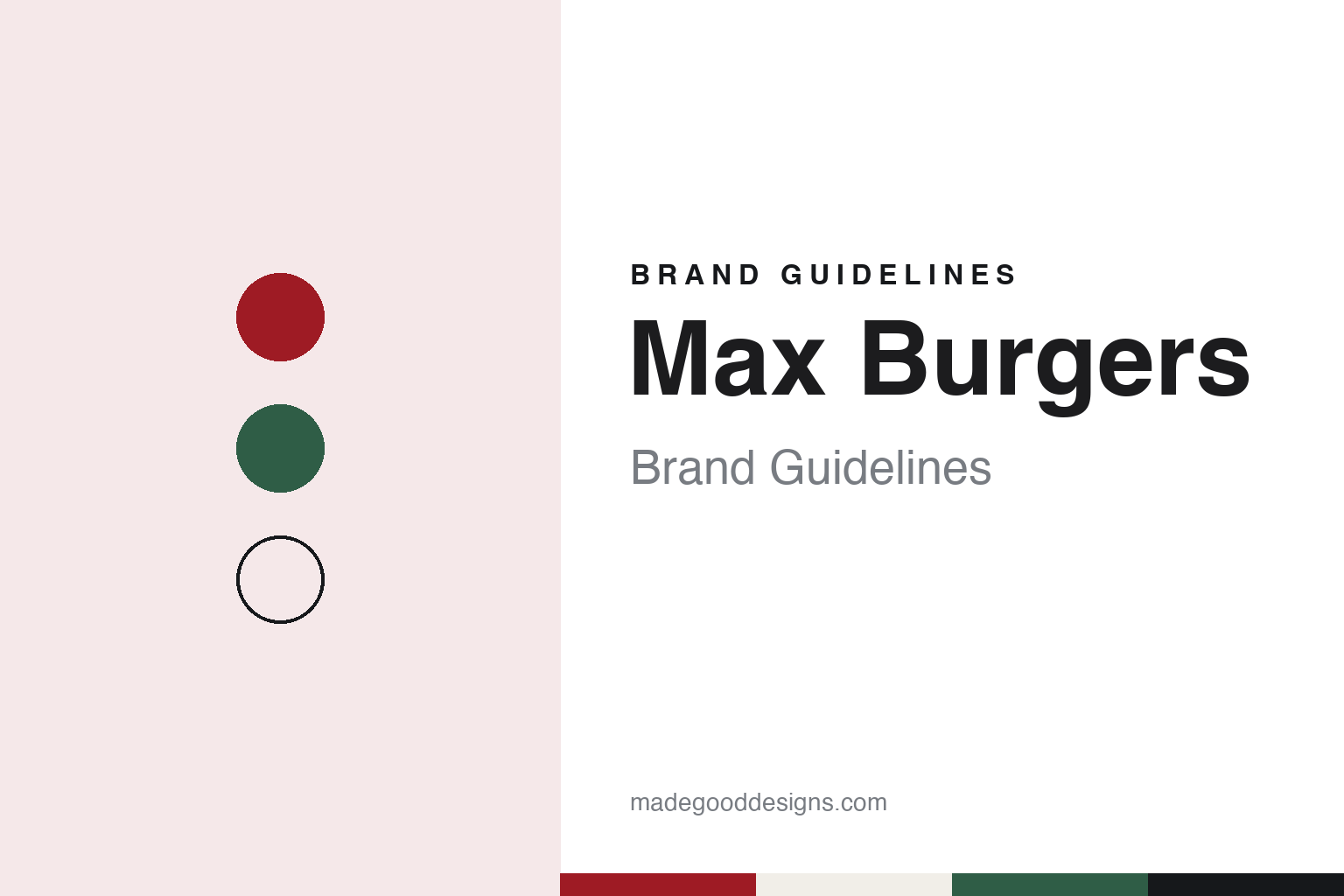
Max Burgers Brand Guidelines
The Swedish chain born at a Gällivare petrol station in 1968.
Aa
Two constants: a red, birch white and pine green palette of our own and a condensed sans register. Abstract homage — not a Max Burgers product or mark; no logo, packaging or menu board is reproduced.
X-grillen
A grill kiosk at a petrol station in Lapland.
Max began in 1968 in Gällivare, a mining town in Swedish Lapland, north of the Arctic Circle. English and Swedish Wikipedia name its founders as Curt Bergfors and Britta Fredriksson. Swedish Wikipedia describes the first outlet as a grill kiosk called X-grillen, set in the eastern end of an Uno-X petrol station in the town, selling fast food through a window.
The name came two years later. Swedish Wikipedia dates the change from X-grillen to Max to 1970, and both Wikipedias say the new name was Curt Bergfors’s own nickname, which he had picked up from the actor Max von Sydow; English Wikipedia cites the Luleå newspaper Norrbottens-Kuriren in 2023 for that detail. The second and third restaurants opened in Skellefteå and on Midgårdsvägen in Luleå, Swedish Wikipedia says. The Skellefteå restaurant, opened in 1970, kept the X-grillen name and is still run by the company with its own menu, a small survival of the original brand inside the chain.
For its first decades Max was a northern business. English Wikipedia says that until the 1980s it was a chain of the Norrland region, with only one restaurant outside it: a two-storey site on Drottninggatan in Stockholm, which Swedish Wikipedia dates to 1982. Over the same years the family firm tried other trades in the north, Swedish Wikipedia records, including a hotel in Luleå in 1983 and later hotel purchases in the city; it sold the hotel business in 1999 to concentrate on hamburgers.
The company is still owned by the founding family. Its formal name today is Max Burgers AB, previously Max Hamburgerrestauranger AB, with its registered seat and head office in Luleå and an office in Stockholm, Swedish Wikipedia says; it sits within a group whose parent is Max Hotell- och restauranginvest AB. Curt Bergfors’s son Richard Bergfors has been president since 2002, English Wikipedia says, with his brother Christoffer Bergfors as deputy chief executive.
Colour
From Norrland to the whole of Sweden.
National expansion came in the 1990s, when Max became a chain across Sweden, English Wikipedia says. The pace quickened after 2005: the same source counts around 85 Swedish restaurants in 2011, against about 40 five years earlier, with much of the growth in western Sweden. Swedish Wikipedia dates the 100th Swedish restaurant, at Lidingö outside Stockholm, to January 2015.
In May 2025 the business magazine Dagens PS met Richard Bergfors at the Max restaurant on Kungsgatan in Stockholm, the address where McDonald’s opened its first Swedish restaurant on 27 October 1973. When McDonald’s left the site, Max took it over.
In the same interview Bergfors described how the chain runs. “90–95 percent of our operations are governed by manuals,” he told Dagens PS, calling that the only way to scale quality, and comparing the model to an airline’s systems more than to a traditional restaurant. The magazine put the chain at 193 restaurants in five countries and about 8,000 employees in May 2025.
Max also has a long-running local streak. Swedish Wikipedia notes that some restaurants have added regional burgers to the standard menu: a lamb burger in Visby on Gotland, a “göteborgare” topped with a west-coast seafood salad in Partille, near Gothenburg, and a “Bureburgare” with cucumber salad in Skellefteå. The company has also put some of its products into Swedish grocery shops, including frozen chicken dishes made with the poultry producer Kronfågel from 2014 and chilled dressings from 2013, according to Swedish Wikipedia, citing the company’s announcements.
Typography
Design and documentation.
Europe’s restaurant chains grew up close to home and then went abroad. The pasta, grill, buffet, pizza, tapas and burger brands in this round come from Germany, France, Spain, Finland and Sweden, and most of them present themselves first through the room: the shopfront, the sign over the door, the counter and the way a guest orders. Vapiano built its look from a long service counter, wooden tables, basket lamps and pots of herbs, and Wienerwald was known for decades for rustic dining rooms built around roast chicken.
Menus are the second layer of identity. The companies name their signature dishes on their own websites, from fresh pasta shapes to grilled chicken, pizza, small sandwiches and burgers, and they change them when they relaunch: Vapiano’s German restaurants swapped pizza for pinsa in 2021, and the new Wienerwald added bowls and vegetarian dishes after its return.
Most of these brands grow through franchising, and their corporate pages explain founders, owners and franchise networks in their own words. Restaurant and country counts change quickly, so this guide gives each one with the date and source it comes from, and separates what independent press reports from what a company says about itself.
Ownership changes are part of the story. Several chains in this group have been sold between families, investors and larger restaurant groups, and some have gone through insolvency: Wienerwald in 1982 and again in the 2000s, Vapiano in 2020. Each guide sets out those events plainly, with dates and outcomes, and says what trades under the name today.
Aa
A condensed sans for a tall, compact menu voice. (Specimen set in Barlow Condensed, a sans STAND-IN; NOT the Max logo.)
Max Burgers
A Luleå family firm abroad.
Max moved beyond Sweden in the 2010s. In November 2011 the Oslo news site NewsInEnglish.no, citing Dagens Næringsliv, reported that the chain had opened its first Norwegian outlet in Oslo that spring, at Egertorget in a site that had previously been a Burger King; English Wikipedia dates that opening to 11 May 2011. Denmark followed on 1 March 2013, with a restaurant on Gammeltorv beside the Strøget shopping street in Copenhagen, according to Swedish Wikipedia.
In Poland the chain trades as Max Premium Burgers. The Warsaw property-trade publication Eurobuild CEE reported in March 2018 that the company had made its Polish debut in 2017 with a restaurant in Wrocław, and was then preparing sites in Gdańsk and Warsaw. Further afield, Max has worked through franchise partners: Swedish Wikipedia says a small number of Max restaurants traded in the United Arab Emirates under franchise between 2012 and 2018, and English Wikipedia names the Landmark Group as the operator of the first Dubai restaurants in 2013 and records franchised restaurants in Egypt.
English Wikipedia’s count from December 2024, taken from the company’s country websites, gives 155 restaurants in Sweden, 26 in Poland, eight in Norway and six in Denmark. Those figures sit close to the 193 restaurants in five countries that Dagens PS reported in May 2025, and both should be read as dated snapshots rather than a fixed total. The company that owns the brand is still run from Luleå by the family that started it in a Gällivare grill kiosk, English and Swedish Wikipedia say.
For a design guide, Max Burgers shows how a regional chain can keep a short founder’s nickname as its whole name while it grows into new countries, and even keep its first name alive in one Skellefteå restaurant. Compare Hesburger, the family-owned Finnish chain that also grew out of a grill kiosk, and Burger King, whose former Oslo site became Max’s first Norwegian restaurant. For this guide we use a deep red, birch white and pine green with a condensed sans, an unofficial interpretation; no product or logo is reproduced.
Explore & save
Keep Max Burgers’s identity on hand — save it to a board in the Made Good inspiration library.
Max Burgers identity set
Pin the Max Burgers red, birch white and pine green palette and the condensed sans register to your own board.
Source & notes
Frequently Asked Questions
What font can I use to match the Max Burgers look?
This guide describes Max Burgers’ type as “A condensed sans for a tall, compact menu voice”. Its type specimen is set in Barlow Condensed from Google Fonts as a stand-in; Barlow Condensed is not Max Burgers’ own lettering.
What colours are in the Max Burgers palette?
This guide’s Max Burgers palette is Deep red #9E1B24, Night ink #16181B, Birch white #F1EEE8, Pine green #2F5D46 and Paper #F8F7F4. The tones are the guide’s own unofficial interpretation, not official Max Burgers hex codes.
When was Max Burgers founded?
Max Burgers was founded in 1968 (as X-grillen; Max from 1970), in Gällivare, Sweden.
Who founded Max Burgers?
Max Burgers was founded by Curt Bergfors and Britta Fredriksson in 1968 (as X-grillen; Max from 1970).