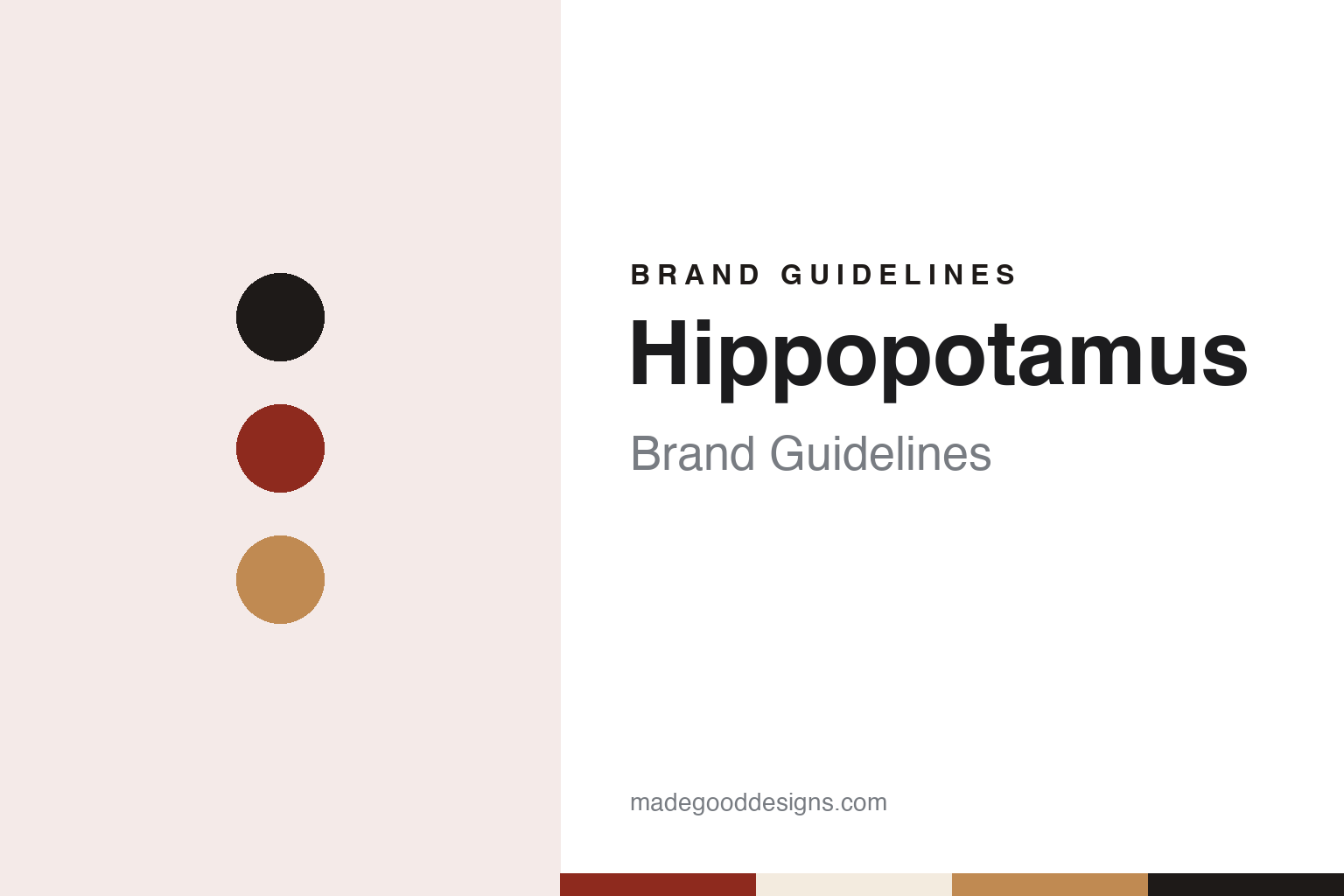
Hippopotamus Brand Guidelines
The 1968 Paris grill chain owned by Groupe Bertrand since 2017.
Aa
Two constants: an ember red, charcoal and oak palette and a steakhouse serif register. Abstract homage — not a Hippopotamus product or mark; no logo, sign or menu is reproduced.
Paris, 1968
A grill restaurant near the Champs-Élysées.
Hippopotamus started in Paris in 1968. French Wikipedia, citing a 2018 article in the Journal du dimanche, says Christian Guignard opened a first grill restaurant not far from the Champs-Élysées that year; English Wikipedia dates the opening to the middle of 1968.
The first restaurant was built around a single dish and a piece of theatre. French Wikipedia describes a côte de bœuf served on a thick wooden board, to be carved at the table with a very sharp knife, with thin matchstick fries on the side. English Wikipedia adds that later changes included vegetarian dishes, menus in Braille and green beans as a side.
The animal gave the brand its name and, for half a century, its emblem. English Wikipedia describes Hippopotamus as a chain of grill restaurants with a hippopotamus as its logo; French Wikipedia records that the historic hippopotamus was taken out of the logo only in 2018.
French Wikipedia says the company that runs it today was registered on 9 March 1982, and gives its head office as Levallois-Perret, just outside Paris. By 1992, it says, Hippopotamus had 15 restaurants.
That year the chain changed hands. French Wikipedia says Groupe Flo, the Paris restaurant group then led by Jean-Paul Bucher and known for its brasseries, bought the whole of Hippopotamus’s capital in 1992; English Wikipedia dates the purchase of its assets to February 1992. Under Flo the chain went abroad: French Wikipedia says the first restaurant outside France opened in Istanbul in 2000, and that the 100th Hippopotamus opened in 2007.
Colour
From Groupe Flo to Groupe Bertrand.
In 2017 Groupe Flo was in difficulty, the Journal de l’Économie reported on 26 April that year, when it wrote that Groupe Bertrand would take over Groupe Flo through a capital increase, and that trading in Flo’s listed shares had been suspended since 7 April.
The deal needed the approval of France’s competition authority. The Autorité de la concurrence said in a statement of 23 May 2017 that Groupe Bertrand had notified it on 26 April of its plan to take exclusive control of Groupe Flo. It described Bertrand as the operator of Burger King and Quick fast-food restaurants in France, of the Au Bureau and Café Leffe chains and of Paris brasseries including Lipp, with about 650 restaurants in all; Flo had about 300 restaurants, under names including Hippopotamus, Tablapizza, Taverne de Maître Kanter and Bistro Romain. After an accelerated review, the authority authorised the deal on 23 May 2017, finding that it did not harm competition; it noted that the two groups competed in commercial restaurants in France but that many rival restaurants operated close to theirs.
The authority also explained its timing. It said it had decided in 17 working days rather than the usual 25, because the takeover agreements had been signed as part of a conciliation procedure and needed to be approved by the commercial court of Nanterre. Groupe Flo’s own statement linked the takeover to an agreement of 25 April 2017 to restructure the group’s bank debt.
That statement also set out what Bertrand was buying. Groupe Flo, listed on Euronext Paris, described itself as a group of about 270 restaurants, owned or franchised, working in three areas: themed restaurants, with Hippopotamus, Tablapizza, Taverne de Maître Kanter and Bistro Romain; concessions; and brasseries.
The takeover closed the following month. In a statement dated 16 June 2017 and filed through France’s official financial-information service, Groupe Flo announced that Groupe Bertrand had taken control that day, and that a new head of Hippopotamus would run a network of about 180 restaurants.
Sources describe the ownership in slightly different ways. English Wikipedia still says the brand belongs to Groupe Flo; French Wikipedia says it belongs to Groupe Flo, majority-owned by Groupe Bertrand, and names Groupe Bertrand as shareholder of the operating company. The brand’s own website, in November 2026, links to Bertrand Franchise for franchising and jobs and runs its loyalty scheme through the group’s La Bonne App.
Typography
Chains, owners and documentation.
Europe’s restaurant chains grew up close to home and then went abroad. The pasta, grill, buffet, pizza, tapas and burger brands in this round come from Germany, France, Spain, Finland and Sweden, and most of them present themselves first through the room: the shopfront, the sign over the door, the counter and the way a guest orders. Vapiano built its look from a long service counter, wooden tables, basket lamps and pots of herbs, and Wienerwald was known for decades for rustic dining rooms built around roast chicken.
Menus are the second layer of identity. The companies name their signature dishes on their own websites, from fresh pasta shapes to grilled chicken, pizza, small sandwiches and burgers, and they change them when they relaunch: Vapiano’s German restaurants swapped pizza for pinsa in 2021, and the new Wienerwald added bowls and vegetarian dishes after its return.
Most of these brands grow through franchising, and their corporate pages explain founders, owners and franchise networks in their own words. Restaurant and country counts change quickly, so this guide gives each one with the date and source it comes from, and separates what independent press reports from what a company says about itself.
Ownership changes are part of the story. Several chains in this group have been sold between families, investors and larger restaurant groups, and some have gone through insolvency: Wienerwald in 1982 and again in the 2000s, Vapiano in 2020. Each guide sets out those events plainly, with dates and outcomes, and says what trades under the name today.
Aa
A heavy, warm display serif for a grill-room menu. (Specimen set in DM Serif Display, a serif STAND-IN; NOT the Hippopotamus logo.)
Hippopotamus
A steakhouse without the hippo.
The new owner moved quickly on the brand. French Wikipedia, citing the Journal du dimanche of September 2018, says that in 2018 Hippopotamus began a transformation of both brand and network: new menus, a new visual identity from which the brand’s historic hippopotamus disappeared, and a new restaurant concept called the “Steak House à la française” — a French-style steakhouse.
That phrase now heads the brand. In November 2026 its website calls Hippopotamus “Le steakhouse à la française” and says its cuts of beef are cooked over embers, “à la braise.” Its autumn and winter 2026 menu, as listed on the site, includes roasted marrow bone with toast, an Argentine rib-eye cut and fries topped with melted Saint-Nectaire cheese and beef bacon.
The network has stayed largely French. English Wikipedia, citing the brand’s restaurant finder, says that as of November 2025 Hippopotamus had 99 locations, in France and in Côte d’Ivoire; French Wikipedia describes the chain as present mainly in France.
For a design guide, Hippopotamus shows how a chain can drop its own mascot and keep its name, letting a serif word and a cooking method carry the identity. Compare Burger King, which Groupe Bertrand runs in France, and Courtepaille, another French restaurant chain. For this guide we use ember red, charcoal and oak with a serif, an unofficial interpretation; no product or logo is reproduced.
Explore & save
Keep Hippopotamus’s identity on hand — save it to a board in the Made Good inspiration library.
Hippopotamus identity set
Pin the Hippopotamus ember red, charcoal and oak palette and the steakhouse serif register to your own board.
Source & notes
Frequently Asked Questions
What font can I use to match the Hippopotamus look?
This guide describes Hippopotamus’ type as “A heavy, warm display serif for a grill-room menu”. Its type specimen is set in DM Serif Display from Google Fonts as a stand-in; DM Serif Display is not Hippopotamus’ own lettering.
What colours are in the Hippopotamus palette?
This guide’s Hippopotamus palette is Ember red #8E2A1E, Charcoal #1E1A18, Oak board #C08A52, Bone #F3EBDF and Paper #FAF7F2. The tones are the guide’s own unofficial interpretation, not official Hippopotamus hex codes.
When was Hippopotamus founded?
Hippopotamus was founded in 1968, in Paris, France. This guide lists Groupe Flo (1992), Groupe Bertrand (2017) as its owner.
Who founded Hippopotamus?
Hippopotamus was founded by Christian Guignard in 1968. This guide lists Groupe Flo (1992), Groupe Bertrand (2017) as its owner.
Who owns Hippopotamus?
Hippopotamus is owned by Groupe Flo (1992), Groupe Bertrand (2017).