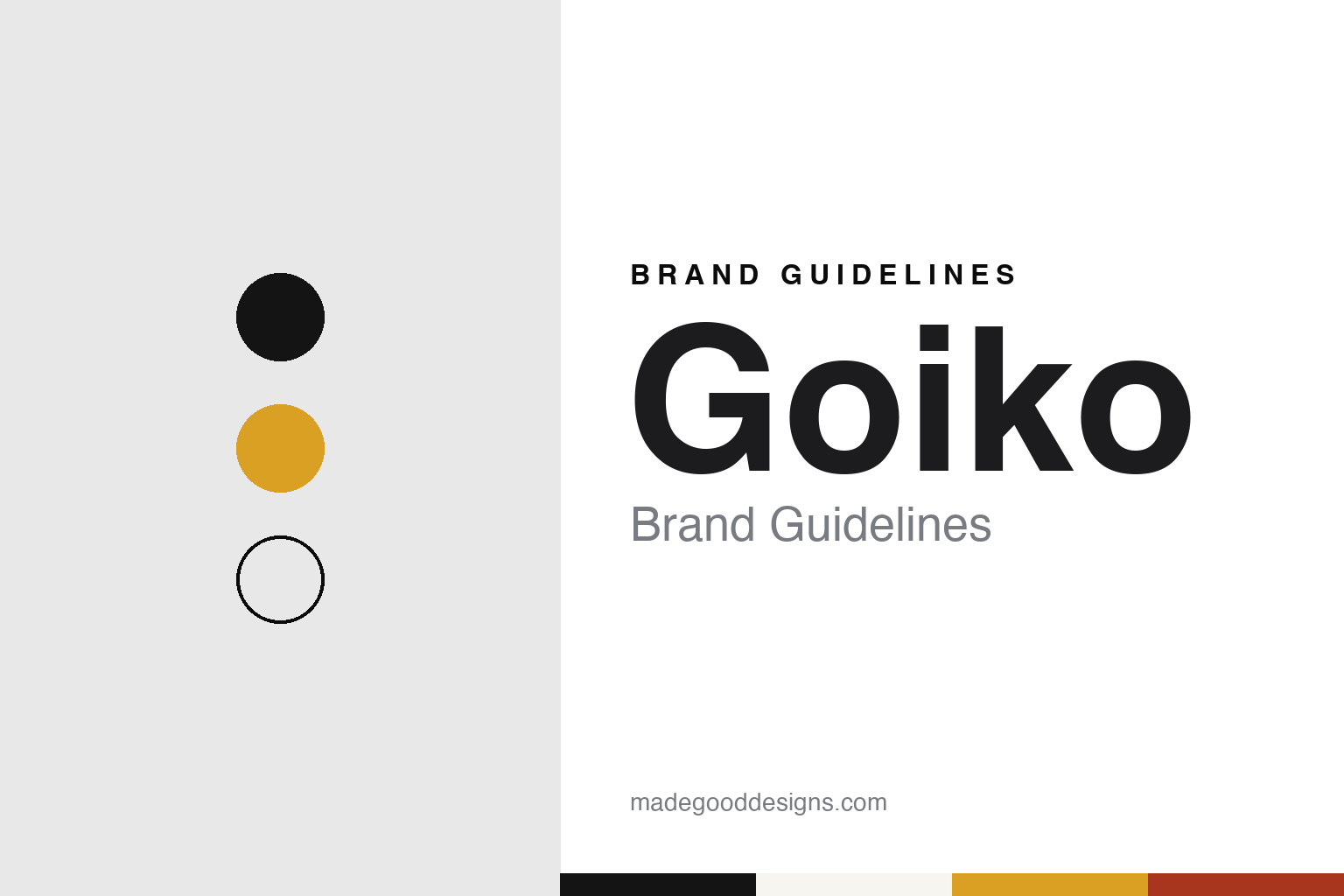
Goiko Brand Guidelines
The Madrid burger bar that turned a drip into a brand.
Aa
Two constants: a black, white and mustard palette and a tall condensed sans register. Abstract homage — not a Goiko product or mark; no menu, logo or sign is reproduced.
María de Molina
A 30-seat burger bar in Madrid.
Goiko began as Goiko Grill, a single burger restaurant on Calle de María de Molina in Madrid. The trade site Reason Why, reporting the company’s 2019 rebrand, dated the opening to January 2013 and quoted the company describing the original site as a small room with 30 seats; La Razón also gave January 2013 in 2022, while Cinco Días wrote in 2018 that the company was founded in 2012. The founder is Andoni Goicoechea, a Venezuelan of Basque descent, according to Cinco Días and ABC.
The family shaped the opening menu. Goicoechea told ABC in 2017 that he had borrowed some money and designed the restaurant’s menu with his father and his sister, aiming for a gourmet burger bar “as if it were at home”. The paper described Spanish and Venezuelan tastes meeting on the menu, as in the Camburger, made with fried plantain and goat’s cheese, and called the Kevin Bacon the house’s star burger.
Growth came quickly and, at first, without franchising. ABC reported in 2017 that Goiko Grill did not franchise its restaurants, and Cinco Días reported in June 2018 that the company ran only its own restaurants, 42 of them, in cities including Madrid, Valencia, Barcelona, Seville and Oviedo. Each new opening, ABC wrote, came with a burger of its own designed by the local staff; in Alicante in 2017 it was the Sabrosona.
By November 2022 the business had grown well beyond that first room. La Razón reported then that Goiko had more than 2,000 employees and 105 restaurants in Spain and France, had launched its own delivery platform, and was selling its burgers, breads and sauces through the El Corte Inglés department stores.
Colour
Black, tall and dripping.
The identity was redrawn in 2019. Reason Why reported on 2 December 2019 that Goiko Grill had become GOIKO, shortening the name because customers had been using the single word anyway. Dropping “Grill” carried a risk, the company told the site: the word Goiko on its own could mean anything. So it created a symbolic logo meant to be associated directly with burgers, and added the drip, the “chorreo” that runs through the company’s own copy.
Colour and lettering changed too. Reason Why said Goiko had chosen black and a simple, tall typeface to suggest a premium product, and that the new identity had been developed by the company’s in-house team, which designed each element. The site reported that the rollout across the 78 restaurants then open would be gradual, starting with Boadilla del Monte and Alcorcón near Madrid and Badalona in Catalonia.
Staff saw the new look before customers did. According to Reason Why, the founder first showed the rebrand to employees at the Goiko Games in October 2019, an annual company event for which all the restaurants close for the day. La Razón reported in 2022 that the fifth edition of the event had drawn 1,800 people.
The brand voice is playful and bilingual. The company’s website, read in November 2026, mixes Spanish and English: menu sections are called “Chicken lovers” and “Smash Burgers”, the starters are headed “To share or not to share”, and the drip returns as a recurring word. The Kevin Bacon still heads the burger list, beside newer specials such as Tres Razas. The site also promotes two branded food trucks and Goikocina, a line that sells the company’s ingredients for cooking at home.
Typography
Design and documentation.
Europe’s restaurant chains grew up close to home and then went abroad. The pasta, grill, buffet, pizza, tapas and burger brands in this round come from Germany, France, Spain, Finland and Sweden, and most of them present themselves first through the room: the shopfront, the sign over the door, the counter and the way a guest orders. Vapiano built its look from a long service counter, wooden tables, basket lamps and pots of herbs, and Wienerwald was known for decades for rustic dining rooms built around roast chicken.
Menus are the second layer of identity. The companies name their signature dishes on their own websites, from fresh pasta shapes to grilled chicken, pizza, small sandwiches and burgers, and they change them when they relaunch: Vapiano’s German restaurants swapped pizza for pinsa in 2021, and the new Wienerwald added bowls and vegetarian dishes after its return.
Most of these brands grow through franchising, and their corporate pages explain founders, owners and franchise networks in their own words. Restaurant and country counts change quickly, so this guide gives each one with the date and source it comes from, and separates what independent press reports from what a company says about itself.
Ownership changes are part of the story. Several chains in this group have been sold between families, investors and larger restaurant groups, and some have gone through insolvency: Wienerwald in 1982 and again in the 2000s, Vapiano in 2020. Each guide sets out those events plainly, with dates and outcomes, and says what trades under the name today.
Aa
A tall condensed sans — the simple, tall lettering the 2019 rebrand chose. (Specimen set in Oswald, a sans STAND-IN; NOT the Goiko logo.)
Goiko
From founder to fund ownership.
Ownership changed twice in seven years. In June 2018 Cinco Días reported that L Catterton, the private-equity firm formed through a partnership of Catterton, LVMH and Groupe Arnault, had won the auction for Goiko Grill, taking a majority while the founder kept 20%.
The purchase was financed in part by the French fund Capza, and that debt came to shape the next chapter. In September 2025 El Confidencial reported that L Catterton was set to hand control to Capza, after a sale of the company and a refinancing had both failed to close. On 30 December 2025 the paper reported that L Catterton had ceded control and that Capza nominees had been appointed to the board of the parent company, Internationalburgerco, on 16 December. Cinco Días reported in September 2026, citing the company’s annual accounts, that the transaction had been completed on 11 December 2025 by converting debt into shares, leaving Capza funds with about 98% of Goiko at the end of 2025, L Catterton with 1.6% and the founder with 0.4%.
The same Cinco Días report said Goiko had begun a strategic review that included repositioning the brand and cutting costs, and that its project to open in Portugal had been ended in 2025. As of September 2026, Goiko was controlled by Capza funds and, by its own account, reviewing how the brand is positioned.
For a design guide, Goiko shows how a restaurant brand can be built around one dish and one word, then redrawn as the company grows. Compare Five Guys, another burger chain, and 100 Montaditos, a Spanish chain run from the Madrid region. For this guide we use black, off-white and a mustard yellow with a condensed sans, an unofficial interpretation; no product or logo is reproduced.
Explore & save
Keep Goiko’s identity on hand — save it to a board in the Made Good inspiration library.
Goiko identity set
Pin the Goiko black, white and mustard palette and the tall condensed sans register to your own board.
Source & notes
Frequently Asked Questions
What font can I use to match the Goiko look?
This guide describes Goiko’s type as “A tall condensed sans — the simple, tall lettering the 2019 rebrand chose”. Its type specimen is set in Oswald from Google Fonts as a stand-in; Oswald is not Goiko’s own lettering.
What colours are in the Goiko palette?
This guide’s Goiko palette is Grill black #141414, Bun white #F7F5F0, Mustard drip #D9A024, Ember red #A8361F and Smoke grey #4B4A47. The tones are the guide’s own unofficial interpretation, not official Goiko hex codes.
When was Goiko founded?
Goiko was founded in January 2013 (as Goiko Grill), in Madrid, Spain.
Who founded Goiko?
Goiko was founded by Andoni Goicoechea in January 2013 (as Goiko Grill).
Who owns Goiko?
Goiko has been controlled by Capza funds (since Dec 2025).