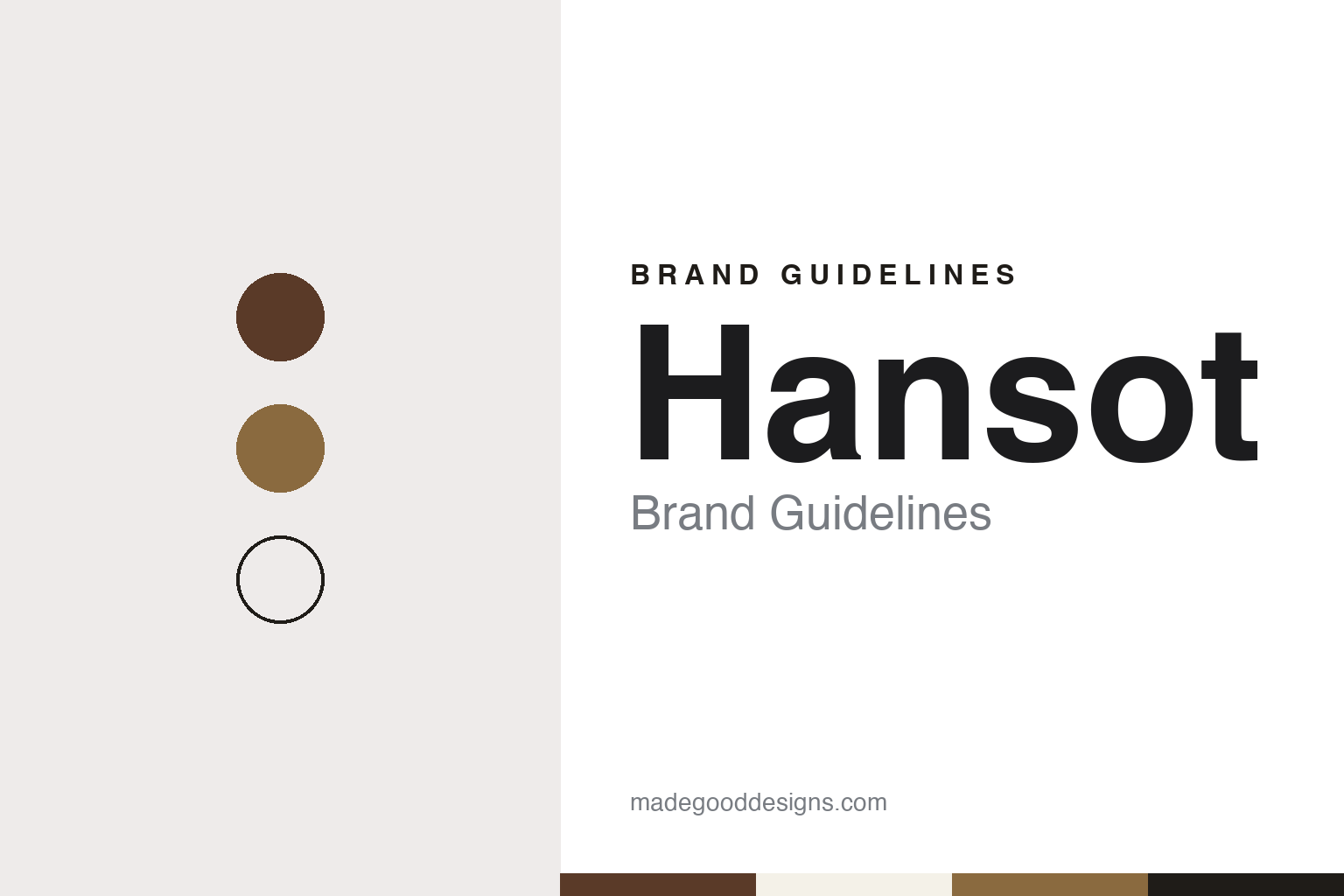
Hansot Brand Guidelines
A 1993 Jongno takeout lunchbox shop and its Cheongdam flagship.
Aa
Two constants: a lacquer brown, bronze and rice white palette and a soft Korean serif register. Abstract homage — not a Hansot product or mark; no logo, lunchbox or store sign is reproduced.
Takeout, not delivery
Eight pyeong in front of the Jongno district office.
Hansot is a Korean chain of dosirak, or lunchbox, shops. Its founder, Lee Young-duk, planned it in the early 1990s after deciding to bring the takeout lunchbox shop, then common in Japan, to Korea, the Korean business weekly Economist reported in a 2016 profile. At that time, the profile says, Korea already had about ten lunchbox franchise brands, but they delivered; Lee chose to sell only for collection, which the magazine says removed the cost of delivery from the price of each box.
The first shop opened on 7 July 1993, a unit of about 26 square metres (eight pyeong) in front of the Jongno district office in central Seoul, according to the same profile. The design magazine Design+ gave the same start in 2024: an eight-pyeong takeout store in Jongno in 1993. Asia Economy, reporting in December 2021, dated the company’s establishment to 1989 and the first store to 1993, so the two dates refer to the company and to its first shop.
Franchising followed quickly. Economist profile says franchised shops were added at a rate of 50 to 60 a year from the following year. Asia Economy reported that the chain passed 100 stores in 1997 and 600 in 2012. Korean Wikipedia, citing a 2016 interview, says restrictions on plastic lunchbox containers between 2000 and 2008 held back the opening of new franchised stores, and that the chain recovered through new menus, store refits and a wider range of goods in its shops.
The counts since then come from the press, each with its date: about 690 franchised shops in November 2016 (Economist), more than 752 stores in December 2021 (Asia Economy), about 800 in April 2024 (Design+) and 817 in October 2025, according to the business site Bizwatch. Design+ reported that most Hansot stores are takeout shops with little room for eating in.
Colour
Chicken Mayo and the flower series.
Hansot’s menu is built around rice and side dishes packed to order. Its signature is the Chicken Mayo bowl, launched in 2003, which Asia Economy described in 2021 as rice topped with strips of egg and slices of fried chicken, finished with the company’s mayonnaise dressing and rice-bowl sauce. Asia Economy reported in July 2022, from the company’s figures, that Chicken Mayo was its top-selling item, followed by the Jindallae, Donkatsu Doryeonnim and Dongbaek lunchboxes.
Several of those boxes belong to a series named after flowers. In October 2022 Hansot launched the Haebaragi (sunflower) lunchbox, with a whole chicken drumstick, a whole-shrimp cutlet and ten side dishes, Asia Economy reported; it was the fourth in the series after Maehwa (plum blossom), Jindallae (azalea) and Gaenari (forsythia), and the company sells the range for group orders, outings and picnics.
The cooking happens in the shop. Bizwatch reported in October 2025 that Hansot cooks lunchboxes after the order is placed and cooks rice in each store, rather than delivering finished boxes from a factory, and that a company spokesperson said it uses a single rice variety, Shindongjin, and updates its rice-cooking manual for franchisees every month. The same report described Hansot’s position next to the convenience-store lunchboxes that Korean chains began promoting heavily in the mid-2010s, and noted two recent product types: a mackerel lunchbox served with budae-jjigae stew, launched in July 2025, and a “Double” series that adds popular side dishes to existing boxes.
Leadership has passed to a new generation. Design+ reported in April 2024 that Lee Ha-rim became chief executive in 2023, succeeding chairman Lee Young-duk, and that the company had bought a building in Cheongdam-dong, Seoul’s luxury shopping street, in 2022 for its head office.
Typography
Shopfronts, packaging and menus.
South Korea’s café, bakery and quick-meal chains present themselves first through the street. Most are franchise networks, so a shopfront, a cup and a menu board have to look the same in thousands of places run by different owners. When the Korea Times reported in January 2025 that one coffee chain’s rebrand was on hold, the reason it gave was franchisees’ reluctance to pay for new store fittings: in a franchise system, a new look is also a shared bill.
Menus carry much of the identity. The chains in this group name their dishes and drinks rather than describing them in general terms, and abroad they lean on Korean flavours: dalgona lattes, sikhye, roasted sweet potato, injeolmi and black sesame cakes, misutgaru drinks and street snacks such as hotteok and bungeoppang, according to press reports on their stores in Malaysia, Laos and the United States. Cakes, toast, porridge, lunchboxes and burgers each give a chain its own signature.
Ownership is described plainly in the companies’ own pages and in the business press. Some chains belong to large food groups, some to private equity funds and some to individual owners; a single brand can pass through several of these in two decades. Store counts are published by the companies and repeated by the press with dates, and the numbers change quickly in a market the Korea Times described as split between premium and budget tiers.
Expansion abroad takes two main forms in these reports: a master franchise, in which a local partner runs the stores, or a subsidiary that runs them directly. This guide sets out what can be checked about each brand: who founded it, who owns it now, how its stores and menus present it at home and abroad, and which facts rest only on the company’s own word.
Aa
A soft Korean serif for a rice-and-side-dish brand. (Specimen set in Gowun Batang, a serif STAND-IN; NOT the Hansot logo.)
Hansot
A bronze cube in Cheongdam.
The clearest statement of Hansot’s design direction is its Cheongdam flagship, which opened in March 2024 on the first two floors of the head-office building, Design+ reported. The interior was designed by Teo Yang Studio. In the magazine’s interview, the studio said it wanted to show a plain, practical rationality rather than decoration: a base of neutral-toned wood and tile, with a large “Hansot Cube” finished in bronze mirror at the centre of the ground floor, where the food is cooked.
The ground floor is laid out for ordering and collection. Two counters stand in front of the cube, one for product display and one for payment and packing; windows in the cube let customers hear the cooking and see the kitchen staff; kiosks and standing tables sit at either end. Because franchisees are trained in the store, the studio said, the layout follows Hansot’s operating manual, so that it matches the functions of an ordinary shop.
Upstairs the store does what most Hansot shops do not: it gives room to eat in. The second-floor dining hall has a long bench along the wall and a single large table in the middle, with low backless stools and dining chairs from the Korean furniture label Eastern Edition, chosen so that diners look out over the street. An archive room, curated with the group Sisterhood, shows the company’s 30-year history beside Joseon-era lunchboxes and contemporary lunchbox pieces by the craftspeople Kim Ji-yong and Yoon Sang-hyun, Design+ reported.
For a design guide, Hansot shows how a takeout chain built on the standard eight-pyeong shop can use a single flagship to show its ingredients, its kitchen and its history in materials rather than slogans. Compare Bonjuk, a Korean porridge chain, and Isaac Toast, another Korean quick-meal franchise. For this guide we use a lacquer brown, bronze and rice white with a serif, an unofficial interpretation; no product or logo is reproduced.
Explore & save
Keep Hansot’s identity on hand — save it to a board in the Made Good inspiration library.
Hansot identity set
Pin the Hansot lacquer brown, bronze and rice white palette and the soft Korean serif register to your own board.
Source & notes
Frequently Asked Questions
What font can I use to match the Hansot look?
This guide describes Hansot’s type as “A soft Korean serif for a rice-and-side-dish brand”. Its type specimen is set in Gowun Batang from Google Fonts as a stand-in; Gowun Batang is not Hansot’s own lettering.
What colours are in the Hansot palette?
This guide’s Hansot palette is Lacquer brown #5A3A28, Bronze #8A6A3F, Steamed rice #F4F1E8, Tile grey #BDB6A8 and Ink #1F1C18. The tones are the guide’s own unofficial interpretation, not official Hansot hex codes.
Who founded Hansot?
Hansot was founded by Lee Young-duk. Hansot is known for Chicken Mayo, flower-named lunchboxes.