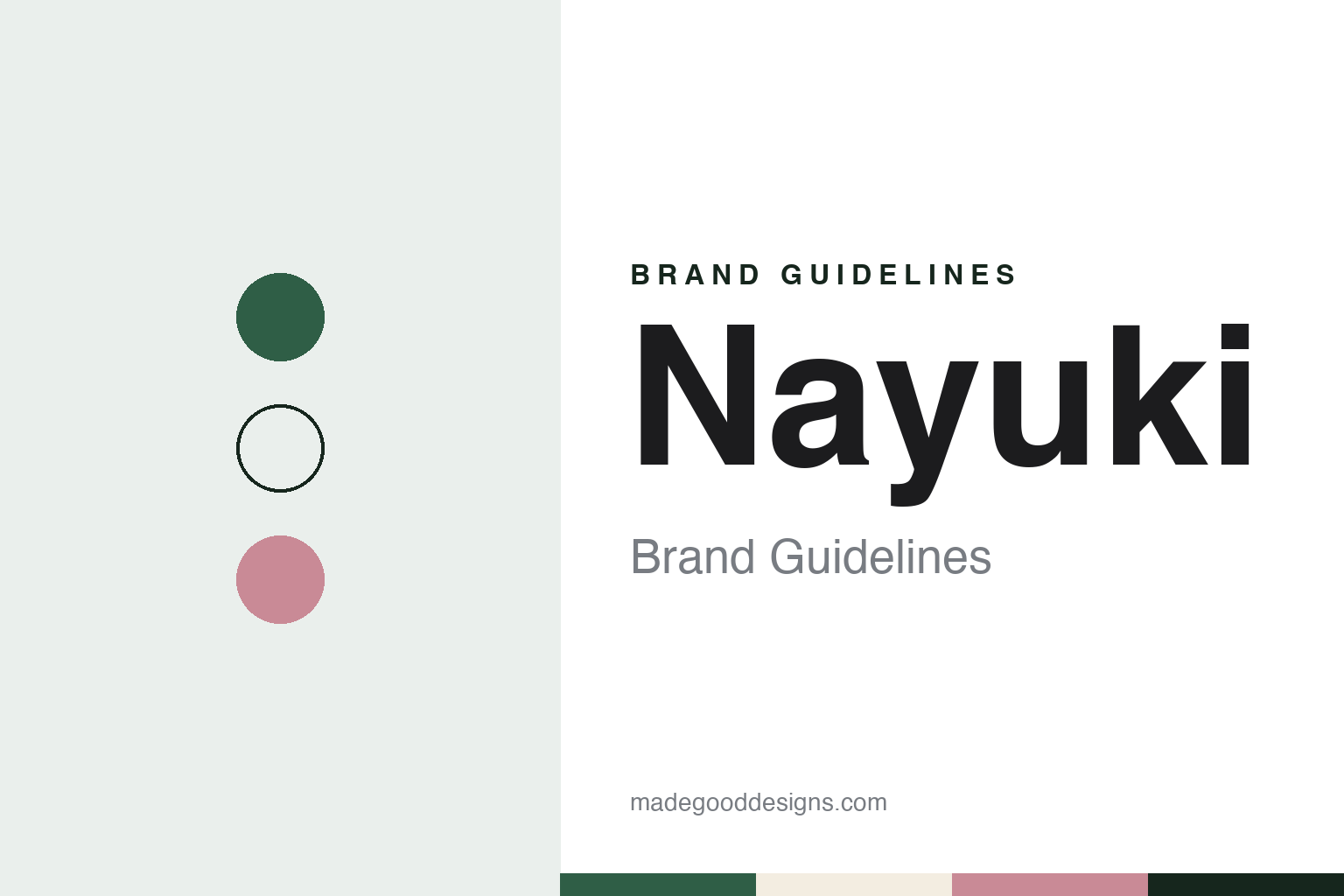
Nayuki Brand Guidelines
A Shenzhen teahouse chain that sold tea and bread as a place to meet.
Aa
Two constants: a tea leaf green, cream and grape rose palette and a display serif register. Abstract homage — not a Nayuki product or mark; no cup, logo or store is reproduced.
Nayuki
A Shenzhen teahouse aimed at young professionals.
Nayuki is a teahouse chain from Shenzhen. Its Chinese name is 奈雪的茶 (Nàixuě de Chá), and it was started by Peng Xin and Zhao Lin. The year of founding is given two ways: Yicai Global reported in June 2021 that the company was founded in 2015, as did the business site Jiemian in 2023, while English Wikipedia gives 2014. English Wikipedia says the name came from an online handle Peng used, and that the first shop opened in Shenzhen’s Excellence Century Plaza, with two more following soon afterwards.
From the start the chain aimed at a particular customer. Jiemian described its target as young women aged 20 to 35, and its stores as comfortable spaces using fresh ingredients at the upper end of the milk tea market. The local New York news site I Love the Upper West Side wrote in January 2026 that the founders set out to create designed spaces for socialising, at a time when milk tea shops were often thought of as low-end, with attention to the drinks, the cups and the store design.
The menu grew from that idea. When Inside Retail Asia reported on the company in January 2020, Nayuki had nearly 400 stores in China and three in Singapore and served tea blended with fruit, cream cheese and toppings. In November 2019 it had opened its largest shop, Nayuki’s Dream Factory in Shenzhen, a space of about 11,000 square feet offering teas, coffees, cocktails, baked goods and desserts exclusive to the store, the magazine said. Baked goods have remained part of the offer: in New York the chain’s pastry range includes a caramel egg tart and coffee and matcha tiramisu tarts, according to the January 2026 report.
Colour
Designed stores, cheese teas and a change of name.
Nayuki’s identity has always been tied to the room as much as the cup. The Dream Factory of 2019 was built as an immersive shop, where visitors could see, hear and learn about the company’s teas while ordering from a menu found only there, Inside Retail Asia reported. In Bangkok it opened its first directly operated Thai store at the Emsphere shopping mall in December 2023, a two-level shop of nearly 200 square metres selling 48 kinds of freshly made tea and baked goods, EqualOcean reported in October 2024. Its first global flagship followed in August 2024 at Central World, combining tea, baked goods and retail in a space of more than 200 square metres.
At the Bangkok flagship opening, guest staff prepared signature items including the “Cheesy Grape” fruit tea and a tiramisu egg tart, EqualOcean wrote. In New York, the January 2026 report listed seaweed and meat floss mini cakes alongside the tarts.
The name itself has changed. In December 2022 the company replaced the Japanese possessive particle の in its Chinese name with the Chinese character 的, which has the same meaning, and changed its English name to Naixue, the pinyin form, according to English Wikipedia. TechNode was already calling the company “Naixue (formerly known as Nayuki)” in December 2022, and Jiemian reported the change in 2023. Outside China the chain now trades as NaiSnow: the New York stores that opened from October 2025 carry that name, I Love the Upper West Side reported, describing it as the brand known in China as Nayuki.
For a designer, the result is a brand with three spellings in use at once: Nayuki in the stock-market name, Naixue in China and NaiSnow abroad, each attached to the same tea-and-bakery concept and the same Shenzhen company.
Typography
Shopfronts, cups and mascots.
China’s tea-drink, coffee, burger and restaurant chains present themselves first at street level. A shopfront, a cup and a paper bag are often the first things a customer sees of the brand, and many chains add a mascot, a theme song or a recurring character that appears on signs, packaging and social media at the same time. Some keep their shops small and built for takeaway; others put the same care into seating, lighting and a bakery counter as into the drinks.
Menus are usually organised by named drinks and dishes rather than by codes. Fruit teas, cheese-topped teas, lemon drinks, soft-serve ice cream, fried chicken and hotpot appear under house names, and chains that move abroad often add local flavours while keeping the core list the same. The names, the cups and the colours of the shop carry the brand from one city to the next.
The size of a network is something these companies publish themselves, in annual reports, listing documents and on their own sites, and the press repeats those counts with a date attached. Some chains run every shop directly; others rely mainly on franchisees, and several have moved from one model to the other. Store networks now reach Southeast Asia, Australia, Europe and North America as well as the home market.
Ownership is usually set out plainly on corporate pages: who founded the business and where, which group owns it now, and whether its shares trade in Hong Kong, on a mainland exchange or in New York. This guide follows those published facts, attributes counts to dated sources, and treats each chain’s visual identity as a design subject rather than a claim about its food or drinks.
Aa
A soft display serif for a teahouse that sells its rooms as much as its drinks. (Specimen set in DM Serif Display, a serif STAND-IN; NOT the Nayuki logo.)
Nayuki Holdings
A listing, a stake in a rival and franchising.
Nayuki Holdings began trading on the Hong Kong Stock Exchange on 30 June 2021, under the code 2150, Yicai Global reported that day; the shares closed below their offer price on the first day. At the time of the listing the chain had more than 489 tea outlets in 66 Chinese cities, plus one teahouse in Hong Kong and one in Japan, according to the same report.
Consolidation followed. In December 2022 the company acquired a 43.64% stake in its rival Lelecha, another Chinese tea and baked-goods chain, becoming its largest shareholder, TechNode reported; the company said Lelecha would continue to operate independently. Until 2023 Nayuki ran all of its own stores directly, Jiemian reported, whereas most competitors franchised. That changed in July 2023, when the company announced it was open to franchise partners in order to reach lower-tier markets not covered by its own stores, TechNode reported, with partners required to have at least two years of experience running food businesses.
The chain then looked abroad again. After the Thai openings of 2023 and 2024, it opened its first store in the United States in Flushing, Queens, in October 2025, followed by a shop in Long Island City and a third New York location on the Upper West Side in January 2026, I Love the Upper West Side reported, describing a chain of nearly 2,000 locations worldwide as of January 2026.
For a design guide, Nayuki shows how a tea chain can make the store, the bakery counter and the cup carry its brand, and how one company can run under several names in different markets. Compare HeyTea, a tea chain founded in Jiangmen, and Mixue, a franchise network built on small grab-and-go shops. For this guide we use a tea leaf green, a cream and a grape rose with a serif, an unofficial interpretation; no product or logo is reproduced.
Explore & save
Keep Nayuki’s identity on hand — save it to a board in the Made Good inspiration library.
Nayuki identity set
Pin the Nayuki tea leaf green, cream and grape rose palette and the display serif register to your own board.
Source & notes
Frequently Asked Questions
What font can I use to match the Nayuki look?
This guide describes Nayuki’s type as “A soft display serif for a teahouse that sells its rooms as much as its drinks”. Its type specimen is set in DM Serif Display from Google Fonts as a stand-in; DM Serif Display is not Nayuki’s own lettering.
What colours are in the Nayuki palette?
This guide’s Nayuki palette is Tea leaf green #2F5E46, Cream #F3EDE1, Grape rose #C98A96, Deep leaf #16261D and Paper #FAF8F4. The tones are the guide’s own unofficial interpretation, not official Nayuki hex codes.
When was Nayuki founded?
Nayuki was founded in 2015 (2014 in some sources), in Shenzhen, Guangdong, China.
Who founded Nayuki?
Nayuki was founded by Peng Xin and Zhao Lin in 2015 (2014 in some sources).


