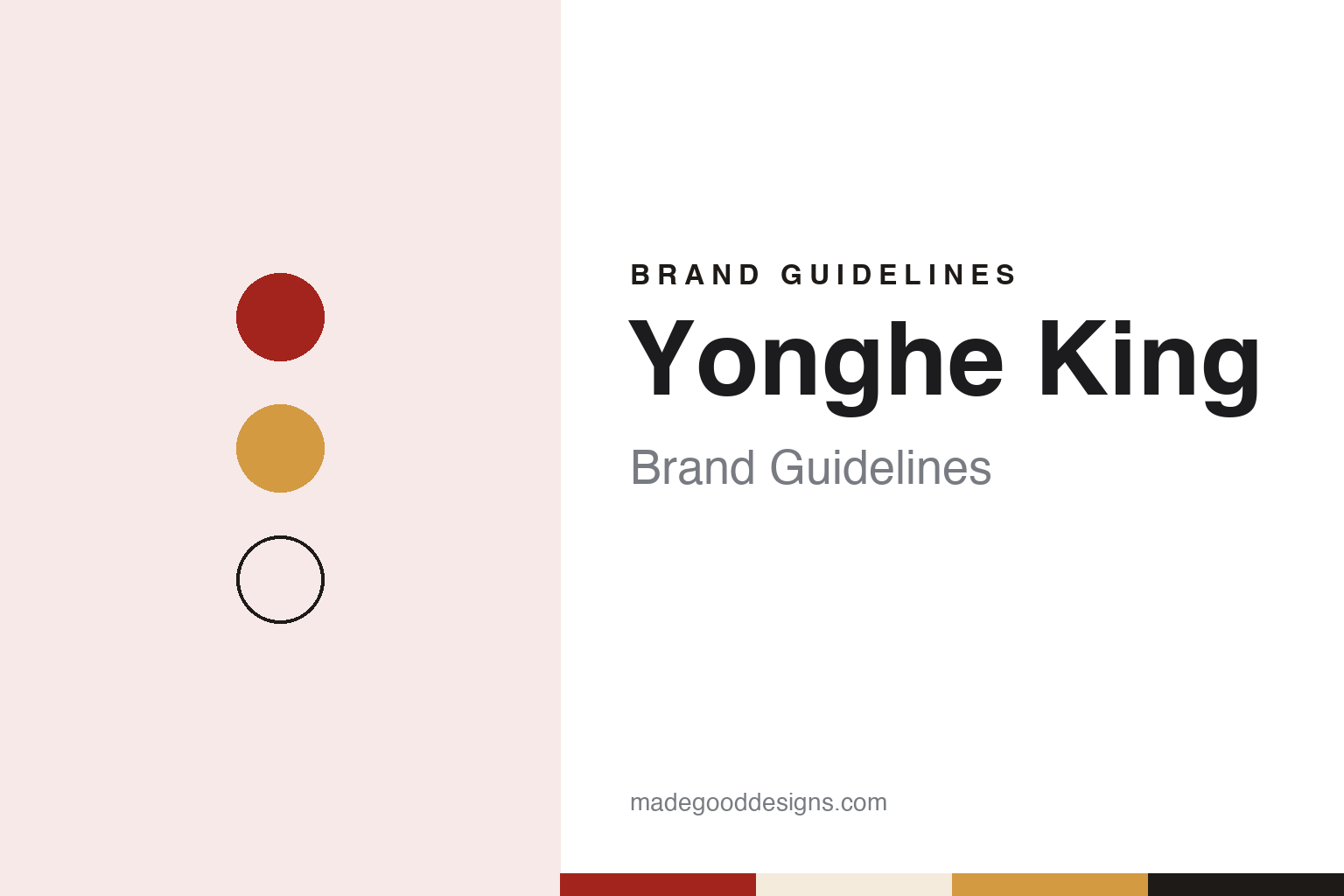
Yonghe King Brand Guidelines
A Shanghai noodle counter of 1995, run since 2004 inside a Philippine food group.
Aa
Two constants: a red, amber and soy-cream palette and a slab serif register. Abstract homage — not a Yonghe King product or mark; no bowl, logo or sign is reproduced.
Shanghai, 1995
Chinese food at a fast-food counter.
Yonghe King is the English name of Yonghe Dawang (永和大王, Yǒnghé Dàwáng), a fast-food chain serving Chinese dishes. English Wikipedia dates its first restaurant to 12 December 1995, in Shanghai, and describes it as a fast-food restaurant that specialises in noodles; Chinese Wikipedia gives the same date and names the founder as Lin Youao. The Chinese business site Yicai Global, reporting in June 2021, also dates the first outlet in Shanghai to 1995.
The idea was a familiar menu served in an unfamiliar way. When the Manila newspaper The Philippine Star reported on the chain in March 2004, it described Yonghe King as serving Chinese food using a Western-style fast-food service system — counter ordering and quick service applied to noodles, rice dishes and soy milk rather than burgers.
By that point the chain had spread well beyond its home city. The Philippine Star counted 77 stores in March 2004: 26 in Shanghai, 26 in Beijing, 11 in Shenzhen, eight in Wuhan and six in Hangzhou. English Wikipedia lists further cities including Jinan and Suzhou. Chinese Wikipedia says the chain operated 309 restaurants in mainland China in 2013.
English Wikipedia places the company’s head office in a business centre in Minhang District, Shanghai.
Colour
Noodles, dumplings, soy milk and a bowl.
The menu has stayed close to everyday Chinese food. Yicai Global described the chain in June 2021 as selling dumplings, noodles and stewed pork rice. Jollibee Group’s brand page describes Yonghe King as a Chinese-style fast-food chain offering breakfast items, meal sets with noodles or rice and desserts, and says it is known for its soya milk, which it says is prepared on site in the restaurants.
The logo has changed once in a way that matters for a design guide. English Wikipedia says the original mark showed a smiling face against a red background. In 2005, the year after the change of ownership, the chain replaced it with a steaming bowl of soup, according to the same source.
The name needs care. English Wikipedia notes that other Chinese restaurant chains also use the word “Yonghe” in their names, among them soy-milk breakfast chains, and Yonghe is also a name used by unrelated companies in other industries. Yonghe King is the chain owned by Jollibee Group, and the guide below covers that business only.
Its owner presents the brand in English as “Yonghe King” and describes it as a “Chinese-Style fast-food chain” made in China, one of several Chinese restaurant brands in the group alongside the Beijing congee chain Hong Zhuang Yuan.
Typography
Shopfronts, menus and group ownership.
China’s tea-drink, coffee, burger and restaurant chains present themselves first at street level. A shopfront, a cup and a paper bag are often the first things a customer sees of the brand, and many chains add a mascot, a theme song or a recurring character that appears on signs, packaging and social media at the same time. Some keep their shops small and built for takeaway; others put the same care into seating, lighting and a bakery counter as into the drinks.
Menus are usually organised by named drinks and dishes rather than by codes. Fruit teas, cheese-topped teas, lemon drinks, soft-serve ice cream, fried chicken and hotpot appear under house names, and chains that move abroad often add local flavours while keeping the core list the same. The names, the cups and the colours of the shop carry the brand from one city to the next.
The size of a network is something these companies publish themselves, in annual reports, listing documents and on their own sites, and the press repeats those counts with a date attached. Some chains run every shop directly; others rely mainly on franchisees, and several have moved from one model to the other. Store networks now reach Southeast Asia, Australia, Europe and North America as well as the home market.
Ownership is usually set out plainly on corporate pages: who founded the business and where, which group owns it now, and whether its shares trade in Hong Kong, on a mainland exchange or in New York. This guide follows those published facts, attributes counts to dated sources, and treats each chain’s visual identity as a design subject rather than a claim about its food or drinks.
Aa
A sturdy slab serif for a counter-service noodle brand. (Specimen set in Zilla Slab, a serif STAND-IN; NOT the Yonghe King logo.)
Yonghe King
A Chinese chain inside the Jollibee Group.
The chain changed hands in 2004. The Philippine Star reported on 27 March 2004 that Jollibee Foods Corporation, the Philippine fast-food group, had made its initial payment for an 85 per cent interest in Belmont Enterprises Ventures Ltd., the company that operated the Yonghe King restaurants, after the conditions of the sale agreement had been met. The stake was transferred to Jollibee’s wholly owned unit Jollibee International (BVI) Ltd., and Belmont kept 15 per cent of Yonghe King, the newspaper reported. Jollibee Group’s own history lists 2004 as the year it acquired its first international brand, Yonghe King. Chinese Wikipedia says Yonghe King became a Jollibee subsidiary in 2007; read together, the two sources describe a majority stake in 2004 and full control later.
Jollibee built a wider Chinese business around the chain. Its history page lists the purchase of Hong Zhuang Yuan, a congee chain based mostly in Beijing, in 2008, and the building of a Jollibee food-processing commissary in China in 2011. In August 2012 The Philippine Star reported that the group’s business in China then took in three Chinese brands — Yonghe King, Hong Zhuang Yuan and the beef-noodle chain San Pin Wang, bought in 2010 — with 368 stores in China in all at the end of June 2012, a research and development facility in Beijing and a food-processing centre in Anhui province. The group’s chief financial officer called Yonghe King its flagship brand in China, the newspaper reported.
The network kept growing under the new owner. Yicai Global reported in June 2021 that Yonghe King had more than 360 restaurants in more than 50 cities, mainly in eastern China but reaching as far west as Xinjiang. In January 2026 the Manila newspaper Daily Tribune reported that Yonghe King had opened 35 new franchised stores in China. The same report set Yonghe King beside Tim Ho Wan, the Hong Kong dim sum chain, in what Jollibee calls its Chinese cuisine segment. Jollibee Group’s brand page invites franchise enquiries for the chain.
For a design guide, Yonghe King shows how a fast-food chain can move its mark from a face to the food, swapping a smiling portrait for a steaming bowl a year after it changed owner. Compare Dicos, another fast-food chain in China, and KFC, the American chicken chain. For this guide we use a lantern red, a broth amber and a soy cream with a slab serif, an unofficial interpretation; no product or logo is reproduced.
Explore & save
Keep Yonghe King’s identity on hand — save it to a board in the Made Good inspiration library.
Yonghe King identity set
Pin the Yonghe King red, amber and soy-cream palette and the slab serif register to your own board.
Source & notes
Frequently Asked Questions
What font can I use to match the Yonghe King look?
This guide describes Yonghe King’s type as “A sturdy slab serif for a counter-service noodle brand”. Its type specimen is set in Zilla Slab from Google Fonts as a stand-in; Zilla Slab is not Yonghe King’s own lettering.
What colours are in the Yonghe King palette?
This guide’s Yonghe King palette is Lantern red #A3241C, Broth amber #D49A42, Soy cream #F4EBDD, Lacquer ink #1E1A17 and Paper #FAF7F2. The tones are the guide’s own unofficial interpretation, not official Yonghe King hex codes.
When was Yonghe King founded?
Yonghe King was founded in 12 December 1995, in Shanghai, China.
Who owns Yonghe King?
Yonghe King is owned by Jollibee Group (since 2004). Yonghe King is known for Noodles, dumplings, soya milk.