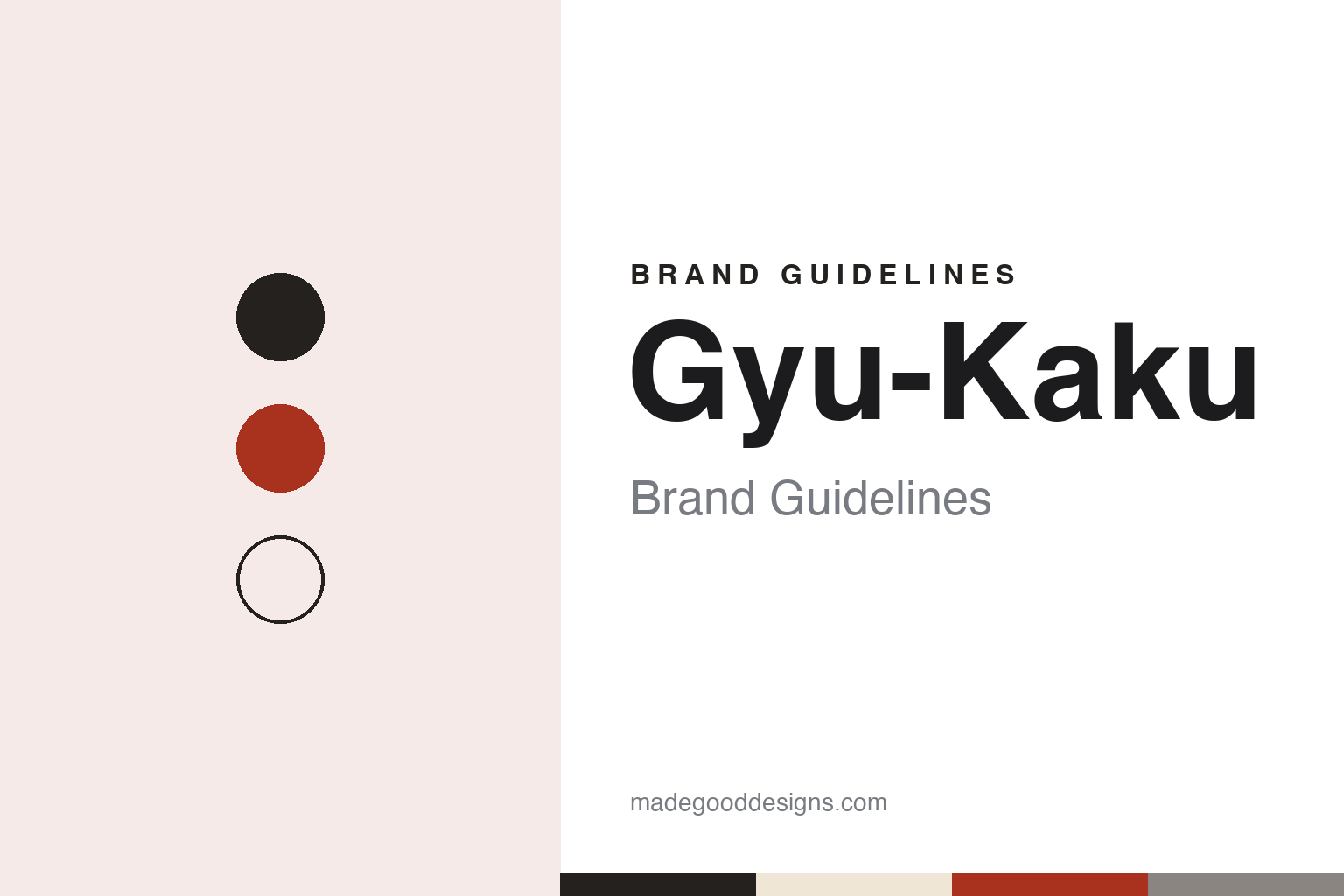
Gyu-Kaku Brand Guidelines
The Sangenjaya grill room named for a bull’s horn.
Aa
Two constants: a charcoal, ember and cream palette and a grill-house sans register. Abstract homage — not a Gyu-Kaku product or mark; no logo, sign or menu is reproduced.
Shichirin
A Sangenjaya grill room that renamed itself.
Gyu-Kaku began in Tokyo in January 1996. Japanese Wikipedia says the company behind it, set up by Tomoyoshi Nishiyama in June 1987 as a property-rental business, entered the restaurant trade that month with a yakiniku room in Sangenjaya, in Setagaya ward, called “Yakiniku Ichiba Shichirin,” after the small charcoal braziers built into its tables. Reins International, which runs the chain today, also dates the opening to January 1996 in Sangenjaya, and says the founding idea was food that tasted good, cost little and came with good service and a pleasant room.
Trade was slow at first, according to Japanese Wikipedia. The restaurant offered diners a small discount on the bill if they would name something they disliked, then worked through the complaints until the room filled. In October 1997 it took a new name, “Sumibi Yakiniku Shuka Gyu-Kaku,” the charcoal-grill yakiniku bar Gyu-Kaku. Gyū-kaku means “bull’s horn,” and Japanese Wikipedia says the horns were read as antennae, picking up quickly what customers wanted. The first franchised restaurant opened the following month, in November 1997, in Udagawachō in Shibuya; English Wikipedia likewise places the first franchise in 1997, after the change to the current name.
The company changed its own name around the brand. It became Reins International in April 1998 and listed its shares over the counter, on the market now called JASDAQ, in December 2000. In May 2005 it became the holding company Rex Holdings, handing the restaurants to a subsidiary that took the Reins International name, Japanese Wikipedia says.
Colour
A grill at every table.
The format has hardly moved since Sangenjaya. Diners grill bite-sized cuts of marinated meat and vegetables themselves over a burner set into the table or counter; Japanese Wikipedia names the shichirin, a small charcoal stove, as the fixture of the style. The chain is run mainly through franchisees, with Reins International supplying ingredients and guidance to the shops, and Japanese Wikipedia counted 479 Gyu-Kaku restaurants in Japan as of May 2026. English Wikipedia adds that the brand sells its own kimchi in Japanese supermarkets, alongside a line of dipping sauces and marinades.
The name now covers several formats. Reins International lists Gyu-Kaku alongside an all-you-can-eat Gyu-Kaku and Gyu-Kaku Yakiniku Shokudō, a food-court counter where staff cook yakiniku set meals and rice bowls on an iron griddle. For its overseas business the company lists Gyu-Kaku, Gyu-Kaku Buffet, Gyu-Kaku Jinan-Bou and Gyu-BOSS. The same company also runs the shabu-shabu chain Shabu Shabu On-Yasai, which it says opened in March 2000 in Kyōdō, Tokyo, and the izakaya chain Doma Doma.
Growth abroad began in the United States. English Wikipedia dates the first restaurant outside Japan to 2001, in the US, and the second to 2002, in Taiwan; Japanese Wikipedia says the American branches were followed in September 2011 by a company-run restaurant in Vancouver. In July 2016 CultureMap Dallas reported that the chain had 35 locations across the United States and Canada and had opened its first Texas branch in Houston in April 2014. The paper listed signature dishes including Angus skirt steak in a miso marinade, garlic shrimp and Angus short rib, all cooked on the grill at each table. English Wikipedia names outlets in China, Hong Kong, Cambodia, Thailand, Indonesia, Malaysia, Singapore, Vietnam and the Philippines, and notes that menus vary by region, with American branches serving US beef.
The North American map also shrinks in places. In January 2026 Daily Hive reported that the Edmonton restaurant had closed that month, leaving five Gyu-Kaku locations in Canada, in Calgary, Richmond, Vancouver, Toronto and Montreal.
The Asian business has its own companies. Japanese Wikipedia counted 28 Gyu-Kaku restaurants outside Japan in August 2011, and Colowide’s history lists Reins International subsidiaries set up in Thailand in September 2013, in Indonesia in 2015 and in Taiwan in February 2016. English Wikipedia lists American branches from New York City and Chicago to Hawaii, Houston and Miami.
Typography
Design and documentation.
Japan’s restaurant and food chains cover a wide spread of formats: takeaway bento shops, tempura and set-meal counters, family restaurants, ramen and champon chains, takoyaki stands, burger shops and yakiniku grills. Most present themselves first through the shopfront. A sign over the door, a colour that can be read from across the street and a short name, often written in both Latin letters and Japanese script, do much of the work of telling passers-by what is sold inside.
Menus carry the rest. Chains tend to describe themselves by named dishes rather than by abstract promises: a standard bowl, a set meal, a takeaway box, a seasonal special that changes through the year. Menu boards, printed menus, ordering screens and ticket machines repeat those names, and many chains publish their menus online as well, so the dish names themselves become part of the identity.
Store networks are another way these companies describe themselves. Corporate pages and annual histories list store counts, prefectures and the year a chain opened in a new region or country, and many chains mix company-run stores with franchised ones. Some brands operate abroad directly, others through joint ventures or local franchise partners, and the overseas store design and menu can differ from those at home.
Ownership is often layered. A single chain may sit inside a larger restaurant group, alongside sister brands with their own names and looks, and some brand names have changed when a franchise arrangement ended or a parent company reorganised. Corporate pages usually set out the founders, the operating company, the owner and the franchise network, and those pages, read alongside dated press reports, are a useful record of how each chain came to look the way it does today.
Aa
A plain, sturdy sans for a grill-house sign. (Specimen set in Zen Kaku Gothic New, a sans STAND-IN; NOT the Gyu-Kaku logo.)
Reins International
From buyout to the Colowide group.
Ownership changed twice in six years. In December 2006 Rex Holdings left the stock market through a management buyout, Japanese Wikipedia says, with effective control passing to the private-equity firm Advantage Partners. On 1 October 2012 Rex Holdings became a consolidated subsidiary of Colowide, the Yokohama restaurant group, the date Colowide’s own corporate history also gives. On 1 January 2013 Rex Holdings absorbed its operating subsidiary and took the Reins International name again, and in January 2015 Reins International became a wholly owned Colowide subsidiary, Colowide says.
Reins International has added chains inside the group. Japanese Wikipedia says it bought all the shares of Freshness, the company behind Freshness Burger, from Unimat Holding in December 2016, and Colowide’s history records the same purchase. Reins International is based in Minatomirai, Yokohama, the company says, and it gave its staff as 714 employees on 1 September 2026. Its American division, Reins International U.S.A., is based in Torrance, California, according to English Wikipedia.
For a design guide, Gyu-Kaku shows how a renamed grill room can turn one image, a bull’s horn read as an antenna, into a franchise name used in Asia and North America. Compare Freshness Burger, another Reins International chain, and Sukiya, a Japanese chain built on beef. For this guide we use charcoal, ember red and a horn cream with a sans, an unofficial interpretation; no product or logo is reproduced.
Explore & save
Keep Gyu-Kaku’s identity on hand — save it to a board in the Made Good inspiration library.
Gyu-Kaku identity set
Pin the Gyu-Kaku charcoal, ember and cream palette and the grill-house sans register to your own board.
Source & notes
Frequently Asked Questions
What font can I use to match the Gyu-Kaku look?
This guide describes Gyu-Kaku’s type as “A plain, sturdy sans for a grill-house sign”. Its type specimen is set in Zen Kaku Gothic New from Google Fonts as a stand-in; Zen Kaku Gothic New is not Gyu-Kaku’s own lettering.
What colours are in the Gyu-Kaku palette?
This guide’s Gyu-Kaku palette is Charcoal #24211F, Ember red #A8321E, Smoke grey #8A8580, Horn cream #EFE6D6 and Paper #F8F6F2. The tones are the guide’s own unofficial interpretation, not official Gyu-Kaku hex codes.
When was Gyu-Kaku founded?
Gyu-Kaku was founded in January 1996 (as Shichirin), in Sangenjaya, Tokyo.
Who founded Gyu-Kaku?
Gyu-Kaku was founded by Tomoyoshi Nishiyama in January 1996 (as Shichirin).