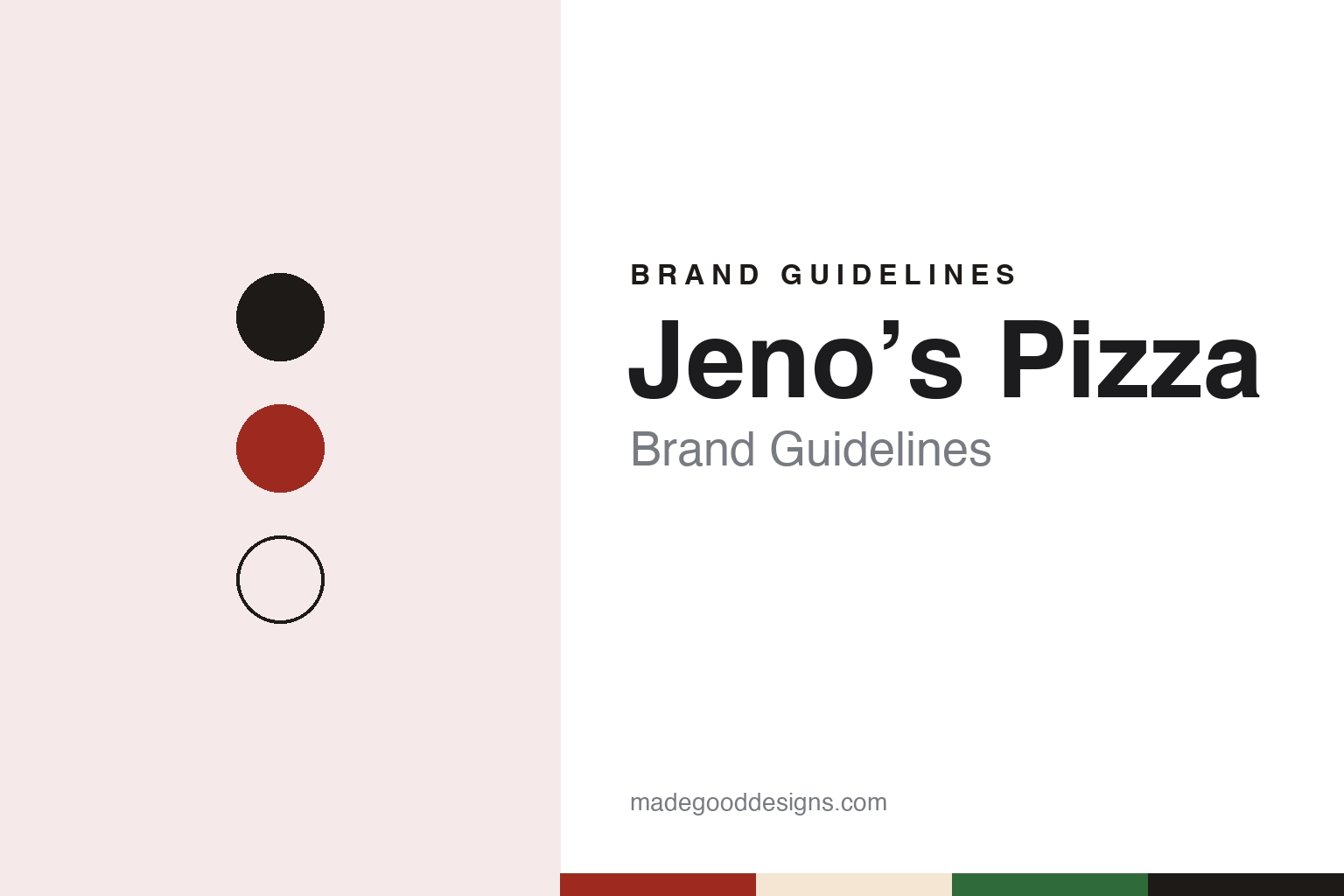
Jeno’s Pizza Brand Guidelines
A 1973 Bogotá pizzeria that grew into a national chain.
Aa
Two constants: a tomato red, cream and basil green palette and a Rounded sans register. Abstract homage — not a Jeno’s Pizza product or mark; no logo, menu or signage is reproduced.
El Lago, 1973
A neighbourhood pizzeria in north Bogotá.
Jeno’s Pizza is a Colombian pizzeria chain, and its story begins in Bogotá in 1973. Spanish Wikipedia names its founders as Alfredo Gracia and Hernando Soto and places the first restaurant in the El Lago neighbourhood of the city. The Spanish trade journal Alimarket gave the same founding city and year when it reported the chain’s sale in June 2010, and the Colombian business daily Portafolio repeated 1973 in September 2018.
Growth was gradual at first. Spanish Wikipedia says a second restaurant opened in 1976 and that there were five by 1978. Through the 1980s and 1990s the chain expanded to about sixty outlets, by the same account, and in the early 1990s it set up its own production plant and organised the company into separate management departments.
The name has a known namesake, and the two are unrelated. In the United States, Jeno’s is a frozen-pizza brand named after the businessman Jeno Paulucci and now part of General Mills, as English Wikipedia says in its disambiguation entry. The Colombian chain is a restaurant business with its own founders, owners and history, and it does not sell the American frozen product.
In Colombia the chain has been run through a holding company that Portafolio named as Inverjenos in 2018. Its menu, as Alimarket described it in 2010, covered pizza, pasta and salads, served at the table and by delivery.
Colour
Clubs, a new look and a Spanish owner.
Spanish Wikipedia says the chain was first aimed at children and families, and that this led to a spin-off format. On 11 December 1992 it opened the first Jeno’s Club, a children’s recreation centre attached to the pizza business. El Tiempo described it in November 1993: arcade machines, a ball pool, mechanical rides, a miniature car train and carousels, alongside pizza and pasta, with members offered children’s parties, puppet theatre, magic and clown shows. The newspaper reported that a second club had opened in the north of the city that month.
Spanish Wikipedia says the company renewed its brand in 2005, changing its corporate identity and its advertising material. The details of that redesign are not set out in the sources used for this guide.
The larger change came in 2010. Alimarket reported on 1 June 2010 that the Madrid pizza chain Telepizza had announced the purchase of Jeno’s Pizza, taking over its 80 company-owned restaurants from that day; the amount was not disclosed. The journal said Jeno’s had a strong presence in Bogotá and outlets in twelve of Colombia’s main cities. At the time, it added, Telepizza already had franchised restaurants in Central America through an agreement with the Guatemalan chicken chain Pollo Campero, and a business in Chile, and the Spanish group had not said whether its own name would come to Colombia. Before the purchase, Alimarket reported, Telepizza counted 1,096 outlets worldwide, 632 of them in Spain, with an international division that also reached Portugal, Poland, Andorra and the United Arab Emirates.
Telepizza kept the Colombian name. Spanish Wikipedia says that by December 2010 fifteen of the chain’s 80 branches had been refurbished, that new restaurants opened in 2011 in cities including Bogotá, Cali, Medellín, Barranquilla and Cartagena, and that the first restaurant in Valledupar opened in late 2013. In October 2012 Alimarket reported that Telepizza would begin franchising Jeno’s Pizza to speed up the Colombian business. Spanish Wikipedia gives a count of 111 outlets in March 2016.
Typography
Design and documentation.
Latin American restaurant chains tend to present themselves through a small set of public surfaces: the shopfront, the menu, the delivery box and the corporate page. The shopfront carries the name and colours to the street, often on a corner unit or inside a shopping centre. Many chains refresh it on a cycle, and anniversaries are a common moment for a new look across dining rooms and signs.
Menus do much of the brand work. A chain is often remembered for one or two named dishes, such as a taco, a pizza or a breakfast plate, and the company repeats those names in its signs, its menus and its own telling of its history. Where a chain says it created a dish, the claim belongs to the company, and independent food writers do not always agree; a careful guide keeps the two apart. Mascots, packaging and delivery boxes extend the same vocabulary to takeaway and app orders.
Ownership is often a group matter. Several chains in Mexico, Brazil, Peru and Colombia sit inside larger restaurant or retail groups that run national brands next to international franchises, and some, like Toks within Grupo Gigante, began as a sideline of a supermarket business. Groups buy, convert and rename chains, so the same dining room can carry two names in a decade. Dated reports and stock-exchange filings are the plain record of who owns what, and when.
Franchising is the other common thread. Corporate pages describe founders, owners and franchise networks, and the business press counts units at a stated date, at home and abroad. Those counts change quickly, and openings in new countries do not always last, so each figure in these guides is tied to the report and the date that gave it.
Aa
A rounded sans — a pizzeria name for families. (Specimen set in Rubik, a sans STAND-IN; NOT the Jeno’s Pizza logo.)
Jeno’s Pizza
A local name inside a global alliance.
In 2018 a conversion was announced. On 15 May that year Telepizza and Pizza Hut International agreed a long-term alliance covering several territories in Latin America and Europe. Portafolio reported on 6 September 2018 that, under the agreement, the Telepizza and Jeno’s Pizza restaurants in Colombia were to be converted gradually to Pizza Hut, and headlined its story as the disappearance of another traditional Colombian brand. Citing the business data site LosDatos.com, it put Jeno’s at 70 establishments at the time, against eleven Telepizza restaurants in the country. Nation’s Restaurant News later noted that the 2018 alliance also moved the management of Pizza Hut’s Latin American supply chain to the Telepizza group.
The Jeno’s name stayed in use. In July 2024 Nation’s Restaurant News reported that Pizza Hut’s parent, Yum Brands, had transferred the trademark rights for the Jeno’s and Telepizza brands in Colombia and Chile to Food Delivery Brands, S.A., the group that operates Telepizza, and that about 120 Jeno’s and Telepizza restaurants would leave Pizza Hut’s global count as a result. The magazine said Food Delivery Brands operated or sub-franchised more than 1,500 Telepizza, Jeno’s and Pizza Hut restaurants, most of them in Spain and Portugal. In November 2026 the Jeno’s Pizza website was taking delivery orders for pizzas, pastas and combos.
The identity has passed through three phases that the sources record: a family-oriented Bogotá pizzeria with its own children’s clubs, a renewed corporate look in 2005, and a local brand held by a Spanish group and placed for six years inside a global master-franchise alliance. No published brand manual, typeface or official colour reference appears in those sources, so the tones on this page are our own.
For a design guide, Jeno’s Pizza shows how a local restaurant name can outlast plans to replace it under a larger international brand. Compare Pollo Campero, the Guatemalan chain that franchised Telepizza in Central America, and El Corral, another Bogotá restaurant chain. For this guide we use a tomato red, a crust cream and a basil green with a sans, an unofficial interpretation; no product or logo is reproduced.
Explore & save
Keep Jeno’s Pizza’s identity on hand — save it to a board in the Made Good inspiration library.
Jeno’s Pizza identity set
Pin the Jeno’s tomato red, cream and basil green palette and the Rounded sans register to your own board.
Source & notes
Frequently Asked Questions
What font can I use to match the Jeno’s Pizza look?
This guide describes Jeno’s Pizza’s type as “A rounded sans — a pizzeria name for families”. Its type specimen is set in Rubik from Google Fonts as a stand-in; Rubik is not Jeno’s Pizza’s own lettering.
What colours are in the Jeno’s Pizza palette?
This guide’s Jeno’s Pizza palette is Tomato red #9E2A1F, Oven black #1E1A17, Crust cream #F4E6D2, Basil green #2F6B3A and Paper #FBF7F1. The tones are the guide’s own unofficial interpretation, not official Jeno’s Pizza hex codes.
When was Jeno’s Pizza founded?
Jeno’s Pizza was founded in 1973, in Bogotá, Colombia. Jeno’s Pizza is known for Pizza, pasta, Jeno’s Club.
Who founded Jeno’s Pizza?
Jeno’s Pizza was founded by Alfredo Gracia and Hernando Soto in 1973.
Who owns Jeno’s Pizza?
Jeno’s Pizza is owned by Telepizza from 2010; Food Delivery Brands.