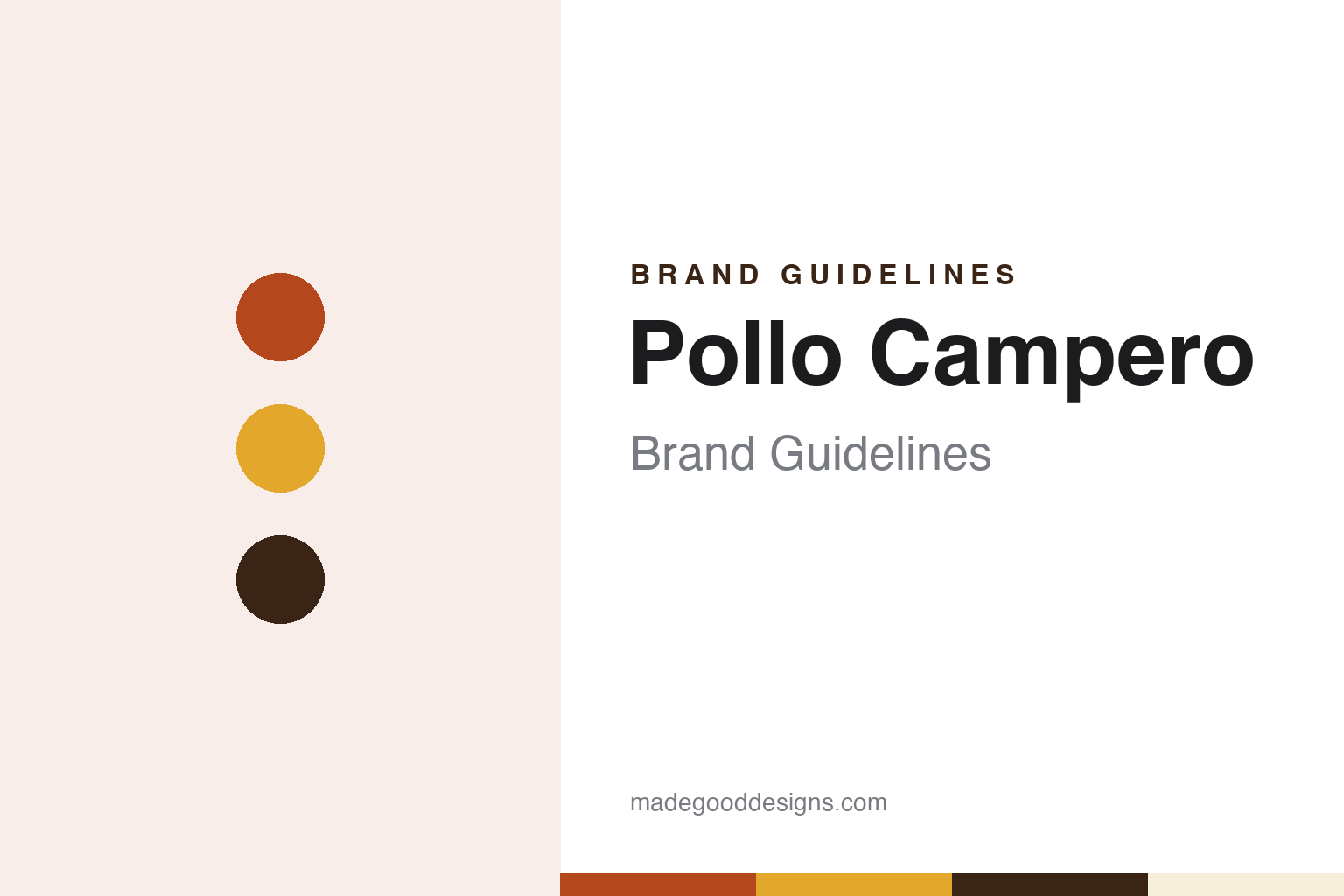
Pollo Campero Brand Guidelines
Guatemala City’s 1971 fried chicken chain and its travelling boxes.
Aa
Two constants: a country orange, fryer gold and bean brown palette and a rounded grotesque register. Abstract homage — not a Pollo Campero product or mark; no box, logo or sign is reproduced.
Country chicken
A poultry family opens a restaurant.
Pollo Campero is a fried-chicken chain from Guatemala. Its name means “country chicken,” Business Insider explained in December 2023. The same report said the family behind it opened a restaurant selling fried chicken in 1967, and that its success led to the opening of the first official Pollo Campero in Guatemala City on 28 April 1971. The Los Angeles Times also dated the first restaurant to 1971 in a 2021 report.
The chain grew out of a poultry business. Spanish Wikipedia says Dionisio Gutiérrez saw the chance to sell the produce of the poultry farms his father, Juan Bautista Gutiérrez, had set up in the 1960s, and opened the first restaurant with several investors; it describes the founding group as led by the businessman Juan José Gutiérrez Mayorga. English Wikipedia describes Pollo Campero as having developed from the Gutiérrez family’s poultry and restaurant businesses.
The owner is a family group that predates the chain by decades. English Wikipedia says Pollo Campero belongs to Corporación Multi Inversiones, known as CMI, a Guatemalan family-owned conglomerate, and places it within CMI’s food business. It traces CMI to a small shop opened in Totonicapán in 1920 by Juan Bautista Gutiérrez and to a flour mill set up in Quetzaltenango in 1936; the group’s other units include flour milling, animal feed, pasta and biscuits, poultry and pork processing, renewable energy and property, the encyclopaedia says.
Colour
Plates, beans and boxes on the plane.
Fried chicken is the core, but the menu is wide. Visiting a US restaurant for Business Insider in 2023, Nancy Luna listed pressure-cooked fried chicken, empanadas, a spicy chicken sandwich, grilled chicken, nuggets, salads, rice bowls, tortillas, and sides including plantains, yuca fries, horchata and the chain’s Campero beans, pinto beans slow-cooked with chorizo, poblano chillies, onion and tomato. Macaroni and cheese was added in the United States in August 2023 and is not served in Central America, the report said.
Presentation follows the home markets. The chain serves food on melamine plates, as in its core restaurants in Central America, because that is how people eat at home, its franchise development director told Business Insider.
The box is part of the story. For years, the Los Angeles Times reported in April 2021, travellers flying from Guatemala and El Salvador to the United States have carried boxes of Pollo Campero chicken for family and friends, so that the cabins smell of fried chicken; the paper described a 12-piece box, an eight-piece combo and a 20-piece box among the orders carried north. The paper also photographed a Pollo Campero restaurant inside La Aurora International Airport in Guatemala City. Business Insider quoted the franchise director saying that pilots sometimes ask passengers to seal their packages.
The chain has also tried other formats. Spanish Wikipedia says that in 2012 it opened take-away-only outlets called Pollo Granjero in Guatemala and Costa Rica, known as Don Pollo in El Salvador, and that it relaunched its ordering app as Campero 2.0 in September 2020.
Typography
How Latin American restaurant chains present themselves.
Latin American restaurant chains tend to present themselves through a small set of public surfaces: the shopfront, the menu, the delivery box and the corporate page. The shopfront carries the name and colours to the street, often on a corner unit or inside a shopping centre. Many chains refresh it on a cycle, and anniversaries are a common moment for a new look across dining rooms and signs.
Menus do much of the brand work. A chain is often remembered for one or two named dishes, such as a taco, a pizza or a breakfast plate, and the company repeats those names in its signs, its menus and its own telling of its history. Where a chain says it created a dish, the claim belongs to the company, and independent food writers do not always agree; a careful guide keeps the two apart. Mascots, packaging and delivery boxes extend the same vocabulary to takeaway and app orders.
Ownership is often a group matter. Several chains in Mexico, Brazil, Peru and Colombia sit inside larger restaurant or retail groups that run national brands next to international franchises, and some, like Toks within Grupo Gigante, began as a sideline of a supermarket business. Groups buy, convert and rename chains, so the same dining room can carry two names in a decade. Dated reports and stock-exchange filings are the plain record of who owns what, and when.
Franchising is the other common thread. Corporate pages describe founders, owners and franchise networks, and the business press counts units at a stated date, at home and abroad. Those counts change quickly, and openings in new countries do not always last, so each figure in these guides is tied to the report and the date that gave it.
Aa
A sturdy, rounded grotesque for menu boards and take-away boxes. (Specimen set in Rubik, a sans STAND-IN; NOT the Pollo Campero logo.)
Pollo Campero
Central America first, then Los Angeles.
The chain left Guatemala early. El Salvador came in 1972, and Honduras in 1992, English Wikipedia says, citing a 2014 case study in the journal Management Decision; the Los Angeles Times wrote that the chain spread quickly across Central America after 1971. Franchising followed in the 1990s: English Wikipedia, citing the same study, dates the franchise programme to 1997 and links it to openings in Panama, Nicaragua, Costa Rica, Ecuador and Mexico, while Spanish Wikipedia dates the start of franchising to 1994.
The move north came in 2002, when the first US restaurant opened in the Pico-Union neighbourhood of Los Angeles. The Los Angeles Times reported that more than 900 people applied for jobs there and that customers queued for six to eight hours. By April 2021 the chain had almost 100 US restaurants, 17 of them in California, the paper said, alongside about 130 in Guatemala and about 70 in El Salvador according to the company. Business Insider reported in December 2023 that the chain had nearly 400 restaurants worldwide, about a quarter of them in the United States, and more than 200 in Guatemala and El Salvador; its US headquarters is in Dallas, Texas.
Expansion further afield has been uneven. Spanish Wikipedia says the chain opened its first Spanish restaurant on Calle de Fuencarral in Madrid and a second on the Plaza de Canalejas in February 2007, opened in Jakarta through franchise partners on 1 February 2007, and opened in Shanghai on 24 May 2007, where it did not succeed; English Wikipedia also dates the Shanghai opening to 2007, citing the news agency EFE. Spanish Wikipedia adds that an alliance with the Spanish pizza chain Telepizza dated from 2001, and that in 2008 Pollo Campero agreed to bring the Spanish sandwich chain Pans & Company to Guatemala and El Salvador, where it opened in 2009. In Mexico, citing a September 2023 report, it says the chain’s restaurants were then limited to the southern state of Chiapas.
For a design guide, Pollo Campero shows how a take-away box and a shared plate can carry a brand across a border. Compare Frisby, the Colombian fried-chicken chain, and Bembos, the Peruvian burger chain. For this guide we use country orange, fryer gold and bean brown with a sans, an unofficial interpretation; no product or logo is reproduced.
Explore & save
Keep Pollo Campero’s identity on hand — save it to a board in the Made Good inspiration library.
Pollo Campero identity set
Pin the Pollo Campero country orange, fryer gold and bean brown palette and the rounded grotesque register to your own board.
Source & notes
Frequently Asked Questions
What font can I use to match the Pollo Campero look?
This guide describes Pollo Campero’s type as “A sturdy, rounded grotesque for menu boards and take-away boxes”. Its type specimen is set in Rubik from Google Fonts as a stand-in; Rubik is not Pollo Campero’s own lettering.
What colours are in the Pollo Campero palette?
This guide’s Pollo Campero palette is Country orange #B4471C, Fryer gold #E3A82B, Bean brown #3A2416, Tortilla cream #F7EEDC and Plantain green #5E7A3A. The tones are the guide’s own unofficial interpretation, not official Pollo Campero hex codes.
When was Pollo Campero founded?
Pollo Campero was founded in 28 April 1971, in Guatemala City, Guatemala.
Who founded Pollo Campero?
Pollo Campero was founded by The Gutiérrez family in 28 April 1971.