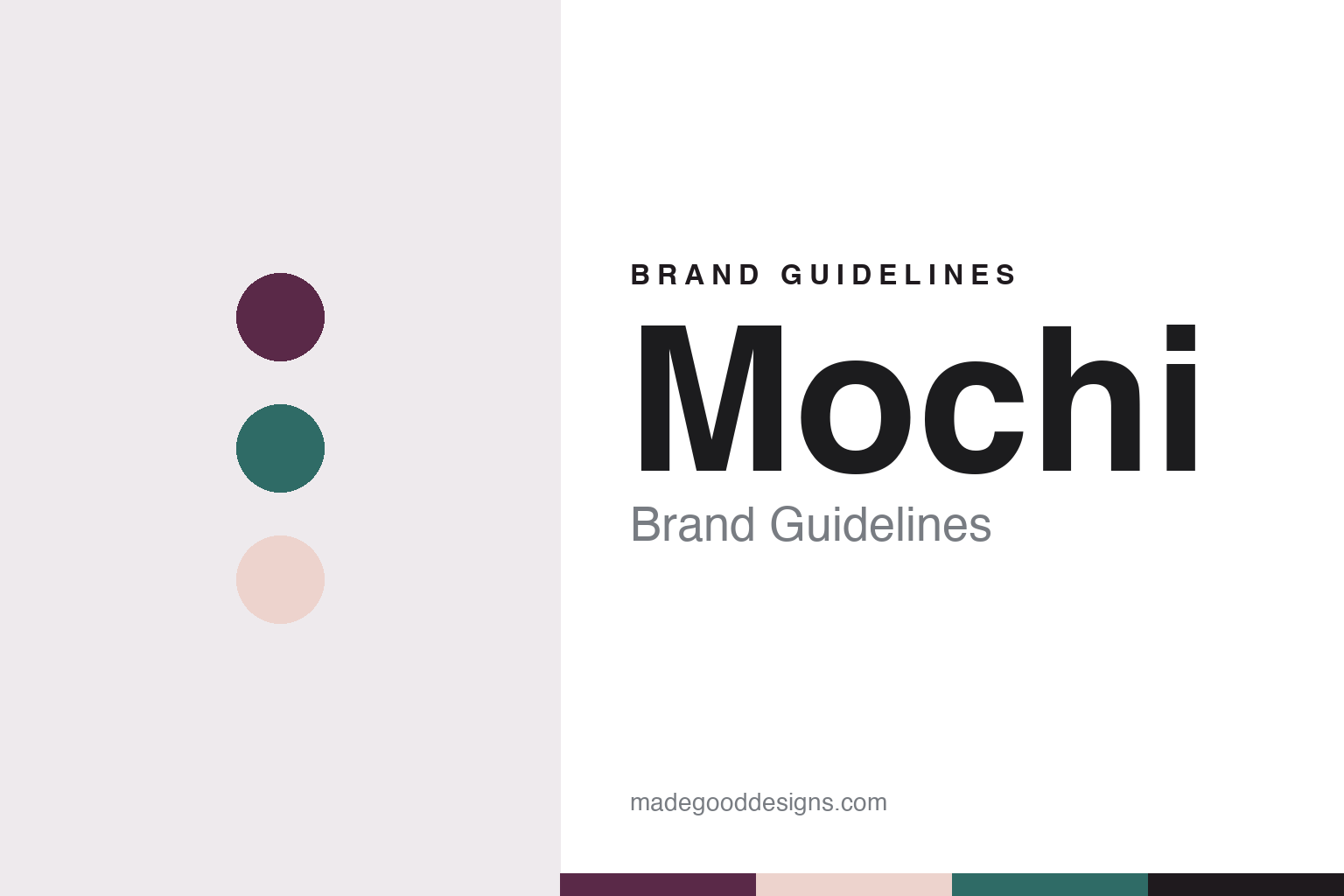
Mochi Brand Guidelines
The younger banner of a Mumbai shoe retailer.
Aa
Two constants: a plum, blush and teal palette and a geometric sans register. Abstract homage — not a Mochi product or mark; no shoe, logo or store sign is reproduced.
A second banner
Built for a younger shopper than Metro.
Mochi is a footwear and accessories banner owned by Metro Brands Limited, the Mumbai retailer that grew out of the Metro Shoes store opened by Malik Tejani in Colaba. Its dates need a little care. The company says it began selling products under the Mochi name in 1977, the year Metro Shoes was incorporated, and opened its first Mochi-branded store in 2000. Press accounts date the banner from that store. Forbes India wrote in February 2019 that Mochi was started in 2000 by Farah Malik Bhanji, granddaughter of the founder and later managing director of Metro Brands; a February 2014 report in the retail trade title Retail4Growth placed the first Mochi store on Commercial Street in Bengaluru, and described the banner as a national chain spread across larger and smaller cities.
The reasoning was about age. Farah Malik Bhanji told Entrepreneur, in a profile published by Franchise India in April 2012, that Metro Shoes had begun with men’s and women’s footwear and was “more of a family store,” and that the company saw a need for a younger brand to reach India’s large youth population: “that’s how we started Mochi.” Forbes India described Mochi in 2019 as having “a younger vibe” than the parent banner. The company today describes Mochi as a brand targeting the youth while also catering to the entire family, with shoes for day, work, evening and party wear and for special occasions including weddings.
Mochi’s story runs through the same family that built the parent chain. Tejani’s son Rafique Malik expanded Metro from two stores in 1969 to about 50 by 2006, Forbes India reported, and it was his daughters who led the move into new banners: Farah Malik Bhanji with Mochi, and her sister Alisha Malik in e-commerce and marketing. Farah Malik Bhanji joined the business in 1999, the magazine said, starting in marketing before moving to product and concept development.
Colour
Stores, ranges and local stock.
Mochi grew as a chain of its own shops. By 2012 it was one of three Metro banners named in the Entrepreneur profile, alongside Metro itself and the value format MSL, short for More Shoes for Less. Trade titles followed its spread into new cities: FashionUnited reported Mochi’s first store in Puducherry in January 2013, and Retail4Growth reported its first Patna store in February 2014, when the chain, then styled “Mochi – The Shoe Shoppe,” had 76 outlets in more than 35 cities. By February 2019 Mochi accounted for 133 of Metro Brands’ 488 stores, Forbes India reported, with Walkway at 59.
The stores mix house labels with bought-in names. In its 2014 report Retail4Growth listed men’s shoes under J Fontini, Florsheim and Reebok, and women’s ranges under the Mochi and Haute Diva names, across casual, formal, party, ethnic and bridal footwear; it said the range in every Mochi store was tailored to local tastes. English Wikipedia describes J. Fontini as a men’s footwear label run under the Mochi retail portfolio, covering formal, casual, ethnic and occasion wear.
Like its owner, Mochi is a retailer rather than a maker. Rafique Malik told Forbes India in 2019 that “manufacturing and retailing are conflicts of interest,” because a factory runs long batches of one style while a shop needs hundreds of styles and sizes, and that the group had built a diverse vendor base instead: about 180 national and international suppliers that year, according to the magazine. The 2012 Entrepreneur profile named supplier cities including Mumbai, Agra, Delhi, Kanpur and Chennai, and overseas sources in China, Malaysia and Brazil, for the group as a whole.
Typography
Indian footwear and accessories.
Indian footwear, bag and accessory brands tend to present themselves through names more than through pictures. A single company often runs several labels at once, each with its own logo, catalogue and shop page, so that a rubber slipper, a sports shoe and a formal shoe can reach different buyers while sharing factories and distributors. On company websites the parent name usually sits in the footer and the investor pages, while the sub-brand names lead on the shelf.
Shopfronts carry much of that identity. Many of these companies sell through a mix of exclusive showrooms, franchised stores, multi-brand dealers and online marketplaces, and their own pages count those outlets and list the cities and states they reach. Some names are above all store names: Metro Brands runs Metro Shoes and Mochi as separate store banners.
Group ownership is part of the picture. Fastrack belongs to Titan Company, the watch and accessories business, and Woodland is the outdoor brand of the Delhi company Aero Club. Others, such as Relaxo, Liberty, Campus and Khadim’s, are listed companies whose corporate pages describe their founders, their factories and their share listings on the National Stock Exchange of India and BSE.
Advertising often leans on film actors, named in dated campaigns reported by the trade press, and on dated catalogues for each range. For a designer, the useful material is the documented part: the names, the store formats, the founding dates and the factories. The palettes and type in these guides are unofficial interpretations, and no logo or product is reproduced.
Aa
A geometric sans for a younger shop front. (Specimen set in Poppins, a sans STAND-IN; NOT the Mochi logo.)
Shutters and stages
Youth culture on the shop front.
Marketing has leaned on youth culture rather than on the film-star ambassadors used for the parent banner. In 2012 Farah Malik Bhanji told Entrepreneur that Mochi’s strategy was to associate with properties that appealed to young Indians, naming MTV Roadies and Channel V’s Indiafest.
Mochi has no listing of its own. It is part of Metro Brands Limited, whose shares were listed on the National Stock Exchange and BSE on 22 December 2021, Business Today reported; the newspaper said the proceeds of the share sale were earmarked for new stores under the Metro, Mochi, Walkway and Crocs names, and that the group then had 598 stores in 136 cities. English Wikipedia describes Mochi as serving casual, formal and occasion wear, and says the group had more than 1,000 stores in 221 cities as of 2026, across its own banners and partner brands such as Crocs, FitFlop and Clarks.
For a design guide, Mochi shows how a family retailer can give a second banner its own name and its own shop fronts aimed at a younger buyer, while the stock and suppliers stay within one group. Compare Metro Shoes, the parent banner from Colaba, and Liberty, the footwear maker from Karnal. For this guide we use plum, ink and blush with a deep teal accent and a sans, an unofficial interpretation; no product or logo is reproduced.
Explore & save
Keep Mochi’s identity on hand — save it to a board in the Made Good inspiration library.
Mochi identity set
Pin the Mochi plum, blush and teal palette and the geometric sans register to your own board.
Source & notes
Frequently Asked Questions
What font can I use to match the Mochi look?
This guide describes Mochi’s type as “A geometric sans for a younger shop front”. Its type specimen is set in Poppins from Google Fonts as a stand-in; Poppins is not Mochi’s own lettering.
What colours are in the Mochi palette?
This guide’s Mochi palette is Plum #5A2948, Ink #1F1A1E, Blush #EDD3CD, Deep teal #2F6B66 and Paper #FAF7F5. The tones are the guide’s own unofficial interpretation, not official Mochi hex codes.
Who owns Mochi?
Mochi is owned by Metro Brands Limited, Mumbai. Mochi is known for Women’s and men’s fashion footwear.