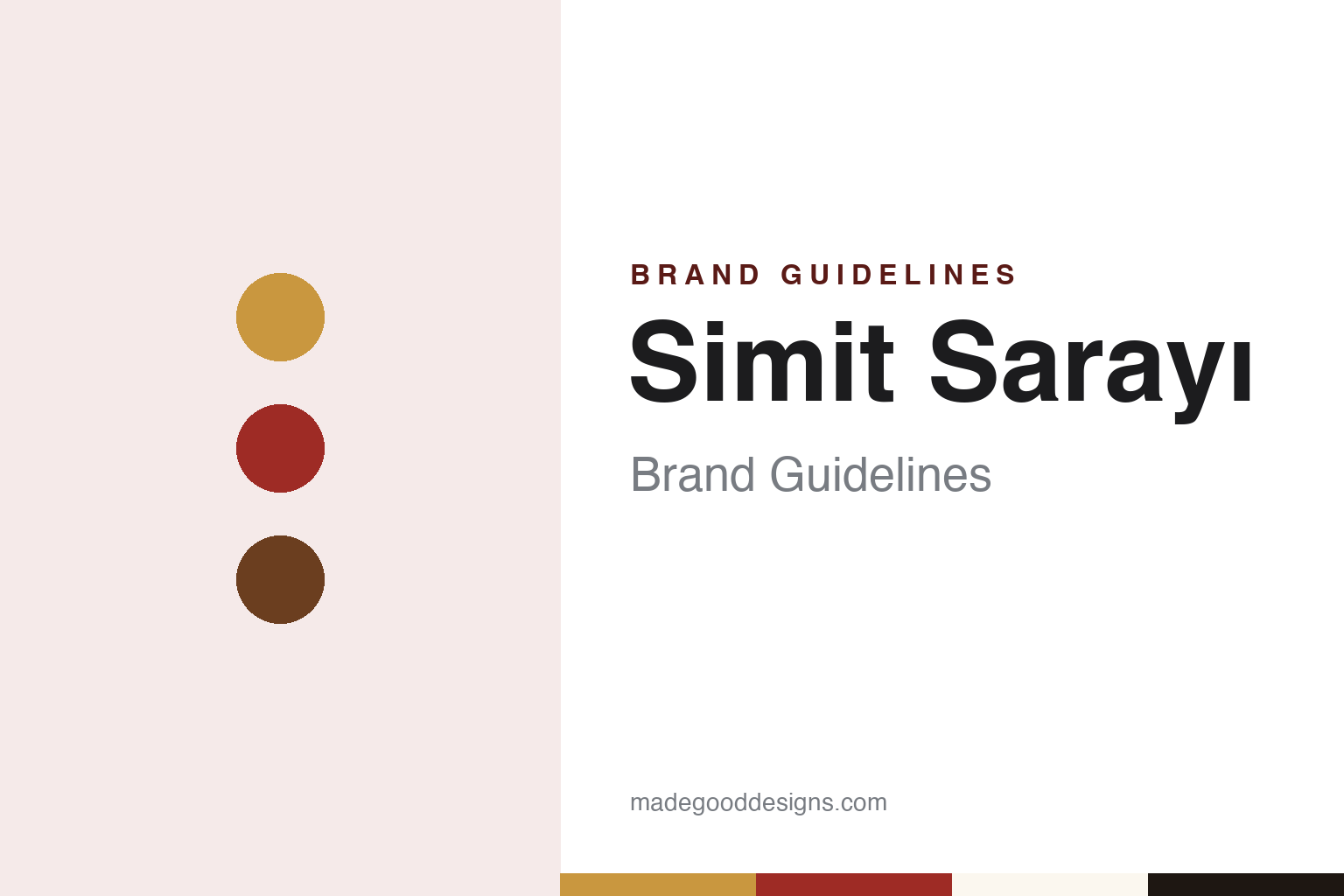
Simit Sarayı Brand Guidelines
The Istanbul street bread that moved indoors.
Aa
Two constants: a sesame gold, tea red and crust brown palette and a bakery sans register. Abstract homage — not a Simit Sarayı product or mark; no logo, sign or package is reproduced.
A simit shop
Three partners and a street bread.
Simit is a ring of bread covered in sesame seeds, loosely defined by Hürriyet Daily News in January 2013 as a Turkish bagel. The paper described it as a pastry dating back to the 14th century, sold mainly by street vendors through the Ottoman Empire and into the modern Turkish republic, and noted that the Simit Sarayı version is a variation of the Istanbul type. For most of that history it was sold from carts and trays in the street.
Simit Sarayı was launched in 2002 as a bakery-café business, the same paper reported. Daily Sabah wrote in July 2017 that it was founded by Haluk Okutur, Abdullah Kavukçu and Mehmet Tarakçı straight after Türkiye’s 2001 economic crisis. Accounts of the first shop differ. A 2013 column on Bloomberg HT placed it in Mecidiyeköy, in Istanbul, and said Okutur borrowed from Tarakçı, now his partner, to take it on. Ekonomist wrote in September 2018 that the brand grew from a shop called Çıtır Simit, which Okutur opened in 2002 at Rumelihisarı, opposite the Boğaziçi University campus.
The founders’ roles have shifted since. Bloomberg HT reported in April 2013 that Kavukçu, Okutur’s brother-in-law, ran the company as chief executive and vice chairman and was one of three equal partners. Ekonomist reported that Okutur had handed the executive chairmanship to Kavukçu in 2012 and moved on to new food-retail projects, and by 2018 Daily Sabah was quoting Kavukçu as chairman. The company behind the brand is Simit Sarayı Yatırım ve Ticaret A.Ş., its website says.
Colour
Counts, countries and a Saudi partner.
Growth was quick, and every count comes with a date. Hürriyet Daily News reported 204 restaurants in January 2013, 18 of them abroad; Bloomberg HT counted 241 stores and about 4,000 employees that April, with shops in the Netherlands, Cyprus, Germany and Mecca; and in November 2013 Hürriyet Daily News reported more than 300 branches in Türkiye and 50 abroad; in the second piece the founder described the company as taking simit from the carts on every corner and putting it into a café setting. The same report said Simit Sarayı took part in Turquality, the Economy Ministry programme that gave Turkish brands financial and advertising support, and was already present in Germany and the Netherlands.
Investors circled early. In January 2013 Kavukçu told the daily Hürriyet, as Hürriyet Daily News reported, that two investment firms were competing for a half stake, and that the founders had never considered selling the business outright. The partner that arrived was a franchisee. Daily Sabah reported in July 2017 that Simit Sarayı had signed an agreement to sell a 10 percent stake to the Saudi retailer Fawaz Alhokair Group, which had held a master franchise for the brand since 2014 and had opened about 50 branches across the Middle East and North Africa. The company’s own timeline now lists a strategic partnership with the Alhokair group.
By that July Daily Sabah counted 400 branches, 250 of them in Türkiye. In May 2018 the paper quoted Kavukçu as saying the chain had 426 stores in 22 countries and had entered Serbia, Dubai, Lebanon, Iraq and Jordan in 2017; Ekonomist gave 408 stores in 21 countries that September. The company’s website now speaks of 25 countries and 11,250 employees.
Production sits in-house. The company says it opened a simit factory in Samandıra, in Istanbul’s Sancaktepe district, in 2005, brought a new plant into service in 2015 for frozen raw and baked simit, and in 2016 made its first factory investment abroad, in London, as a base for Europe.
Typography
Shopfronts, menus and franchises.
Turkish café, bakery, kebab and casual-dining chains tend to build their names around a single dish or a single place. Some carry a city in the name, as Mado does with Maraş, the older name of Kahramanmaraş; others carry the food itself, as Simit Sarayı does with the sesame-covered simit. On their own websites the companies present the dish first and the shop second, with menus organised by named dishes such as künefe, baklava, simit or döner rather than by abstract product lines.
Many of these chains grew by moving street food indoors. Hürriyet Daily News wrote in 2013 that simit, once sold from carts, had become a large business run by chain restaurants, and the companies themselves describe their shopfronts as cafés, bakeries or restaurants with seating, counters and displays that make the food the main sight.
Franchising carries the brands abroad. Turkish chains publish franchise pages and lists of foreign branches, and some work through master franchisees that run a whole region; Daily Sabah reported in 2017 that a Saudi retail group had held such a franchise for Simit Sarayı across the Middle East and North Africa since 2014. Shops abroad often sit in malls and on main shopping streets, according to the companies’ own branch lists.
Ownership is usually described plainly on corporate pages: a family company, a holding company behind several brands, or a founding partnership that later sold a minority stake. This guide sets out who founded each brand, who owns it now and where its food is made, using dated press reports where they exist and marking what rests only on the company’s own word.
Aa
A round, friendly sans for a bakery café. (Specimen set in Outfit, a sans STAND-IN; NOT the Simit Sarayı logo.)
Simit Sarayı
A bakery café the world can read.
The brand’s design idea is the café itself. In May 2018 Kavukçu told Daily Sabah that Simit Sarayı had a design the world reads as a “bakery cafe,” with a product range to match, and that the company’s own architectural team was working on new store concepts, with research and development teams that included Turkish, British, Italian and French specialists.
The menu runs through the day. The company’s website describes fresh products from the oven at breakfast, lunch and dinner, served with tea brewed dark in the style Turks call “tavşan kanı,” and its timeline lists airline catering among its businesses. Its shops abroad, it says, include the Netherlands, where it opened its first store outside Türkiye, Saudi Arabia, New York, Amsterdam’s Dam Square and London’s Oxford Street, where it says it began baking on site.
The format keeps changing. The company says its second store at the Mecca Towers in Saudi Arabia was its first abroad in a “gourmet” concept, a 335-square-metre space aimed at every hour of the day with more than 150 products. Its corporate pages present the business as a Turkish name kept on purpose: the company says it gave up neither its name nor its taste, so that the food of these lands would be known by their name.
For a design guide, Simit Sarayı shows how a cheap street staple can be given a shopfront, a menu and a franchise manual without changing its name, and how one bread can carry a chain from Istanbul to Mecca and London. Compare Mado, another Turkish food tradition turned into a café chain, and Kahve Dünyası. For this guide we use sesame gold, tea red and crust brown with a sans, an unofficial interpretation; no product or logo is reproduced.
Explore & save
Keep Simit Sarayı’s identity on hand — save it to a board in the Made Good inspiration library.
Simit Sarayı identity set
Pin the Simit Sarayı sesame gold, tea red and crust brown palette and the bakery sans register to your own board.
Source & notes
Frequently Asked Questions
What font can I use to match the Simit Sarayı look?
This guide describes Simit Sarayı’s type as “A round, friendly sans for a bakery café”. Its type specimen is set in Outfit from Google Fonts as a stand-in; Outfit is not Simit Sarayı’s own lettering.
What colours are in the Simit Sarayı palette?
This guide’s Simit Sarayı palette is Sesame gold #C9973F, Tea red #9E2B25, Crust brown #6B3E1F, Ink #1E1712 and Flour white #FBF7EF. The tones are the guide’s own unofficial interpretation, not official Simit Sarayı hex codes.
When was Simit Sarayı founded?
Simit Sarayı was founded in 2002, in Istanbul, Türkiye. Simit Sarayı is known for Simit, pastries, tea.
Who founded Simit Sarayı?
Simit Sarayı was founded by Haluk Okutur, Abdullah Kavukçu and Mehmet Tarakçı in 2002.


