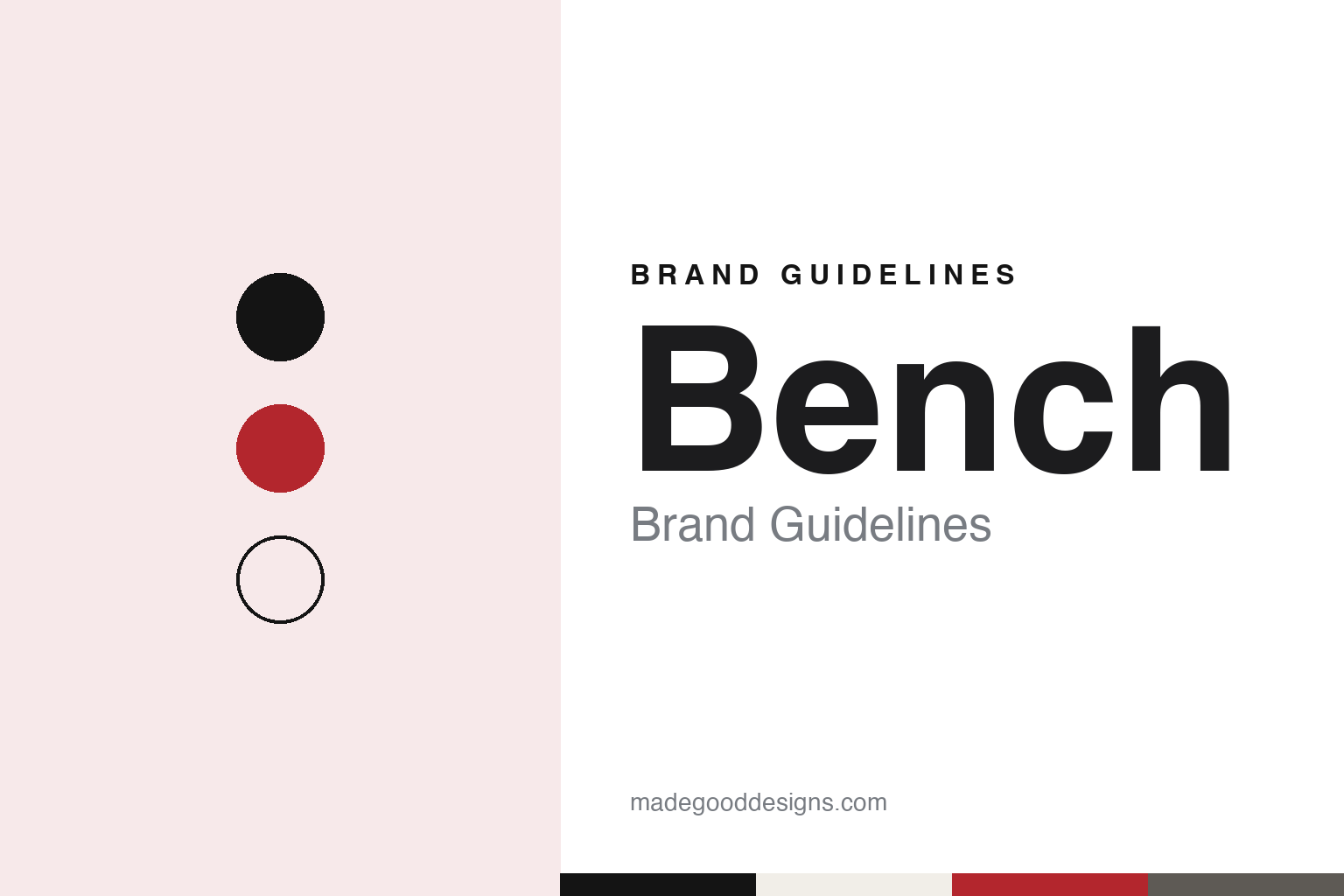
Bench Brand Guidelines
Ben Chan’s 1987 Manila T-shirt label, compressed into one word and a slash.
Aa
Two constants: a black, white and red palette and a clean retail sans register. Abstract homage — not a Bench product or mark; no garment, logo or shopfront is reproduced.
Ben + Chan
A T-shirt line in an SM department store.
Bench is a Philippine clothing and lifestyle brand founded by Ben Chan in 1987. English Wikipedia says it is owned by Suyen Corporation and sells casualwear, underwear and sportswear alongside bags, accessories, footwear and fragrances. The name is a contraction of its founder’s own name, Chan told the New Zealand fashion magazine Lucire in an interview first published in 2016: Ben plus Chan. Lucire adds that the brand is usually written with a trailing slash, as BENCH/, and English Wikipedia gives both bench/ and BENCH/ as its styled forms.
Chan came to clothing through design rather than through garments. The Philippine Star, marking the brand’s 25th year in July 2012, said he studied interior design in San Francisco, then worked as an accessories designer at Chan C. Brothers, a family firm, and opened a concept store called Dimensione that showed office furniture. Lucire says he set up a furniture store and an art gallery before he turned to T-shirts.
The company name came from a children’s shop. According to the same Philstar article, Chan’s sister Nenita Lim first opened a children’s boutique called Suyen at Harrison Plaza in Manila, and that boutique gave its name to the umbrella company, Suyen Corporation. Its success, the paper said, led the SM group to offer the pair a concession at SM Makati, and Chan designed a line of T-shirts and jeans for men that was branded Bench in 1987. English Wikipedia describes that first outlet as a small store selling men’s T-shirts inside an SM department store.
Colour
Billboards, endorsers and runways.
Bench grew through stand-alone shops and advertising. The Philippine Star dated the first Bench boutique to 1989, at Park Square, and said Chan signed the actor Richard Gomez as the brand’s image model, after which, in the paper’s words, came a “fabulous billboard history.” English Wikipedia dates the brand’s first television commercial, called “Sculler,” in which Gomez rows a boat, to 1991. A womenswear line, Her Bench, followed in 1993 with the actor Agot Isidro as its face, the 2012 Philstar article said.
Celebrity endorsement has stayed central to the brand. English Wikipedia says Bench turned to international faces from 1995 and, in the early 2020s, to Korean celebrities, reflecting the popularity of Korean drama and K-pop in the Philippines. Runway shows belong to the same approach: Lucire recorded a “Bench under the Stars” catwalk show in 2017, the brand’s 30th year, and GMA News reported that the “Body of Work” show was held at the Mall of Asia Arena on 21 March 2025, with the group SB19 among those at the event.
The visual side has drawn attention from outside the Philippines too. Writing in Lucire, its publisher Jack Yan described Bench’s outdoor, point-of-sale and television advertising as either clean or cutting-edge, and said the brand kept “a very strict adherence to its brand standards,” in contrast to what he saw as often ad hoc branding around it. He also described a short-lived Bench Design Studio at Glorietta in Makati, where customers could have T-shirts designed and made on site within minutes.
The product range has widened as well. Philstar.com reported in April 2023 that Bench sells ready-to-wear versions of the terno, the Filipino national dress with butterfly sleeves, often made in denim, together with modern versions of the barong Tagalog that run from linen and cotton polo barongs to hand-embroidered pieces; Chan said the terno was selling “very well.” The same report described Bench and Suyen as long-time partners of Ternocon, the biennial terno-making convention and competition.
Typography
Southeast Asian fashion and lifestyle.
Southeast Asia’s fashion, bag, accessory and lifestyle brands mostly speak through their own channels: a wordmark over a shopfront, a seasonal campaign, a named collection and an online shop. Many began as small businesses (a leather wholesaler, a garment maker, a family shop) and only later built a retail identity, so the brand story is often told through a founding date, a first boutique and a list of markets reached.
Collections and collaborations do much of the visual work. Labels name their lines by occasion, material or season, and add licensed characters, local actors and regional pop stars as ambassadors or muses. These partnerships change from season to season, while the name, the lettering and the shop interior usually stay fixed.
Ownership is often layered. Several labels sit inside larger groups: in Malaysia, Padini Holdings runs Vincci alongside its own clothing labels and sells them together in its concept stores, and Bonia Corporation holds a family of leather goods brands. In the Philippines and Thailand, groups such as Golden ABC and Jaspal Group own more than one label each, and each guide in this series describes its group from that brand’s own sources. Some companies are listed on their home stock exchange and publish corporate pages on founders, directors, subsidiaries and shareholdings; others remain private.
This guide sets out what can be checked about each brand: who founded it and when, who owns it now, where it sells and how it presents its name, with dated reporting from newspapers and trade press, and with the companies’ own claims marked as theirs. The palettes and type samples are our own interpretations, not official brand assets.
Aa
A clean retail sans — one word closed with a slash. (Specimen set in Archivo, a sans STAND-IN; NOT the Bench logo.)
Suyen
A family company with many brands.
Bench sits inside a wider retail group. The Philippine Star’s 2012 anniversary feature counted 28 brands in the Bench group, from its own labels — Bench, Her Bench, the clothing brand Human, started in 1999, and Kashieca, a knitwear label the group bought from an exporter — to the Bench Fix salons and franchised foreign names such as Charles & Keith and Aldo. Lucire called Suyen family-owned and described Chan as the founder, chairman and creative director of Bench; Philstar.com named him president and chief executive of Suyen Corp. in 2023.
Abroad, Lucire said Bench opened in Saudi Arabia in 1994 and then in China and Kuwait, and English Wikipedia lists the United States, the Middle East, China, Myanmar and Singapore among its overseas markets. At home the brand has stretched into lifestyle lines: English Wikipedia lists housewares and snacks among them, records that the first Bench Cafe opened in January 2018, and describes the Bench Design Awards, a fashion-design competition for young designers first held in 2017.
The thread through all of this is the T-shirt. Chan told Lucire that the T-shirt is the basic piece from which a whole wardrobe is built, and used it as a metaphor for how far the company had grown from its concession counter at SM Makati.
For a design guide, Bench shows how a founder’s name, compressed into one word and closed with a slash, can carry a whole retail group, backed by billboards, endorsers and tightly kept brand standards. Compare Penshoppe, the Cebu T-shirt label that grew into another Philippine fashion group, and Kamiseta. For this guide we use billboard black, cotton white and a signal red with a sans, an unofficial interpretation; no product or logo is reproduced.
Explore & save
Keep Bench’s identity on hand — save it to a board in the Made Good inspiration library.
Bench identity set
Pin the Bench black, white and red palette and the clean retail sans register to your own board.
Source & notes
Frequently Asked Questions
What font can I use to match the Bench look?
This guide describes Bench’s type as “A clean retail sans — one word closed with a slash”. Its type specimen is set in Archivo from Google Fonts as a stand-in; Archivo is not Bench’s own lettering.
What colours are in the Bench palette?
This guide’s Bench palette is Billboard black #141414, Signal red #B3262D, Cotton white #F1EEE8, Concrete grey #5E5A55 and Paper #F8F7F4. The tones are the guide’s own unofficial interpretation, not official Bench hex codes.
When was Bench founded?
Bench was founded in 1987, in Manila, Philippines. Bench is known for T-shirts, jeans, underwear, endorsers.
Who founded Bench?
Bench was founded by Ben Chan in 1987. Bench is known for T-shirts, jeans, underwear, endorsers.


