Kamiseta Brand Guidelines
A 1990 Philippine women’s label with Hollywood campaign faces.
Aa
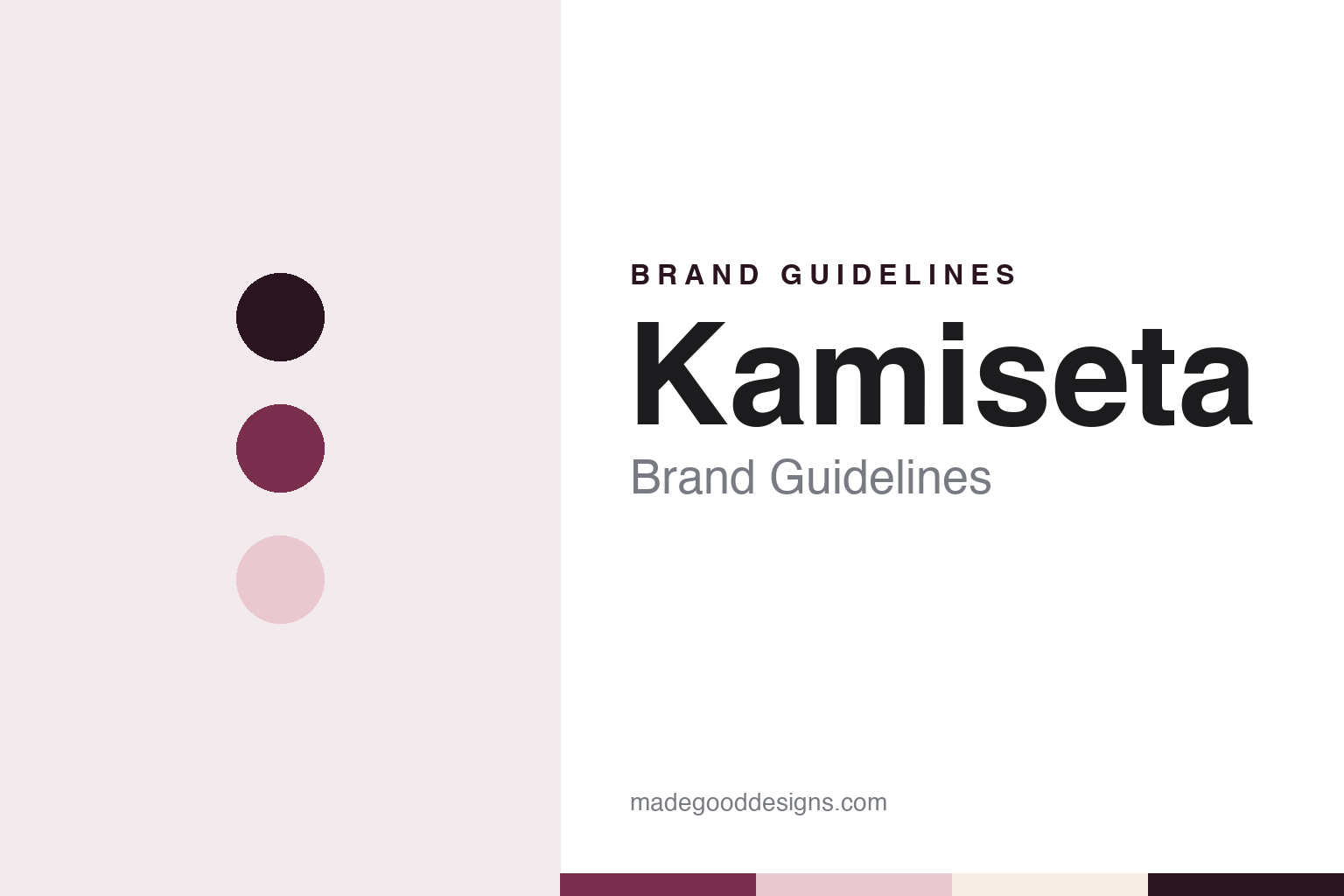
Two constants: a plum, blush and ivory palette and a high-contrast serif register. Abstract homage — not a Kamiseta product or mark; no garment, logo or campaign image is reproduced.
A corner in Sari-Sari
A fresh graduate, a borrowed corner and a mall boutique.
Kamiseta is a Philippine fashion brand for women, started in 1990 by Cris Aldeguer-Roque. In an interview with The Philippine Star published in April 2020, she said she began Kamiseta Clothing that year as a fresh graduate, with a small amount of seed money from her father and few other resources. MEGA magazine, writing in July 2021, also describes her as Kamiseta’s founder and chief executive.
The first sales point was not a shop of its own. Roque told the Star that she applied to sell through Sari-Sari, the store run by the designer Ricco Ocampo, and that, because her budget was tight, she made miniature samples of the clothes she planned to sell. He gave her a space of about ten square metres in his store. In those early years, she said, she bought the fabric and loaded it into her car, sent designs out to sewers, bought the buttons and thread, delivered the finished clothes and worked as the saleslady herself. The label grew to eight counters inside Sari-Sari.
The turning point, in her account, came when the SM group offered Kamiseta a space at SM Megamall. She had to choose between the eight counters she already had and one store of her own, and took the mall space, opening the first Kamiseta boutique there. From that point the label grew as a chain of its own stores: The Philippine Star reported 28 branches nationwide in April 2002 and 31 stores in May 2003.
The Roque family has run the company throughout the period these reports cover. In 2002 and 2003 the Star named Gonzalo “Gunn” Roque III as president and chief executive. In the 2020 interview Cris Roque described herself as owner, president and CEO of Kamiseta Clothing, Kamiseta Skin Clinic and Kamiseta Skin Care, and The Voice Newsweekly, a Pampanga paper, again called her CEO and owner in March 2022.
Colour
Hollywood faces on Manila billboards.
Kamiseta’s public image was built largely through its campaign faces. Its early endorsers were the sisters China and Mai Mai Cojuangco, The Philippine Star reported in 2002. In April that year the brand ran teaser billboards along Metro Manila highways and in its stores before revealing its new “Kamiseta girl,” the American actress Alicia Silverstone. The Star reported that the campaign was shot in the studio of the British photographer Paul Westlake, and that Silverstone modelled ten sets of clothes in a session lasting about eleven hours.
Other names followed. Natalie Portman became the image model in 2003, photographed in New York by the director Alek Keshishian, the Star reported in May 2003. Kate Hudson and the model Petra Nemcova came later, and in January 2010 the paper reported that the Russian model Natalia Vodianova, flown to New York for her shoot, was the newest face. In the 2020 interview Cris Roque listed past endorsers that also included Gretchen Barretto, Kris Aquino and Katie Holmes, and named the actress and painter Heart Evangelista-Escudero as the current face of Kamiseta Clothing.
Collaborations carried the same approach into the clothes. In November 2018 MEGA covered Love Marie x Kamiseta, a limited-edition collection with Evangelista, previewed during New York Fashion Week and then shown on a runway, in which her paintings were printed onto the garments alongside pleated details, stripes and denim pieces. Evangelista told the magazine that the paintings traced the ups and downs of her life so far, and that she used bright colours to express hope. In July 2021 MEGA reported Kamiseta x Kaayo, a collection between two home-grown, women-led labels, Kamiseta and the Mindanao brand Kaayo, that featured hand beadwork by T’boli women from Lake Sebu; the magazine said it was the first time Kamiseta had drawn on the craft of Mindanao.
Typography
Design and documentation.
Southeast Asia’s fashion, bag, accessory and lifestyle brands mostly speak through their own channels: a wordmark over a shopfront, a seasonal campaign, a named collection and an online shop. Many began as small businesses (a leather wholesaler, a garment maker, a family shop) and only later built a retail identity, so the brand story is often told through a founding date, a first boutique and a list of markets reached.
Collections and collaborations do much of the visual work. Labels name their lines by occasion, material or season, and add licensed characters, local actors and regional pop stars as ambassadors or muses. These partnerships change from season to season, while the name, the lettering and the shop interior usually stay fixed.
Ownership is often layered. Several labels sit inside larger groups: in Malaysia, Padini Holdings runs Vincci alongside its own clothing labels and sells them together in its concept stores, and Bonia Corporation holds a family of leather goods brands. In the Philippines and Thailand, groups such as Golden ABC and Jaspal Group own more than one label each, and each guide in this series describes its group from that brand’s own sources. Some companies are listed on their home stock exchange and publish corporate pages on founders, directors, subsidiaries and shareholdings; others remain private.
This guide sets out what can be checked about each brand: who founded it and when, who owns it now, where it sells and how it presents its name, with dated reporting from newspapers and trade press, and with the companies’ own claims marked as theirs. The palettes and type samples are our own interpretations, not official brand assets.
Aa
A high-contrast serif for a fashion label. (Specimen set in Playfair Display, a serif STAND-IN; NOT the Kamiseta logo.)
Kamiseta
Stores, a web shop and a skin clinic.
The range has stayed broad. When The Philippine Star reported the launch of online shopping at kamiseta.com in December 2009, it listed tops, dresses, knits and accessories among the lines on sale. Gunn Roque told the paper that the web shop answered requests from customers spread across the country’s islands and from Filipinos living abroad.
Kamiseta looked outward early. In 2002 Gunn Roque told the Star that the company was receiving franchise inquiries from abroad, including from Switzerland, Japan, France and the United States, and in 2003 the paper reported that Kamiseta had shown its clothes at the MAGIC trade show in Las Vegas. Roque said then that, rather than simply placing clothes in outlets overseas, he wanted Kamiseta sold abroad in shops with an identity of their own, so that a Filipino brand would be recognised as such. The name was carried beyond clothing in 2017, when Cris Roque started Kamiseta Skin Clinic, she said in 2020; a Kamiseta Skin Care line sits alongside it. The chain kept opening mall branches: in March 2022 The Voice Newsweekly reported a new Kamiseta store on the ground floor of SM City Clark in Pampanga.
For a design guide, Kamiseta shows how a home-grown label can borrow the language of international fashion advertising, with named campaign faces, teaser billboards and collaboration collections, while keeping its own name at the centre. Compare Bench and Penshoppe, two other Philippine fashion labels built through malls and celebrity campaigns. For this guide we use a deep plum, a blush rose and a warm ivory with a high-contrast serif, an unofficial interpretation; no product or logo is reproduced.
Explore & save
Keep Kamiseta’s identity on hand — save it to a board in the Made Good inspiration library.
Kamiseta identity set
Pin the Kamiseta plum, blush and ivory palette and the high-contrast serif register to your own board.
Source & notes
Frequently Asked Questions
What font can I use to match the Kamiseta look?
This guide describes Kamiseta’s type as “A high-contrast serif for a fashion label”. Its type specimen is set in Playfair Display from Google Fonts as a stand-in; Playfair Display is not Kamiseta’s own lettering.
What colours are in the Kamiseta palette?
This guide’s Kamiseta palette is Deep plum #7A2E4E, Ink plum #2A1420, Blush rose #E9C9CF, Warm ivory #F6EEE6 and Soft sand #D9C2A7. The tones are the guide’s own unofficial interpretation, not official Kamiseta hex codes.
When was Kamiseta founded?
Kamiseta was founded in 1990, in Philippines. Kamiseta is known for Women’s clothing, Hollywood campaign faces.
Who founded Kamiseta?
Kamiseta was founded by Cris Aldeguer-Roque in 1990. Kamiseta is known for Women’s clothing, Hollywood campaign faces.