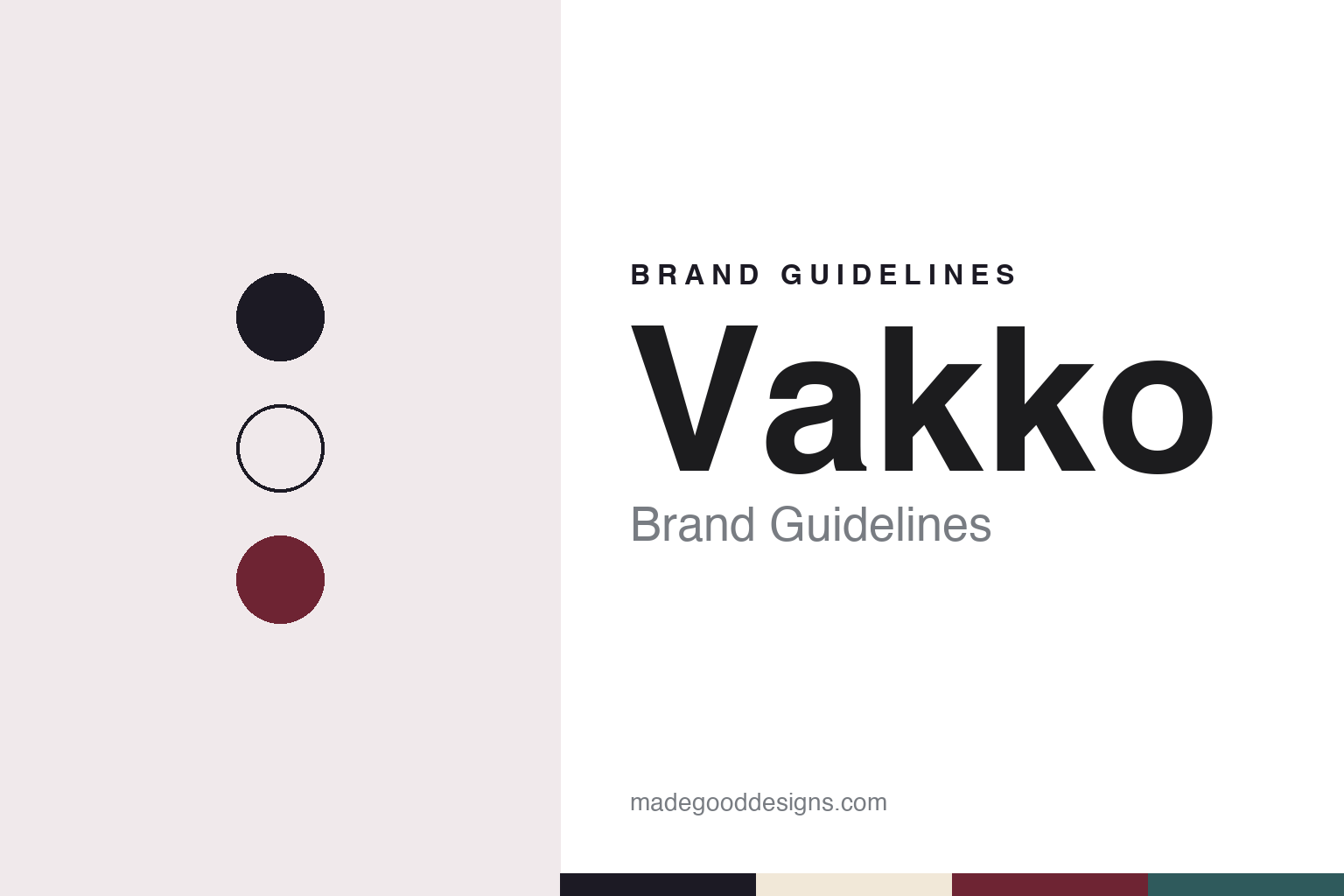
Vakko Brand Guidelines
A hat shop in Sultanhamam that grew into a silk-scarf house.
Aa
Two constants: an ink, silk cream and bordeaux palette and a high-contrast serif register. Abstract homage — not a Vakko product or mark; no scarf design, logo or label is reproduced.
Şen Şapka
A hat shop, then a scarf house.
Vakko began as a hat shop. In 1934 Vitali Hakko opened Şen Şapka, “the Happy Hat,” in Sultanhamam, Istanbul, Daily Sabah reported in a January 2015 feature on the history of hats. The paper linked the shop to the hat reform of 1925 and wrote that it became a destination for the city’s elite women. English Wikipedia says that in 1937 Hakko’s older brother Albert became a partner, the business took the name Vakko, and it set up a silk-dyeing workshop in Kurtuluş, in the Şişli district; Turkish Wikipedia places the move to the Vakko name in the 1940s, so the two accounts differ on the year.
Scarves were the bridge from hats to fashion. English Wikipedia says the renamed business made scarves of Turkish silk, cotton and wool, then moved into printed fabrics and ready-to-wear. In a March 2025 report, the Greek news site iefimerida wrote that by the 1940s Hakko’s attention had turned to scarves, using Anatolian cotton and silk from Bursa and working with artists on the patterns, and that in 1948 he acquired a fabric-printing works in Kurtuluş; Turkish Wikipedia also dates the start of printed scarves to 1948. The same report tells how Hakko brought a Paris scarf artist to Istanbul, where she painted a series of designs including “Bosphorus” and “Princes’ Islands.”
Hakko set down the story himself. His memoir, Hayatım Vakko (“My Life, Vakko”), was published in 1997, Turkish Wikipedia says. The company is now led by his son, Cem Hakko, according to English Wikipedia and iefimerida.
Colour
Beyoğlu, Vakkorama and a factory by Haluk Baysal.
The retail side grew from Beyoğlu. In 1962 Vakko opened an eight-storey store on İstiklal Avenue with a café and a fashion gallery, English Wikipedia says; it traded there until 2006, when the building became a Mango branch. Further stores followed in Ankara in 1973 and İzmir in 1979, and in September 1979 Vakko opened a shop on Old Bond Street in London. In 1982 it opened Vakkorama, a store aimed at young shoppers, in Taksim, and in 2000 Vakkorama introduced V2K Designers, a multi-brand concept that stocks international designer labels.
Production gained its own landmark. In 1969 the company built the Vakko Turistik Elişi, Eşarp ve Konfeksiyon Fabrikası, a handicraft, scarf and garment factory on the Londra Asfaltı road in Istanbul, designed by the architect Haluk Baysal, the Turkish news site GZT reported in an August 2022 architecture feature. The complex had about 24,000 square metres of covered space on a site of more than 62,000, with showrooms and a restaurant along the road, workshops and offices behind, and a social block with sports grounds and a pool. Artists worked on the building itself: GZT lists ceramic panels by Jale Yılmabaşar and mosaic and concrete works by Bedri Rahmi Eyüpoğlu, among others, and quotes the architecture magazine Arkitekt of the period praising the collaboration between owner, architects and artists.
That building is gone. After Vakko decided in 2007 to move production, the factory was demolished and a shopping centre built on the site, and some of the artworks were moved to Vakko’s head office at Nakkaştepe, GZT reported. The company’s profile on KAP, Turkey’s Public Disclosure Platform, now gives its production facilities at Esenyurt, Istanbul, and Turkish Wikipedia dates the move there to 2008. KAP describes the main business as printed-fabric and ready-to-wear production and sale, in luxury retail, through formats including Vakko, Vakkorama, W Collection and Vakko Home.
Typography
Design and documentation.
Türkiye’s grocery trade includes three neighbourhood discount chains with stores in all 81 provinces, BİM, A101 and ŞOK, according to English Wikipedia. In October 2021 the newspaper Türkiye counted about 10,150 A101 branches, 9,274 BİM stores and 8,145 ŞOK markets, and ESM Magazine reported in July 2026 that A101 alone ran around 13,600 outlets. Alongside them sit multi-format grocers: Migros, whose formats include Macrocenter stores, and CarrefourSA, with a multi-format network of around 1,237 stores at the end of 2025, according to the same magazine.
The discount chains publish their identity mainly through range and print. BİM says it keeps its store interiors deliberately modest, and its website gives separate sections to its own labels and its special buys; A101 prints a weekly discount catalogue and publishes it online, Turkish Wikipedia says. Own labels are a large part of that picture: English Wikipedia lists more than 150 for BİM and more than 60 for A101, from dairy and pantry lines to small electronics.
The screens follow the shelf. Migros fulfilled online orders from 2,103 stores at the end of 2025, ESM Magazine reported, and A101 launched its A101 Kapıda delivery app in April 2020, according to English Wikipedia. Electronics retailers, home-improvement chains and online marketplaces add showrooms, apps and product pages of their own, and the guides in this group look at each company’s fascia, app screens and naming as the company publishes them.
Ownership is part of the public face too. BİM has been listed on Borsa İstanbul since 2005; A101 is privately owned by the Aydın family and, ESM Magazine noted, does not publish detailed financial results; ŞOK and Migros report full-year results. Each guide sets out who founded the company, who owns it and where it is listed, and marks what rests on the company’s own word.
Aa
A high-contrast serif for a scarf house. (Specimen set in Bodoni Moda, a serif STAND-IN; NOT the Vakko logo.)
Vakko
A listed company with a library and a school.
Vakko is a listed company. Its shares, under the name Vakko Tekstil ve Hazır Giyim Sanayi İşletmeleri, have been listed on Borsa Istanbul since April 1998 and trade under the ticker VAKKO, KAP shows. Its head office is in Üsküdar, on Istanbul’s Asian side. English Wikipedia says the Vakko Fashion Center at Nakkaştepe, designed by the New York practice REX and shared with the group’s broadcaster Power Media, opened in 2010 and houses the management and creative teams, showrooms, an auditorium and the Vitali Hakko Creative Industries Library, a public library of books on fashion, architecture, design, film and music.
The brand has stretched well beyond clothing. English Wikipedia records Vakko Home from 2009, the Vakko Esmod fashion school set up in 2013 with the Paris school ESMOD, and Vakko Patisserie and the Vakko L’Atelier food and drink brand from 2016. As of 31 December 2023, it says, Vakko had 181 points of sale, including 29 department-store units, 44 Vakko Boutique stores, 27 Vakkorama stores and 51 W Collection menswear stores. Its store on Bağdat Avenue in Suadiye has been housed since 1996 in a historic wooden yalı, a traditional Istanbul mansion, English Wikipedia says.
The house has also gone abroad again. In March 2025 iefimerida reported the opening of a Vakko store in Greece, in the Kolonaki district of Athens, in the former house of the actress Marika Kotopouli, with fragrances, homeware and Vakko Chocolate on the ground floor and womenswear and menswear on the floors above. The palette in this guide, with its ink, silk cream and bordeaux, is our own reading of that scarf-and-store heritage rather than a company colour standard.
For a design guide, Vakko shows how a scarf house built an identity on printed silk, store architecture and artists’ work. Compare Boyner, the department-store chain that grew from the Altınyıldız textile business, and Trendyol, the Istanbul online marketplace. For this guide we use ink, silk cream and bordeaux with a high-contrast serif, an unofficial interpretation; no product or logo is reproduced.
Explore & save
Keep Vakko’s identity on hand — save it to a board in the Made Good inspiration library.
Vakko identity set
Save the Vakko ink, silk cream and bordeaux palette and the high-contrast serif register to your own board.