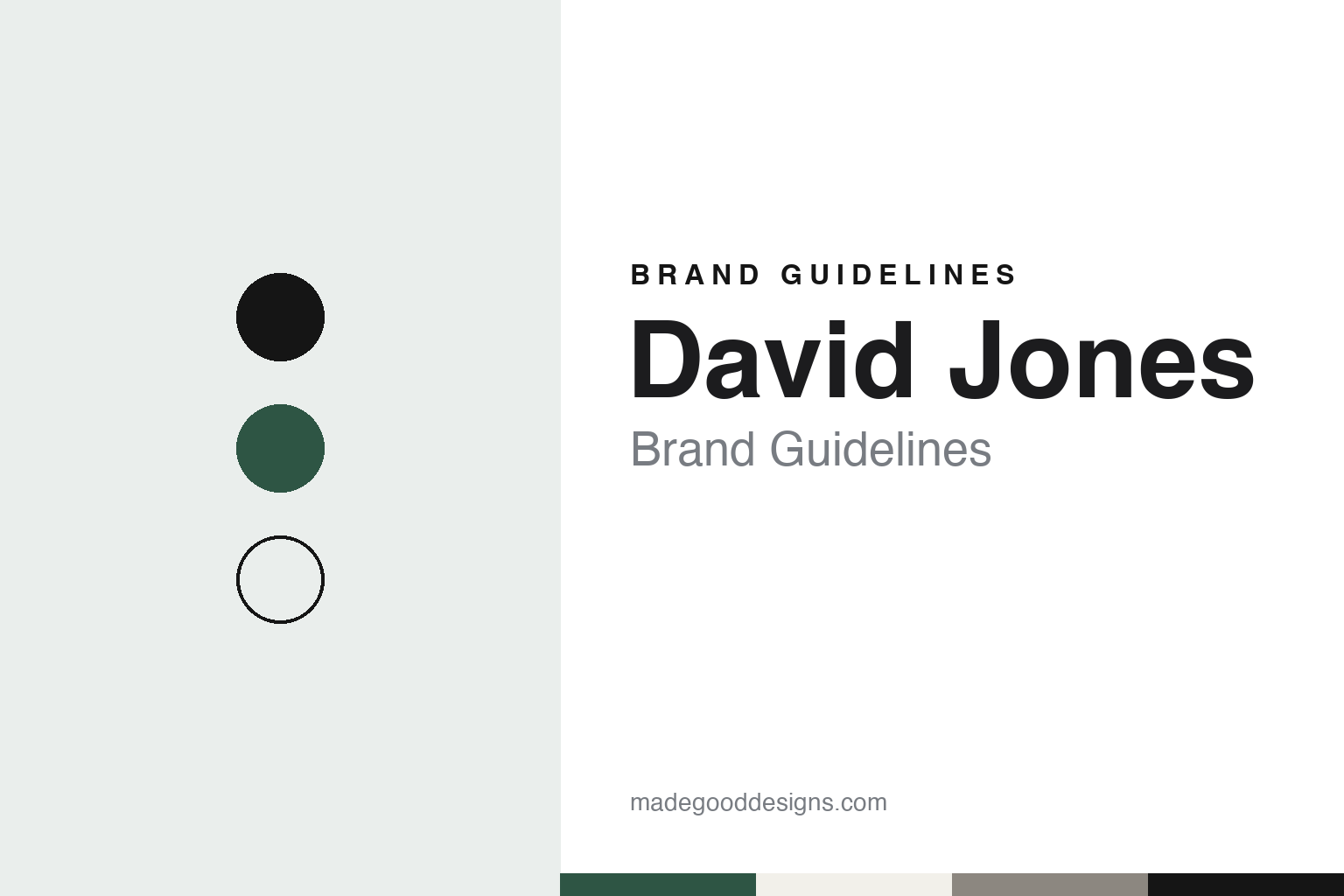
David Jones Brand Guidelines
A Sydney drapery name carried for 188 years.
Aa
Two constants: a black, white and green palette and a high-contrast serif register. Abstract homage — not a David Jones product or mark; no logo, houndstooth artwork, bag or sign is reproduced.
Appleton and Jones
A Welsh merchant’s Sydney drapery.
David Jones takes its name from its founder, David Jones, a Welsh merchant. English Wikipedia says he met the Hobart businessman Charles Appleton in London; Appleton had set up a store in Sydney in 1825, Jones went into partnership with him and moved to Australia in 1835, and the shop became known as Appleton and Jones. When the partnership ended in 1838, Jones moved his business to premises on the corner of George Street and Barrack Lane. ABC News, in a report for its 7.30 programme published on 12 November 2026, describes the 1838 business as a drapery on the corner of Barrack and George streets, opposite the General Post Office.
The young business had hard years. Jones survived the depression of the 1840s and had withdrawn from active management by 1856; when the firm later failed, he came back to run it and within a few years had paid its creditors in full, English Wikipedia says. By 1887 the George Street store had been rebuilt, a mail-order service had been added, and a factory in Marlborough Street, Sydney, was making goods to reduce reliance on imports. His son Edward Lloyd Jones and then Edward Lloyd Jones Jr led the company after him, and it became a public company in 1906.
The Sydney flagships date from the interwar years. The Elizabeth Street store opened in 1927 under the chairman Charles Lloyd Jones, and a further store in Market Street followed in 1938; ABC News describes the period as a move into new buildings in Market and Elizabeth streets. In 1944 the company opened the David Jones Art Gallery inside the Elizabeth Street store, whose programme that year included a William Dobell exhibition and, in 1962, the Mendel Collection of modern painting, English Wikipedia says. In the 1940s the store also hosted a Christian Dior fashion parade.
Colour
Suburbs, takeovers, Woolworths and Anchorage.
After the war David Jones spread beyond central Sydney, largely by buying local department stores. English Wikipedia lists Charles Birks & Co in Adelaide and Bon Marche in Perth in 1954, Finney Isles in Brisbane in 1955, Scott’s in Newcastle in 1957, Walter Lance and Co in Wollongong in 1960 and T.C. Beirne in Brisbane in 1961, with a move into Victoria in the 1960s. By 1959, it says, the network had eight stores, with growth aimed at the new suburbs of Sydney. ABC News described the opening of the Parramatta store in Sydney’s west in the early 1960s, when an estimated 4,000 people gathered outside to watch the ribbon being cut.
Family control ended in 1980. ABC News called it a hostile takeover by Adelaide Steamship; English Wikipedia says the Adelaide Steamship Company built a substantial stake that ended in a complete takeover, taking the business out of the Jones family’s hands for the first time. The family had owned or run the store for more than 140 years, ABC News reported. In those years the company added Buckley & Nunn in Melbourne in 1982 and John Martin’s in Adelaide in 1985. After the early-1990s recession broke up the Adelaide Steamship group, the department stores were floated in 1995 as a new David Jones Limited on the Australian Securities Exchange.
A rival bid came and went. Myer approached David Jones about a merger in October 2013; the board rejected it, and Myer withdrew a second approach in April 2014 when David Jones recommended a cash offer from the South African group Woolworths Holdings. The Federal Court of Australia approved that takeover in July 2014, English Wikipedia says. Under Woolworths the chain opened its first New Zealand store in Wellington on 28 July 2016, in the former Kirkcaldie & Stains department store, and a store at Westfield Newmarket in Auckland on 21 November 2019; the Wellington store closed in June 2022. The 1938 Market Street building was sold in 2016, and its departments moved into an enlarged Elizabeth Street store. Woolworths agreed to sell David Jones to the Australian private-equity firm Anchorage Capital Partners in December 2022, and the sale was completed in March 2023; The Daily Aus also gives Anchorage as the owner since 2023.
Typography
How Australian and New Zealand retailers present themselves.
Australian and New Zealand department, discount and specialty retailers present themselves first through the shop front. Many chains grew by buying older local stores and then putting their own name over the door, so a single fascia in a city mall or a regional town often carries several earlier businesses behind it. Myer, for example, renamed the Grace Bros stores of New South Wales in 2004, two decades after buying the chain. Store names are usually plain: a founder’s surname, a description of what is sold, or a short set of initials.
The calendar does much of the talking. Department stores mark Christmas with window displays, and in Melbourne the Myer windows on Bourke Street have been documented by State Library Victoria since their start in 1956. Discount and specialty chains lean instead on printed and online catalogues, seasonal sales with their own names and colour-coded sale signs, published on the companies’ own channels. Loyalty programmes, cards and apps carry the same name and colours as the stores.
Own-label ranges sit beside the brands a retailer stocks. Many groups sell products under house names, or own fashion and homewares labels that also trade as separate shops, and present them in their own sections of the store and website. A pattern, a single colour or a capitalised wordmark often does the work of recognition: David Jones adopted a black-and-white houndstooth in 1967 so that its packaging would not need the name.
Behind the fascias sit corporate pages. These usually give a founding story and name the founders, the parent group and, for listed companies, the exchange and investor pages with dated announcements. Changes of owner, administrations and store closures appear there and in the business press, which is often the clearest record of how a shop name has passed from one owner to the next.
Aa
A high-contrast serif for a name kept since 1838. (Specimen set in Playfair Display, a serif STAND-IN; NOT the David Jones logo.)
David Jones
A houndstooth, and a store network cut in half.
The chain’s visual signature is a black-on-white houndstooth pattern. English Wikipedia dates it to a 1967 rebranding led by Charles Lloyd Jones Jr, who wanted the store to be so well known by the pattern that its name would not be needed on the packaging. On 25 July 2016 the company introduced a new logo with revised lettering and removed the houndstooth references online, the same source says. Food halls in several stores have also been treated as part of the brand.
In November 2026 the business entered administration. David Jones went into voluntary administration on 5 November 2026, after rescue talks with its biggest landlord, the Westfield owner Scentre Group, broke down, The Daily Aus reported that day. ABC News reported on 11 and 12 November that McGrathNicol had been appointed administrator and that FTI Consulting had been appointed receiver on behalf of the main secured lender, Hilco. On 11 November the receiver confirmed that 19 of the 38 stores would close, among them Parramatta, the Hay Street Mall store in Perth and Newmarket, the last New Zealand store; the affected stores were expected to keep trading through the peak season, with closure dates later in the year. As of 12 November 2026, ABC News reported, the administrator was seeking expressions of interest from prospective buyers, and the remaining stores were trading.
For a design guide, David Jones shows a Sydney drapery name carried for 188 years, a pattern meant to identify the store without its name, and a network being cut back under administrators in 2026. Compare it with Myer, its long-standing department store rival, and with Farmers, the New Zealand department store chain. For this guide we use a houndstooth black, a gallery white, a food-hall green and a warm grey with a high-contrast serif, an unofficial interpretation; no product or logo is reproduced.
Explore & save
Keep David Jones’s identity on hand — save it to a board in the Made Good inspiration library.
David Jones identity set
Pin the David Jones black, white and green palette and the high-contrast serif register to your own board.