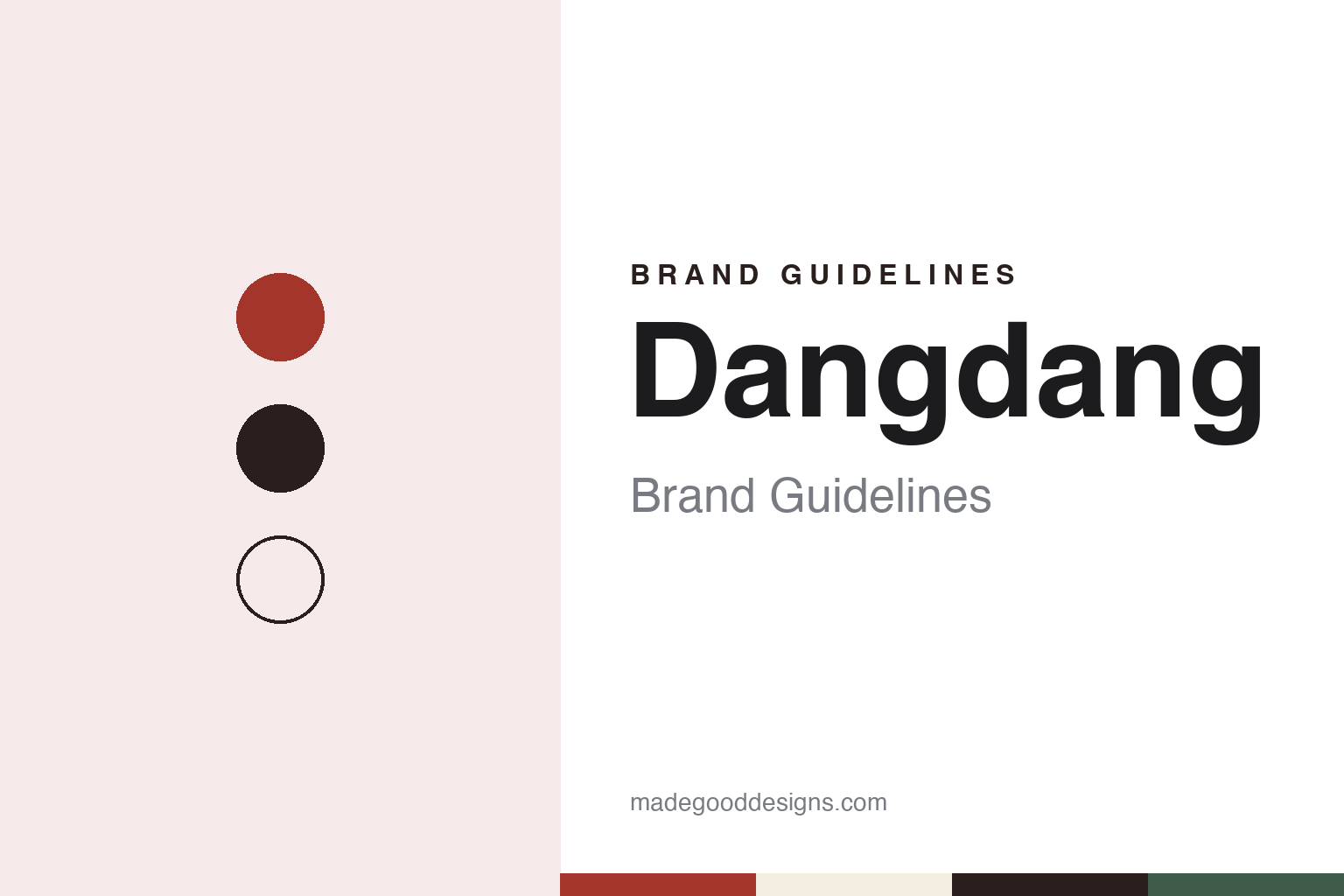
Dangdang Brand Guidelines
The Beijing online bookseller that went general, went private and went back to books.
Aa
Two constants: a red, ink and paper cream palette and a bookish serif register. Abstract homage — not a Dangdang product or mark; no logo, shop front or app screen is reproduced.
Dangdang.com
A Beijing online bookshop from 1999.
Dangdang (当当) is a Beijing online retailer that began as a bookseller. Chinese Wikipedia describes it as selling mainly books and audio-visual products, with small appliances, toys and online game cards among its other lines. English Wikipedia names its founders as Peggy Yu (Yu Yu) and Li Guoqing and dates the launch of the website to November 1999; Chinese Wikipedia says the company was set up in 1997 and the site went live in November 1999, and that in February 2000 it took investment from groups including IDG and SoftBank. Caixin Global described Dangdang in March 2018 as starting out as an Amazon-like book retailer in 1999, and in March 2019 named Peggy Yu as co-founder and chair.
The bookshop did not stay only a bookshop. Chinese Wikipedia says Dangdang began selling general merchandise after taking new investment in 2004, and the technology site ifanr wrote in January 2017 that it had turned into a general e-commerce platform in 2010. Peggy Yu told Caixin in 2019 that the company had expanded into maternal and childcare products, electronics and clothing, and that those efforts were later abandoned because the company chose to protect its profitability for its investors rather than chase market share. Caixin reported that Dangdang returned to profit in 2014 after three years of losses.
Dangdang listed on the New York Stock Exchange on 8 December 2010, a date given by both Caixin and Chinese Wikipedia. The listing lasted less than six years, and the years in between saw the company try to be much more than a bookseller.
Colour
A new mark and a private company.
In 2014 Dangdang changed its 当当网 logo, ifanr reported. The change came during the years of the general-store push that Peggy Yu later described to Caixin.
The company then left the stock market. A management buyout was proposed in July 2015, Chinese Wikipedia says; in May 2016 Dangdang signed a merger agreement with its parent company, and shareholders approved the deal on 12 September 2016, completing the privatisation and the delisting from New York. ifanr and Caixin both date the delisting to 2016. At a supplier conference on 9 January 2017, its first high-profile appearance after going private, Dangdang told publishers that it would concentrate on books again, ifanr reported, citing Xinhua; a company manager said low-margin categories such as everyday goods, clothing and electronics would be run more selectively.
Ownership talks followed. In March 2018 Tianjin Tianhai Investment, the Shanghai-listed subsidiary of HNA Group, said in a filing that it was seeking a stake in Dangdang, Caixin reported. A year later Caixin wrote that HNA had abandoned the deal in 2018. In February 2019 co-founder Li Guoqing said he was no longer part of the company and would pursue other book-related ventures, and Caixin described Dangdang as by then mostly focused on the online book market.
Typography
Platforms, stores and festivals.
Chinese retailers and e-commerce platforms present themselves across a wide range of surfaces at once. A single group may run hypermarkets, appliance showrooms, shopping malls, small franchised shops and a shopping app, and each has to carry the same name at very different sizes, from a rooftop sign on a city-centre store to a small icon on a phone. Many of these companies grew from one shop or one website into groups with several store formats, so their names often began with one product category and later had to stretch to cover many.
Naming is often plain and descriptive. Store and company names commonly pair a short brand word with a description of what is sold, such as electrical appliances, and later drop that description as the business widens. Platform names and company names can swap places: a group may rename itself after its own website or app, or give an app a new name and later return to the original one. Chinese characters and an English or pinyin form usually appear side by side, and the two do not always translate each other.
Shopping festivals shape much of the visual calendar. Dates such as 11 November, known as Double Eleven, bring campaign artwork across store windows, app home screens and delivery packaging, usually set around the date itself and the company’s own name. For a designer, the useful material is how the companies publish these campaigns and how the core name holds steady while the seasonal graphics change around it.
Corporate pages fill in the rest. Listed retailers publish their founders, owners and exchange listings in annual results and announcements, and these records also show renamings, store closures and changes of control as dated facts. Read together with independent press, they give a fuller picture of how each name has been used over time.
Aa
A bookish serif for a bookseller’s name. (Specimen set in Libre Caslon Text, a serif STAND-IN; NOT the Dangdang logo.)
Dangdang bookshops
From the screen to the shop floor.
The return to books also took Dangdang onto the high street. Its first physical bookshop, the Meixi bookshop in Changsha, opened in 2016, ifanr reported. The retail trade site Winshang described it in October 2023 as a four-storey shop of nearly 5,000 square metres built with the Bubugao retail group, open 24 hours, charging the same prices as Dangdang’s website, with online orders collected in store and home delivery for titles not on the shelves. By January 2017, ifanr said, Dangdang had about 143 shops, graded from large general bookshops and standard shops to children’s bookshops, supermarket and airport shops, and county-level stores. At the end of 2017 Dangdang said it had opened more than 160, Winshang reported. An analyst at the research firm Analysys told the January 2017 conference, according to ifanr, that Dangdang’s strength in books rested on brand recognition and supplier relationships built up over many years, and on early moves into children’s and business titles.
The estate later shrank. Winshang reported a wave of closures in 2020, with shops in Shenyang, Fuzhou and Wuhu among them. In October 2023 it said the Chongqing shop, opened in 2018 with about 2,500 square metres and a salon area for talks, was closing. That shop sat in a basement level of a mall in the Jiefangbei district and mixed books and reading areas with light dining, flowers and homewares, an art classroom and handmade goods. Winshang said 12 Dangdang shops were still trading, based on the list published by Dangdang’s own bookshop account; the Changsha shop was then shut for a move. The Meixi Shuyuan venue that housed it closed in July 2023 with no reopening date set, Winshang reported. Dangdang.com itself was still online in November 2026, under the 当当网 name, with a footer giving its copyright from 2004.
For a design guide, Dangdang shows how a bookseller’s name can stretch to a general store and come back to books, on screen and on the shop floor. Compare Alibaba and Vipshop, two other Chinese online retailers. For this guide we use a book-cloth red, ink and paper cream with a serif, an unofficial interpretation; no product or logo is reproduced.
Explore & save
Keep Dangdang’s identity on hand — save it to a board in the Made Good inspiration library.
Dangdang identity set
Pin the Dangdang red, ink and paper cream palette and the bookish serif register to your own board.