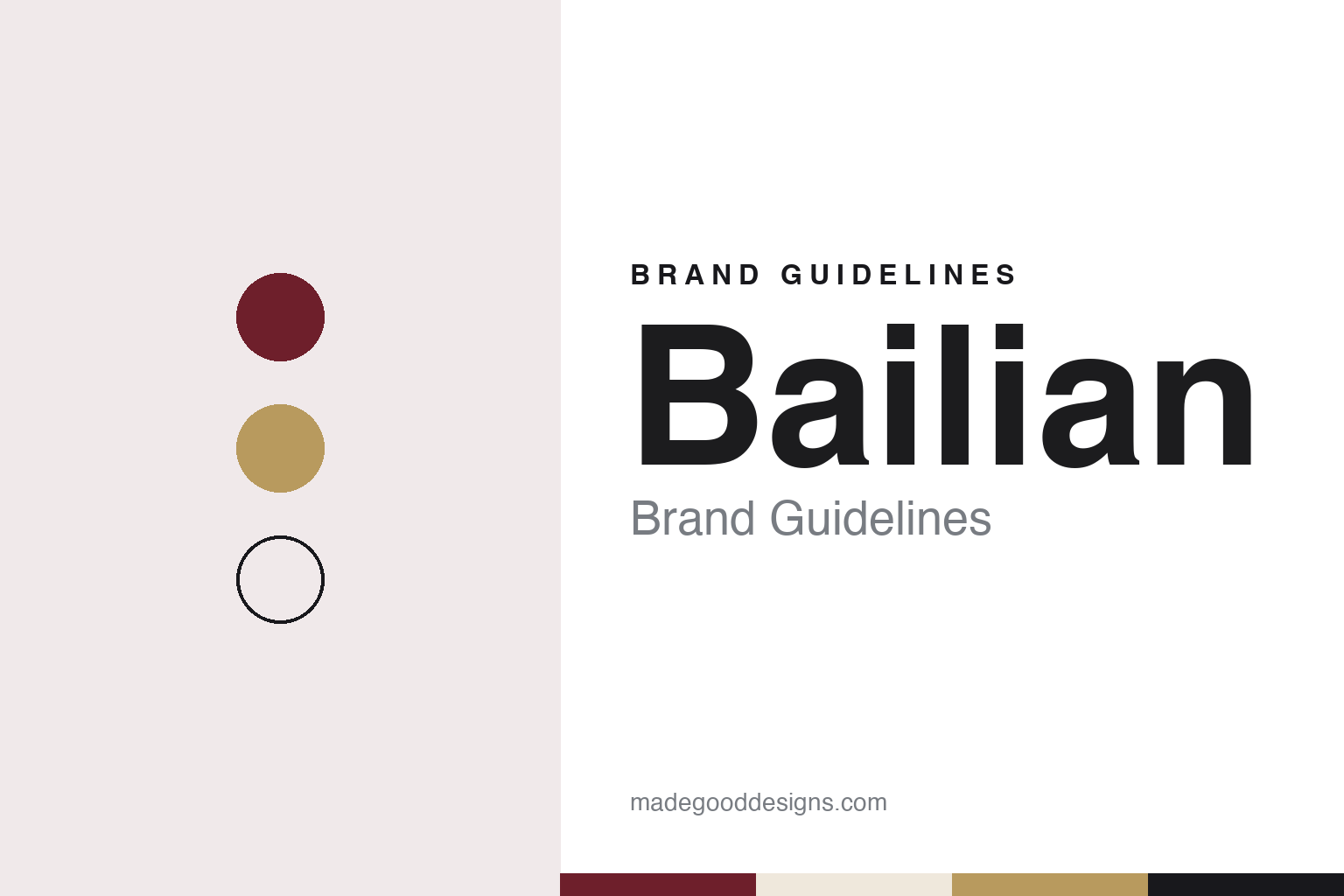
Bailian Brand Guidelines
Shanghai’s 2003 department-store group.
Aa
Two constants: a claret, brass and stone palette and an art deco serif register. Abstract homage — not a Bailian store, product or mark; no logo, facade or sign is reproduced.
Bailian
Four Shanghai groups made into one.
Bailian Group, written 百联集团 in Chinese, is a retail holding company based in Shanghai. It was put together in 2003. In May that year, the monthly China Economic Review reported in September 2003, the Shanghai government announced a plan to merge a department-store group, retail grocery chains and a logistics business to form Shanghai Bailian Group. Chinese Wikipedia names the four parts as the former Shanghai Yibai group, the parent of the No. 1 Department Store; the Hualian group; the Shanghai Friendship group; and the Shanghai Materials group.
Each brought something different. China Economic Review wrote that the Friendship group included the Lianhua supermarket chain, which had listed on Hong Kong’s stock exchange in June 2003, and that the Hualian group ran its own supermarket chain; a Hualian spokeswoman told the magazine it had more than 1,200 supermarkets across ten provinces. Shanghai Materials, a logistics company, was meant to handle sourcing in larger volumes and the movement of goods around the country, the magazine reported.
Analysts quoted by the magazine were divided on how much size alone would help, pointing instead to store management and information systems.
The group remains in public hands. Chinese Wikipedia describes Bailian Group as a wholly state-owned company whose controlling shareholder is the Shanghai State-owned Assets Supervision and Administration Commission.
Colour
Nanjing Road stores and an outlet plaza.
Bailian’s portfolio is a map of Shanghai shopping. Chinese Wikipedia lists among its main brands the No. 1 Department Store, Yong’an department store, the Orient Shopping Centre and the No. 1 Yaohan, alongside a group of shopping centres and the Bailian Outlets discount stores; it also lists the Kesongfang bakery chain, the Haomeijia home stores and the Wu Liangcai and Maochang opticians.
The No. 1 Department Store is the oldest of the landmarks. Caixin Global reported in June 2017 that the eight-storey art deco building on Nanjing Road East first opened in 1936, then known as the Sun Company. That month the store closed for a large overhaul: the building was to be combined with an adjacent store from the same era and linked by skywalks to form the No. 1 Department Store Shopping Center, keeping its art deco facade and adding a rooftop garden and an international food market, the magazine reported. A Bailian deputy general manager told Caixin the new centre was meant for local office workers spending holidays with friends and for visitors wanting a taste of the city’s traditional atmosphere. The nearby Wing On department store, also on Nanjing Road and known in Chinese as Yong’an, was among the other Bailian properties being renovated.
Renewal has continued. The Shanghai government’s English website reported in November 2024 that the No. 1 Yaohan in Pudong, which opened in 1995, was going through its most significant renovation since opening, with its six-storey “Big Curved Wall” restored and its twelve zodiac relief sculptures polished. The same report said Bailian was also reworking other classic landmarks, among them Wing On (Yong’an) and the Orient Shopping Centre.
The outlet business grew alongside. Yicai Global reported on 22 September 2026 that the second phase of the Bailian Outlets Plaza in Shanghai’s Qingpu district had opened the day before. The plaza first opened in 2006, as a centre selling branded goods at discounted prices, Yicai reported.
Typography
Design and documentation.
Chinese retailers and e-commerce platforms present themselves across a wide range of surfaces at once. A single group may run hypermarkets, appliance showrooms, shopping malls, small franchised shops and a shopping app, and each has to carry the same name at very different sizes, from a rooftop sign on a city-centre store to a small icon on a phone. Many of these companies grew from one shop or one website into groups with several store formats, so their names often began with one product category and later had to stretch to cover many.
Naming is often plain and descriptive. Store and company names commonly pair a short brand word with a description of what is sold, such as electrical appliances, and later drop that description as the business widens. Platform names and company names can swap places: a group may rename itself after its own website or app, or give an app a new name and later return to the original one. Chinese characters and an English or pinyin form usually appear side by side, and the two do not always translate each other.
Shopping festivals shape much of the visual calendar. Dates such as 11 November, known as Double Eleven, bring campaign artwork across store windows, app home screens and delivery packaging, usually set around the date itself and the company’s own name. For a designer, the useful material is how the companies publish these campaigns and how the core name holds steady while the seasonal graphics change around it.
Corporate pages fill in the rest. Listed retailers publish their founders, owners and exchange listings in annual results and announcements, and these records also show renamings, store closures and changes of control as dated facts. Read together with independent press, they give a fuller picture of how each name has been used over time.
Aa
A high-contrast serif with the air of a 1930s Nanjing Road storefront. (Specimen set in Playfair Display, a serif STAND-IN; NOT the Bailian logo.)
Bailian
A state retail group working with online partners.
Like other traditional retailers in China, Bailian has had to answer the rise of online shopping. Caixin Global reported in June 2017 that the group was struggling alongside other department-store operators in a market increasingly shaped by e-commerce, and that earlier that year it had announced a strategic tie-up with Alibaba to cooperate on supply-chain technology using the online group’s data capabilities. Observers quoted by the magazine were divided on whether nostalgia and a good location would be enough to draw younger shoppers.
The group’s mix is also changing. Yicai Global reported in September 2026 that Bailian runs department stores, chain supermarkets, shopping centres and outlets, but was gradually reducing its emphasis on supermarkets. According to Yicai, the listed arm, Shanghai Bailian Group, had announced earlier in 2026 that it would end its trust management of the stake in Lianhua Supermarket held by its parent; once that is completed, the listed company will no longer consolidate Lianhua in its accounts and will concentrate on department stores, shopping centres and outlets. Yicai described the change as one still to be completed, and it was not completed at the time of writing.
Across all of this, the group’s identity is less a single logo than a set of named stores. The No. 1 Department Store, Wing On and the Orient Shopping Centre each keep their own names on Nanjing Road, and the No. 1 Yaohan keeps its curved wall in Pudong, while Bailian sits behind them as the owner.
For a design guide, Bailian shows how a holding group can let historic store names carry the identity while the parent stays in the background. Compare Alibaba, its online partner from 2017, and Yonghui, another Chinese grocery and supermarket retailer. For this guide we use a claret, a brass and a warm stone with a serif, an unofficial interpretation; no product or logo is reproduced.
Explore & save
Keep Bailian’s identity on hand — save it to a board in the Made Good inspiration library.
Bailian identity set
Pin the Bailian claret, brass and stone palette and the art deco serif register to your own board.