Yonghui Brand Guidelines
A Fuzhou farmers’ market, a 2010 listing and Miniso.
Aa
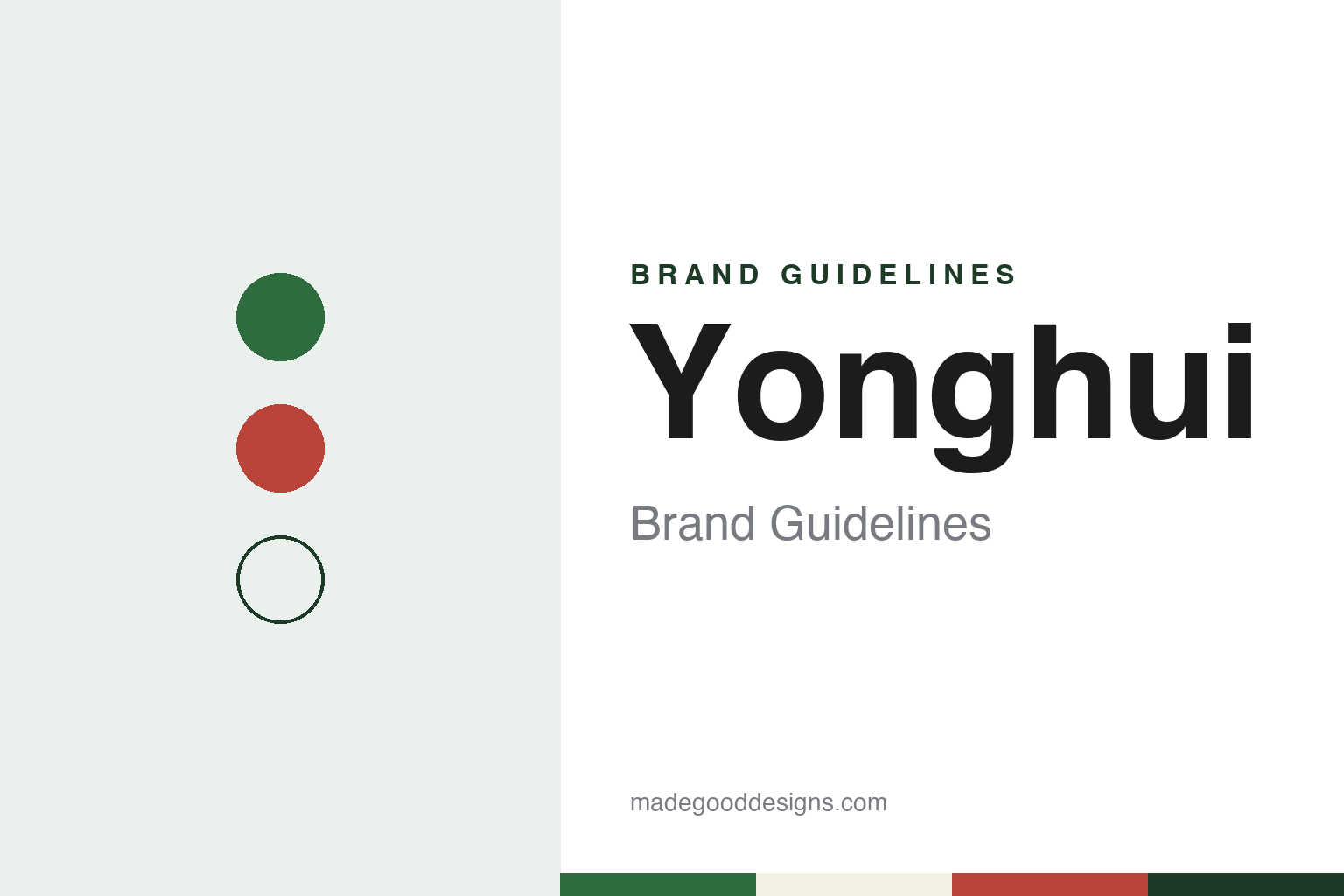
Two constants: a green, cream and red palette and a rounded market sans register. Abstract homage — not a Yonghui product or mark; no logo, fascia or pack is reproduced.
A farmers’ market indoors
A beer-delivery business becomes a supermarket.
Yonghui is a supermarket chain based in Fuzhou, the capital of Fujian province in south-east China. Its founder and chairman, Zhang Xuansong, a Fuzhou native, started out in the early 1990s with a beer-delivery business, The China Project wrote in June 2023. On the back of it he opened a low-cost supermarket in 1995, which became Yonghui in 2001, when he turned a farmers’ market in Fuzhou into a modern supermarket. Chinese Wikipedia also dates the company to 1995 and places its first store in Fuzhou’s Gulou district.
Putting a fresh market inside a supermarket became the core of the business. The China Project wrote that, as Yonghui grew across Fujian, it built the direct buying and cold-chain networks that fresh food needs. Chinese Wikipedia lists Yonghui among the companies taking part in the link-up between farms and supermarkets known in Chinese as nongchao duijie.
Expansion beyond the home province came in stages. Yonghui moved into Chongqing in 2004 and into several other large cities in 2009, The China Project reported. In December 2010 it listed on the Shanghai Stock Exchange, at a time when it ran about 180 supermarkets. After the listing it grew quickly, to 1,440 supermarkets by 2019, supported by a national logistics network of ordinary and cold-chain warehouses, according to the same report.
Colour
One name, several store formats.
As it grew, Yonghui split its stores into named formats rather than relying on one large box. China Daily reported in July 2017 that the company, then known for hypermarkets of about 5,000 square metres, had nearly 500 stores and more than 70,000 staff. It described Bravo YH stores in Fuzhou with fresh seafood counters and a cooking service, and a smaller format called Super Species, launched in Fuzhou, whose stores of about 500 square metres cooked the salmon or beef that shoppers picked out. The same report described the YH Member Experience community stores, first opened in Shanghai in 2015, and YH Life, a convenience-style format that appeared in Shanghai in May 2017 with online ordering and delivery.
Chinese Wikipedia lists the main brands as Yonghui Superstores, Bravo YH, Yonghui Life, Yonghui warehouse stores and Bai Jia Yonghui. The last name dates from October 2018, when Yonghui agreed to put its Guangdong stores into a joint venture with the Parknshop China business of the A.S. Watson group and with Tencent, with the combined stores to trade as Bai Jia Yonghui, the same source says. It adds that the first Yonghui warehouse store opened in Fuzhou on 1 May 2021, converted from an existing store, and that other Yonghui and Bravo stores were later reopened in that format.
Shareholders changed alongside the formats. Yicai Global reported that JD.com first invested in Yonghui in August 2015, and Chinese Wikipedia records a share placement to the Dairy Farm group in 2014 and the purchase of a 5 per cent stake by Tencent from the founders in December 2017. In 2021 Yonghui hired Li Songfeng, who had spent ten years at JD.com, as chief technology officer in January and as chief executive from September, The China Project reported.
Typography
How Chinese retailers present themselves.
Chinese retailers and e-commerce platforms present themselves across a wide range of surfaces at once. A single group may run hypermarkets, appliance showrooms, shopping malls, small franchised shops and a shopping app, and each has to carry the same name at very different sizes, from a rooftop sign on a city-centre store to a small icon on a phone. Many of these companies grew from one shop or one website into groups with several store formats, so their names often began with one product category and later had to stretch to cover many.
Naming is often plain and descriptive. Store and company names commonly pair a short brand word with a description of what is sold, such as electrical appliances, and later drop that description as the business widens. Platform names and company names can swap places: a group may rename itself after its own website or app, or give an app a new name and later return to the original one. Chinese characters and an English or pinyin form usually appear side by side, and the two do not always translate each other.
Shopping festivals shape much of the visual calendar. Dates such as 11 November, known as Double Eleven, bring campaign artwork across store windows, app home screens and delivery packaging, usually set around the date itself and the company’s own name. For a designer, the useful material is how the companies publish these campaigns and how the core name holds steady while the seasonal graphics change around it.
Corporate pages fill in the rest. Listed retailers publish their founders, owners and exchange listings in annual results and announcements, and these records also show renamings, store closures and changes of control as dated facts. Read together with independent press, they give a fuller picture of how each name has been used over time.
Aa
A rounded market sans. (Specimen set in Varela Round, a sans STAND-IN; NOT the Yonghui logo.)
Yonghui
Miniso and the Pangdonglai model.
The network then shrank. By the end of 2022 Yonghui ran about 1,000 supermarkets, some 350 fewer than two years earlier, The China Project reported, and Yicai Global put the count at around 850 stores in more than 25 provinces and municipalities in September 2024, describing the Fuzhou-based company as focused on large integrated supermarkets and community supermarkets.
From May 2024 Yonghui began remodelling stores along the lines of Pangdonglai, a retailer from Xuchang in Henan province. KrASIA, publishing reporting by 36Kr in December 2024, wrote that some stores were reworked with hands-on guidance from the Pangdonglai team, mainly in Henan, while others adopted its methods on their own; the remodelled store at Xinwan Plaza in Zhengzhou became the showcase of the effort, and 20 restructured stores had reopened nationwide by that December. Chinese Wikipedia says the remodels gave more shelf space to own-brand goods and prepared food and widened the aisles.
Ownership moved at the same time. On 23 September 2024 Miniso, the Guangzhou-based variety retailer, agreed through its subsidiary Guangdong Juncai International Trading to buy 29.4 per cent of Yonghui from a Dairy Farm subsidiary of DFI Retail Group and from subsidiaries of JD.com, Inside Retail Asia reported, a purchase that made Miniso the largest single shareholder. Yicai Global gave the split as 21.1 per cent from DFI and 8.3 per cent from JD.com, and reported in March 2025 that Guangdong Juncai had taken formal control of the stake after that sale.
For a design guide, Yonghui shows how a fresh-food grocer can carry one name across hypermarkets, smaller Bravo YH and YH Life formats and remodelled stores. Compare RT-Mart, a mainland hypermarket chain that also changed owners in the mid-2020s, and Wumart, a supermarket group from Beijing. For this guide we use a market green, a deep leaf green, a rice-paper cream and a lychee red with a rounded sans, an unofficial interpretation; no product or logo is reproduced.
Explore & save
Keep Yonghui’s identity on hand — save it to a board in the Made Good inspiration library.
Yonghui identity set
Pin the Yonghui green, cream and red palette and the rounded market sans register to your own board.