Wumart Brand Guidelines
The Beijing supermarket group behind Metro China and Super Value.
Aa
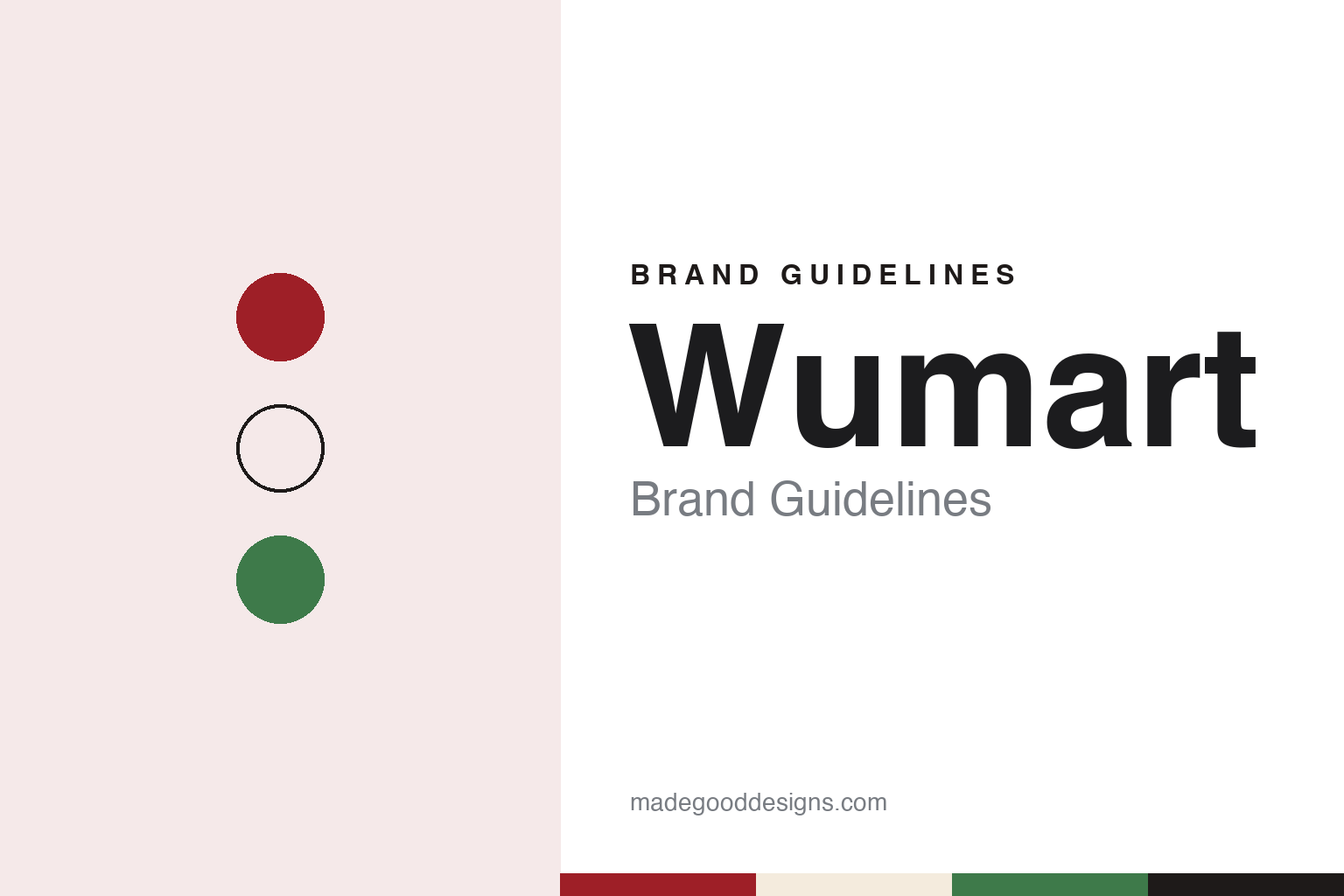
Two constants: a Wumart red, cream and green palette and a plain grotesque register. Abstract homage — not a Wumart product or mark; no logo, sign or packaging is reproduced.
Good product
A Beijing supermarket chain from 1994.
Wumart is the English name of Wumei (物美), a Beijing retail group whose Chinese name English Wikipedia glosses as “good product.” English Wikipedia says the company was founded in 1994 by Zhang Wenzhong and has its headquarters in the Wumart Commercial Building in Haidian District, Beijing. The same article says its registered office is in the Badachu high-tech park in Shijingshan District, and that the head office was earlier on the tenth floor of the Yuquan Building, also in Shijingshan. The date fits later reporting: in March 2025 China Daily described a store remodelling programme as part of Wumart’s plan to mark its 30th anniversary.
The group grew through the stock market. Chinese Wikipedia says Beijing Wumart Commercial Group listed on the Growth Enterprise Market of the Hong Kong stock exchange on 21 November 2003, and moved to the exchange’s Main Board on 30 June 2011. After the first listing it bought into other chains, including Chaoshifa in Beijing and Darong in Tianjin, and in 2004 signed an agreement with a commercial group in Huairou, on Beijing’s northern edge. In 2006 it took a 27.7% stake in Xinhua Department Store of Yinchuan, according to the same article.
The listing did not last. In October 2015, Chinese Wikipedia says, the majority shareholder, Wumart Holdings, proposed taking the company private by buying all of its H shares and domestic shares, and the article now describes the Hong Kong listing in the past tense. English Wikipedia describes its business as spanning retail, internet and connected-device technology, logistics and supply chain.
One deal that did not happen is part of the record too. In October 2013 Wumart and the supermarket operator CP Lotus agreed a cross-shareholding under which Wumart would take over 36 CP Lotus stores in Beijing, Shanghai and other provinces; in December 2013 the two sides said they had failed to sign final documents in time, and the deal was terminated, Chinese Wikipedia says.
Colour
Supermarkets, canteens and a discount format.
The group runs several store names. Chinese Wikipedia lists brands including Wumart supermarkets, Meilianmei, Wumart convenience stores and the Chongwenmen food market, alongside B&Q and Metro. English Wikipedia says the group has developed location-based e-commerce in cities including Beijing, Hangzhou, Yinchuan and Wuhan.
Recent reporting shows Wumart reworking its stores. In March 2025 China Daily reported that a Wumart store on Xueqing Road in Beijing would reopen on 21 March after a month of remodelling, drawing on practices from the Henan retailer Pangdonglai; about 90% of the products followed the layout Pangdonglai uses. The paper said the range had been cut to about 10,000 items, about 70% of them newly added, with a larger in-store area for freshly baked and prepared food, self-service tea stations at the entrance and shorter opening hours. About 15% of the new range was imported, and 68 products had been brought in from Pangdonglai itself, the report added. It also said Wumart had launched a “supermarket plus large canteen” model in Beijing and Tianjin.
A second format followed that summer. In August 2025 China Daily reported that Wumart had opened six stores of a hard-discount format, Wumart X Super Value, at the same time across five districts of Beijing, its first move into the discount sector. Each store, the paper said, carries fewer than 1,300 stock-keeping units across six high-turnover categories, from fresh produce, meat and seafood to baked goods, ready meals and daily-use goods, and more than 60% of the range is own label. The format, it added, relies on limited ranges, direct sourcing and lean operations. Hard-discount stores, the paper explained, keep prices down by cutting costs such as marketing, merchandising, packaging, sales assistants and store space.
Typography
How Chinese retailers present themselves.
Chinese retailers and e-commerce platforms present themselves across a wide range of surfaces at once. A single group may run hypermarkets, appliance showrooms, shopping malls, small franchised shops and a shopping app, and each has to carry the same name at very different sizes, from a rooftop sign on a city-centre store to a small icon on a phone. Many of these companies grew from one shop or one website into groups with several store formats, so their names often began with one product category and later had to stretch to cover many.
Naming is often plain and descriptive. Store and company names commonly pair a short brand word with a description of what is sold, such as electrical appliances, and later drop that description as the business widens. Platform names and company names can swap places: a group may rename itself after its own website or app, or give an app a new name and later return to the original one. Chinese characters and an English or pinyin form usually appear side by side, and the two do not always translate each other.
Shopping festivals shape much of the visual calendar. Dates such as 11 November, known as Double Eleven, bring campaign artwork across store windows, app home screens and delivery packaging, usually set around the date itself and the company’s own name. For a designer, the useful material is how the companies publish these campaigns and how the core name holds steady while the seasonal graphics change around it.
Corporate pages fill in the rest. Listed retailers publish their founders, owners and exchange listings in annual results and announcements, and these records also show renamings, store closures and changes of control as dated facts. Read together with independent press, they give a fuller picture of how each name has been used over time.
Aa
A plain, sturdy grotesque for aisle signs and price cards. (Specimen set in Work Sans, a sans STAND-IN; NOT the Wumart logo.)
Wumart
From supermarkets to DIY and cash-and-carry.
Wumart has also bought foreign retailers’ Chinese businesses. Chinese Wikipedia says that in December 2014 the British group Kingfisher agreed to sell a 70% controlling stake in B&Q China to Beijing Wumei Investment Group, and that in July 2016 Wumart’s Hong Kong arm bought the remaining 30%, taking full ownership of the home-improvement chain.
Another is Metro China, known in Chinese as Maidelong. Chinese Wikipedia says Wumart, its technology affiliate Dmall and the German wholesaler Metro announced a joint venture in October 2019. China Daily reported in April 2026 that Wumart Group acquired an 80% stake in Metro China in 2019, while English Wikipedia dates the purchase to 2020. The paper described Maidelong as the high-end retail format of Wumart Group, noted that Metro AG had entered China in 1996 with a membership warehouse model for restaurants, hotels and retailers, later adding retail consumers as well as business customers, and said the chain operated nearly 100 stores in more than 60 cities as of April 2026, when it changed its top management. Chinese Wikipedia also records that in January 2021 Dmall and Dairy Farm formed an equal joint venture to build shopping apps for Hong Kong supermarkets.
For a design guide, Wumart shows how one Beijing grocer can carry several store names at once, from neighbourhood supermarkets to a cash-and-carry brand and a discount format. Compare Yonghui, another mainland supermarket group, and Freshippo, a grocery chain built around an app. For this guide we use a market red, a warm cream and a leaf green with a sans, an unofficial interpretation; no product or logo is reproduced.
Explore & save
Keep Wumart’s identity on hand — save it to a board in the Made Good inspiration library.
Wumart identity set
Pin the Wumart red, cream and green palette and the plain grotesque register to your own board.