Eurospin Brand Guidelines
The four-family discount grocer that put “smart shopping” into its name.
Aa
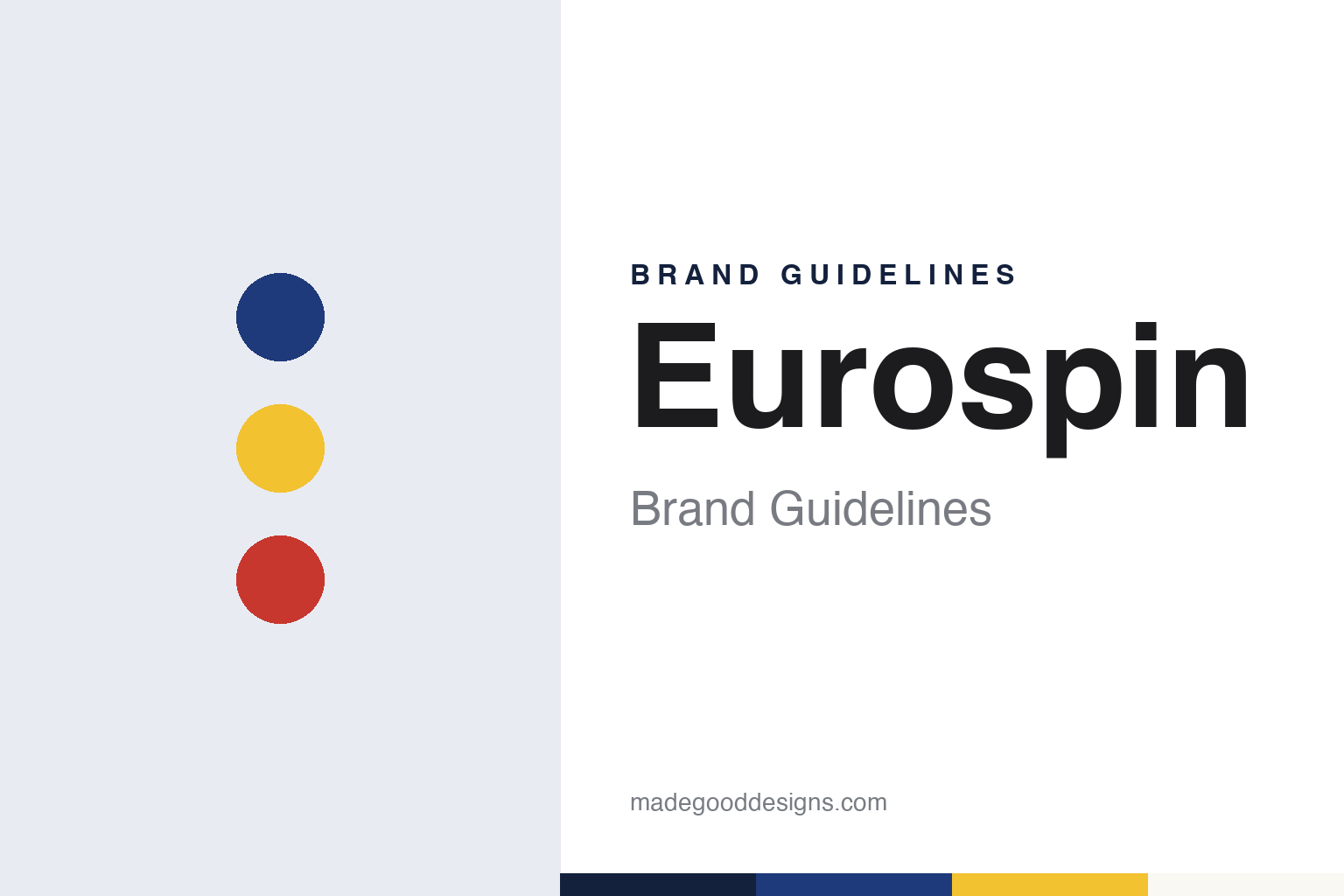
Two constants: a deep blue, warm yellow and tomato red palette and a rounded sans register. Abstract homage — not a Eurospin product or mark; no pack, logo or sign is reproduced.
Four families
A 1993 venture by four regional grocers.
Eurospin was set up in 1993 by four families who already ran supermarkets in northern Italy, Italian Wikipedia says: the Pozzi family of Dugan in Lombardy, the Mion family of Migross in Verona, the Odorizzi family of the Dao cooperative in Trentino and the Barbon family of Vega in the Treviso area. The company’s own history page tells the same story in brief, describing four retail entrepreneurs who wanted an Italian answer to shoppers’ growing demand for savings. The chain began by franchising, Italian Wikipedia adds, and later opened stores of its own.
The name carries the idea. The company says the “SP” in Eurospin stands for spesa, the Italian word for the grocery shop, and the “IN” for intelligente, so that the name reads as “Spesa Intelligente,” smart shopping. The phrase sits beside the name in the company’s communication and was carried abroad in translation.
Ownership has stayed with the founding groups. In June 2024 Milano Finanza reported that Migross, the Verona grocery group founded by Alessandro Mion, held 25% of Eurospin Italia, with the remaining shares divided equally among Centro Alimentare Maddalene of Trento, Shop of the Pozzi family in Milan and Sinergia of Treviso. The same report said Migross itself operated 53 stores under the Eurospin sign, mostly in Veneto, Lombardy and Emilia-Romagna. Italian Wikipedia also describes the four partners as equal holders, naming their companies slightly differently.
The holding company, Eurospin Italia S.p.A., is based at San Martino Buon Albergo, just east of Verona. Italian Wikipedia says it handles buying, quality assurance, logistics, marketing and store planning for regional operating companies that trade under the Eurospin name, among them Eurospin Tirrenica, Eurospin Lazio, Eurospin Puglia and Eurospin Sicilia, and for subsidiaries in Slovenia and Croatia.
Colour
Own labels, cartons and a short range.
Eurospin’s offer is built around its own labels. The company says its packaged-food aisles carry only Eurospin-owned brands rather than the large industrial brands, and its brand directory lists about 50 of them, from Pascoli Italiani for milk and dairy and Tre Mulini for fresh pasta and flour to Dolciando for biscuits and sweets and Amo Essere for organic, vegan, gluten-free and lactose-free lines. Alongside packaged fresh, dry and frozen food, the company says its stores have butchery and fruit-and-vegetable counters, that many add bread, fish and delicatessen counters, and that non-food goods such as small appliances, kitchenware, textiles and DIY items appear only as promotions.
The stores follow a plain format. The company says its newest shops cover about 2,000 square metres and that goods are displayed in their shipping cartons so shelves can be refilled quickly, a choice it links to keeping running costs down. On the same pages it says the group has more than 1,300 stores across Italy, Slovenia, Croatia and Malta and more than 22,000 employees; Italian Wikipedia gave about 20,000 staff and more than 1,200 stores for 2024, roughly three-quarters of them owned and run directly, supplied from 17 depots.
Logistics have often been shared with the partners. In March 2010 the Verona daily L’Arena reported that Migross had begun building a temperature-controlled platform in the city’s Quadrante Europa freight area, initially to handle fruit and vegetables for both Migross and Eurospin Italia, while non-food goods were handled at centres in Bussolengo and San Martino.
The chain moved abroad in stages. Italian Wikipedia dates its arrival in Slovenia to 2004, together with the retailer Era, and in Croatia to 2020; in July 2020 the Croatian news site Net.hr reported that Eurospin had announced a store in Zadar as its entry into Croatia, presented under the local version of its smart-shopping line. Malta followed in 2024 with a store of about 1,400 square metres in Mosta, Times of Malta reported, and in March 2026 the same paper reported the opening of a second Maltese store in Marsa, on the site of a former shipyard. Since 2009 the group has also sold holidays under the Eurospin Viaggi name, Italian Wikipedia says, and it offers online grocery ordering with home delivery around Milan, Monza and Pavia and in-store collection in a number of cities.
Typography
How Italian chains present themselves.
Italian retail chains present themselves first through the fascia, the name over the door, and one group often runs several. Esselunga trades as Esselunga, as laEsse for smaller neighbourhood stores and as Bar Atlantic for its coffee bars; Conad’s network includes Conad City, Spazio Conad and Margherita Conad, names that signal the size of a store as much as its owner.
Own-label ranges carry much of that identity. Grocers put their own name on packaging and then build sub-brands for price, origin or occasion, and they publish flyers, in print and in apps, alongside advertising campaigns that can run for years. Several of the brands in this guide have worked with outside graphic designers and advertising agencies, and some of that work, such as Max Huber’s long S for Esselunga, is now kept in design archives.
Ownership structures differ, and each guide states them plainly. Some chains are family-controlled companies with a holding company above them; some are cooperatives, in which independent shopkeepers own the stores and share purchasing, logistics and a common mark; others are brands inside a larger fashion or retail group, or the Italian arm of a foreign group, and some have been listed on the stock exchange. Each guide names the owner as a dated source gives it, and says plainly when a business changed hands.
The guides draw on what the companies publish about themselves (their timelines, founders’ pages, store formats and investor pages) and check it against independent dated sources: Italian and English Wikipedia, the business and trade press, and official records such as decisions of Italy’s competition authority. Where a company’s own account and an independent source differ, both are given.
Aa
A rounded, friendly sans for a name that explains itself. (Specimen set in Nunito, a sans STAND-IN; NOT the Eurospin logo.)
Eurospin
Smart shopping as a brand idea.
Eurospin’s communication leans on the idea in its name. Its national campaign of March 2026, “Certe Scoperte ti cambiano la Spesa” (roughly, “some discoveries change the way you shop”), plays on famous Italian figures of discovery: shoppers named Galileo, Leonardo, Colombo and Volta turn up in the aisles talking about own-label products, fresh counters and the Eurospin app, and a digitally reconstructed Albert Einstein appears as the face of the brand, the company says. The tone is light and domestic rather than technical, and each scene ends back in the store.
The name also travels beyond the shelves. The Verona marathon runs as the Eurospin Verona Run Marathon, with marathon, half-marathon and family distances, and its route reaches San Martino Buon Albergo, where the company is based, Corriere dello Sport reported in October 2026 in a preview of the race’s 25th edition.
What a designer can take from Eurospin is how the brand works in practice: a short name with a built-in explanation, a store format that puts cartons straight on the shelf, and dozens of private labels, each with its own pack style, gathered under one fascia. The labels do the work that manufacturers’ brands do elsewhere, so the shop sign has to hold together ranges as different as dairy, fresh pasta, sweets and free-from foods.
For a design guide, Eurospin shows how a discount grocer can make its own name the explanation of its offer and carry that idea across dozens of own labels. Compare Lidl, another discount grocer built on its own ranges, and Conad, the Italian retailers’ cooperative. For this guide we use a deep blue, a warm yellow and a tomato red with a rounded sans, an unofficial interpretation; no product or logo is reproduced.
Explore & save
Keep Eurospin’s identity on hand — save it to a board in the Made Good inspiration library.
Eurospin identity set
Save the Eurospin deep blue, warm yellow and tomato red palette and the rounded sans register to your own board.