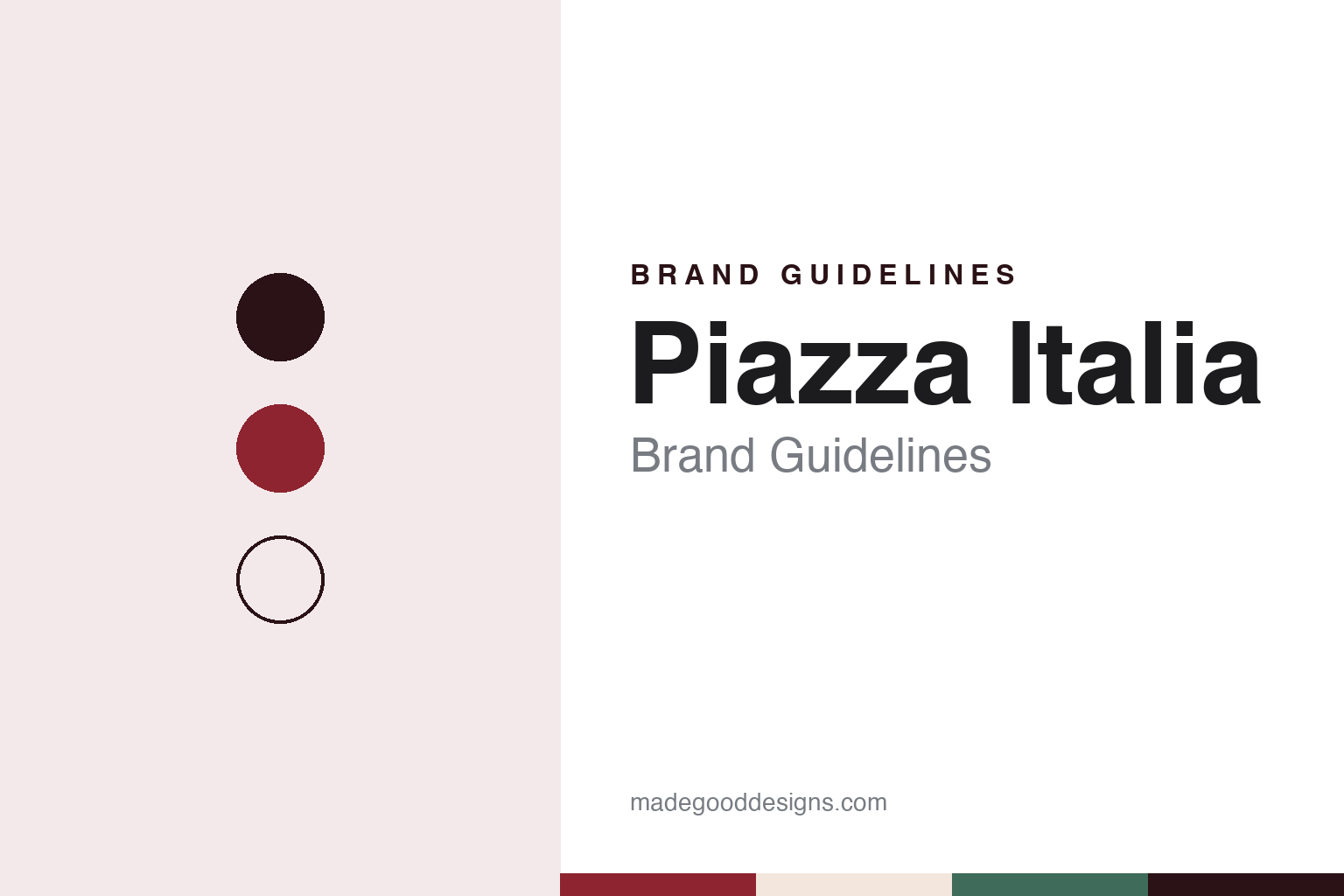
Piazza Italia Brand Guidelines
The 1993 Campanian fashion chain with four store formats.
Aa
Two constants: a brick red, linen and olive palette and a Bold retail sans register. Abstract homage — not a Piazza Italia product or mark; no logo, fascia or garment is reproduced.
From Campania
A family chain founded in 1993.
Piazza Italia is an Italian clothing chain for women, men and children, founded in 1993. ItaliaOggi, reporting in November 2025, describes it as the accessible-fashion group founded in Naples in 1993 by Luigi Bernardo; Italian Wikipedia gives Nola, a town in the province of Naples, as its place of founding. Nola is where the company has its head office, ItaliaOggi reported.
The company is a Società per azioni, a joint-stock company, and its own profile describes it simply as “a fashion company established in 1993.” Italian Wikipedia says the chain’s first shop opened in the Lo Zodiaco shopping centre at Anzio, on the coast south of Rome, and that in July 2003 it opened a store of about 3,000 square metres, then the chain’s biggest, in the Ipercoop shopping centre at Sesto San Giovanni, on the edge of Milan. From 2007, the same source says, the brand also grew through franchising.
It has stayed a family business. Luigi Bernardo leads the group, and his eldest son, Arnaldo Bernardo, became co-chief executive in 2025, ItaliaOggi reported. The paper also noted, in July 2026, that Luigi Bernardo’s brother Antonio Bernardo runs a separate holding company, Pamaf, whose retail interests include the housewares chain Kasanova and the children’s clothing brand Original Marines; that business is not part of Piazza Italia.
The name itself is a play on the Italian town square, the piazza, and the company presents its style as Italian: its profile speaks of “the enhancement of Italian style” and of a shopping concept “centered on continuous renewal.” Those are the company’s own words.
Colour
Kids, Fashion, Family, Megastore.
Piazza Italia sells a full family wardrobe under one fascia. Its online shop is divided into women, men, girls and boys from 3 to 14 years, and baby girls and baby boys from birth to 36 months, with knitwear, jeans, coats, sweatshirts, shoes, bags and costume jewellery, and children’s ranges carrying licensed cartoon characters.
The chain is organised around four store formats, which the company describes on its website and which ItaliaOggi set out in November 2025 and again in July 2026. Kids stores, of about 80 to 150 square metres, are given over entirely to children. Fashion stores, of about 300 to 400 square metres, are aimed at a young, trend-conscious public with men’s and women’s clothes. Family Store units run from 600 to 1,200 square metres and are aimed at young families. The Megastore covers more than 1,500 square metres and carries more than 3,000 items, arranged, the company says, as a “shop in the shop.”
The company also describes how the larger stores are laid out. Family and Fashion stores use a circular plan, it says, with the women’s world on the right, the men’s department on the left and the children’s section in the middle. It says it chooses sites in city centres or major shopping centres, that a team of visual merchandisers and architects looks after store layouts, and that the layout is updated every week. Directly run stores are large and in strategic sites, the company says, while franchise stores are smaller and placed in areas of at least 20,000 inhabitants.
Its advertising has at times answered other brands. In 2010, Italian Wikipedia records, Piazza Italia ran a campaign called “Be Intelligent,” a reply to the “Be stupid” campaign that Diesel had launched shortly before, with posters pairing its own garments with a photograph of Albert Einstein. In November 2011 it followed with “I veri miracoli li facciamo noi” (“We are the ones who work real miracles”), photographed in the streets of Milan with people chosen on the spot and, according to the same source, without any of the company’s clothes in the pictures.
Typography
Design and documentation.
Italian retail chains present themselves first through the fascia, the name over the door, and one group often runs several. Esselunga trades as Esselunga, as laEsse for smaller neighbourhood stores and as Bar Atlantic for its coffee bars; Conad’s network includes Conad City, Spazio Conad and Margherita Conad, names that signal the size of a store as much as its owner.
Own-label ranges carry much of that identity. Grocers put their own name on packaging and then build sub-brands for price, origin or occasion, and they publish flyers, in print and in apps, alongside advertising campaigns that can run for years. Several of the brands in this guide have worked with outside graphic designers and advertising agencies, and some of that work, such as Max Huber’s long S for Esselunga, is now kept in design archives.
Ownership structures differ, and each guide states them plainly. Some chains are family-controlled companies with a holding company above them; some are cooperatives, in which independent shopkeepers own the stores and share purchasing, logistics and a common mark; others are brands inside a larger fashion or retail group, or the Italian arm of a foreign group, and some have been listed on the stock exchange. Each guide names the owner as a dated source gives it, and says plainly when a business changed hands.
The guides draw on what the companies publish about themselves (their timelines, founders’ pages, store formats and investor pages) and check it against independent dated sources: Italian and English Wikipedia, the business and trade press, and official records such as decisions of Italy’s competition authority. Where a company’s own account and an independent source differ, both are given.
Aa
A bold retail sans for a family fashion fascia. (Specimen set in Archivo, a sans STAND-IN; NOT the Piazza Italia logo.)
Piazza Italia
A family buy-out and a leather brand.
The ownership changed shape in 2025. In November that year ItaliaOggi reported a family buy-out in which Luigi Bernardo took control of the whole of the group’s capital, financed by a pool of banks led by UniCredit with BNL BNP Paribas, Banca Monte dei Paschi di Siena, Cdp, Mediocredito Centrale and Banco di Desio. A year later, in November 2026, the paper reported Arnaldo Bernardo as saying that the leveraged buy-out had been completed about a year earlier, and that it had taken his father to 100% by buying the 37% stake held by Antonio Bernardo.
The size of the network depends on the date. In November 2025 ItaliaOggi reported 342 stores, 305 in Italy and 37 abroad, run directly and through franchise partners; in November 2026 it described the network as more than 300 stores. Italian Wikipedia lists stores in countries including Greece, Cyprus, Malta, Albania, Serbia and Saudi Arabia, and former stores in countries such as Morocco, Croatia and Romania.
The newest move is into another Italian clothing name. In July 2026 ItaliaOggi reported that Piazza Italia, through a subsidiary, had bought just under half of the 51% of Conbipel, the leather and clothing brand of Cocconato d’Asti, founded in 1958, that was held by the silk group Euroseta; Invitalia, the national development agency, held the other 49%, and Conbipel had been in a relaunch since June 2025 after a negotiated crisis settlement overseen by Italy’s ministry of enterprise. In November 2026 the paper reported that Piazza Italia had reached 49% of Conbipel with option rights to go higher; a move to full control was announced in November 2026 and not completed at the time of writing. L’Express Franchise reported the same month that the fund manager Green Arrow Capital had agreed to take a minority stake of 14.63% in Piazza Italia through a capital increase, with joint control alongside Luigi Bernardo, according to a notice from Italy’s competition authority; that deal was agreed in November 2026 and not completed at the time of writing.
For a design guide, Piazza Italia shows how one fascia can be stretched across four store sizes, from a children’s corner shop to a megastore of several departments. Compare OVS, another Italian family-clothing chain, and Terranova, the Rimini fashion fascia that also grew through franchising. For this guide we use brick red, linen and olive green with a bold sans, an unofficial interpretation; no product or logo is reproduced.
Explore & save
Keep Piazza Italia’s identity on hand — save it to a board in the Made Good inspiration library.
Piazza Italia identity set
Pin the Piazza Italia brick red, linen and olive palette and the Bold retail sans register to your own board.