Tezenis Brand Guidelines
Calzedonia’s 2003 Verona brand for young underwear shoppers.
Aa
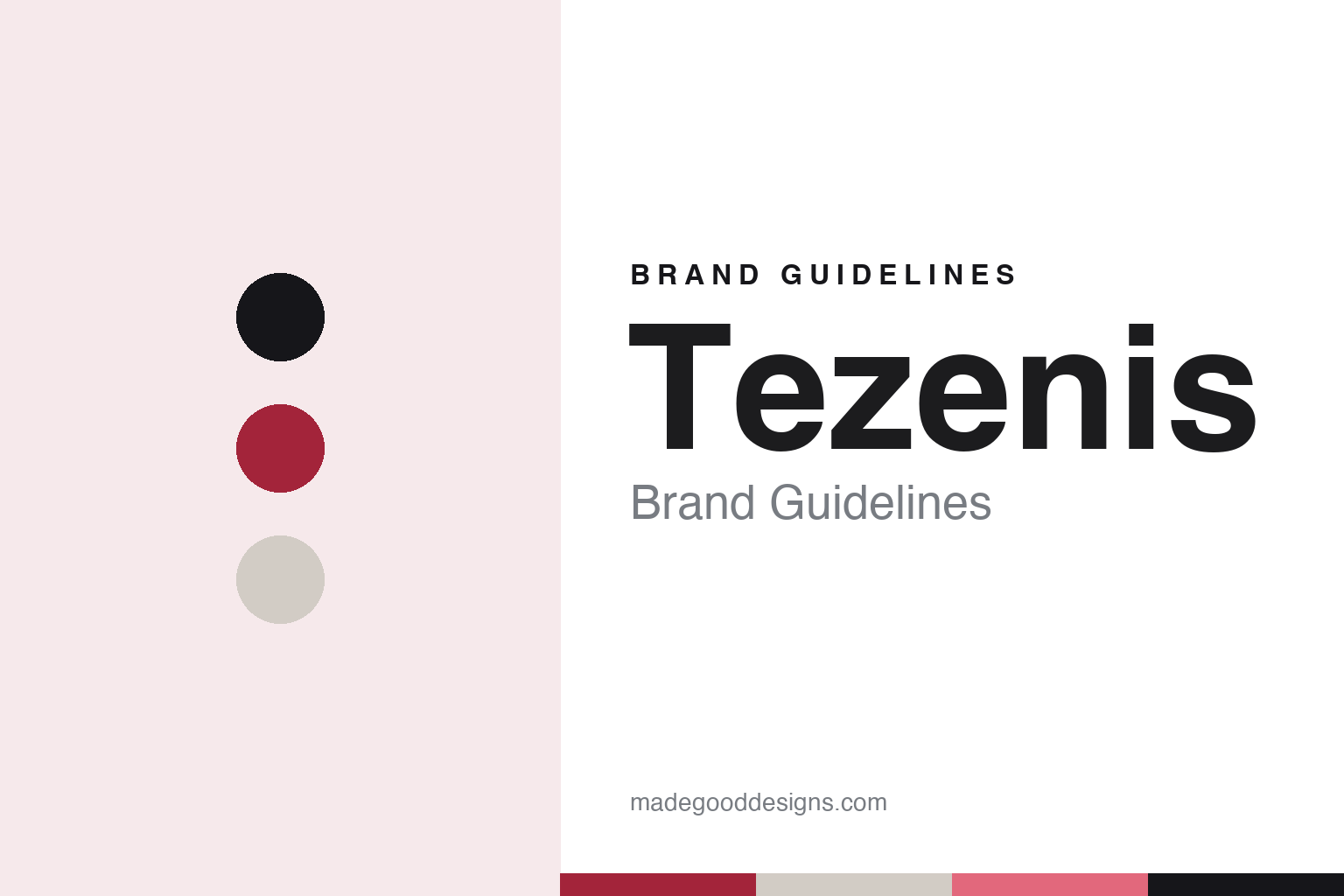
Two constants: a Tezenis studio red and concrete palette and a Bold grotesque register. Abstract homage — not a Tezenis product or mark; no garment, logo or shop fascia is reproduced.
A brand for the young
A third chain from the Calzedonia group.
Tezenis was created by the Verona hosiery group Calzedonia in September 2003. Panorama marked the tenth anniversary in a report of 2 September 2013, describing it as a brand Calzedonia had set up “aimed at attracting young customers.” The group’s own corporate site also gives 2003 as the year the brand was born.
The parent company is older. Calzedonia was founded in 1986 by Sandro Veronesi, according to the group, which says he remains its chairman and largest shareholder; English Wikipedia places its start in Vallese di Oppeano, in the province of Verona, in 1986, with an official launch in 1987, and gives its administrative headquarters as Dossobuono, at Villafranca di Verona. The group grew on a franchise model, Italian Wikipedia says, and on 4 December 2023 it renamed itself Oniverse, a name Italian Wikipedia describes as an anagram of Veronesi. Its brands include Calzedonia, Intimissimi, Intimissimi Uomo, Falconeri and Tezenis.
Within that family, Tezenis was given the youngest audience. The group’s brand page presents it as the side of Oniverse that follows new trends and social media, with a “chameleon-like” style. It says the collections are renewed every four months and cover underwear, swimwear, hosiery, knitwear and easywear for women, men and children. In 2013 Panorama described the range as underwear, homewear and pyjamas for men and women, with new items reaching the shops almost every week and, that summer, swimwear in bright colours and camouflage prints.
The group says it keeps the product cycle in-house, from design to production in factories it owns and on to distribution, and sells its collections only through single-brand shops, run directly or by franchisees. English Wikipedia lists the group’s production sites in Italy, Sri Lanka, Croatia, Bulgaria, Serbia, Bosnia and Herzegovina and Ethiopia.
Colour
Concrete floors, ceiling fans and music.
The shop has been central to the Tezenis identity from early on. In its 2013 report Panorama set out the format the company prescribed to franchisees: lounge music in the background, a large space “reminiscent of an American loft,” brushed concrete floors, big fans turning in the ceiling and shelves running round the walls. The aim, the magazine wrote, was to give young customers a cosy setting and an entertaining shopping experience.
Music is the brand’s other constant. Panorama reported that Tezenis had launched a music festival around 2010 that was broadcast nationally and drew Italian performers such as Eros Ramazzotti, Zucchero and Gianna Nannini. The group’s brand page today says Tezenis has always chosen “the young and universal language of music” to speak to its customers, and that it takes part with digital projects at festivals including Coachella, Sónar and NOS Alive.
The most visible face of that approach has been the singer Rita Ora. Vogue Italia announced her as the new Tezenis testimonial on 19 October 2015, saying the full campaign video would be shown at a new Tezenis flagship store in Frankfurt. On 20 September 2016 she presented a black lingerie capsule she had designed for the brand, in lace, satin and velvet, at the Calzedonia group’s new auditorium in Verona, Elle Italia reported; it reached the shops on 1 November 2016. In October 2017 Grazia described a new Tezenis television spot in which she performed the song “Your Song,” dressed in black-and-gold sets from the collection.
Sport gives the name a second public life. Verona’s main basketball club, Scaligera Basket, is also known as Tezenis Verona for sponsorship reasons, according to Italian Wikipedia, which records the Tezenis sponsorship from the late 2000s, when the club was rebuilding in the lower divisions; it moved up to the Legadue in 2010 and now plays in Serie A. In 2013 Panorama already listed the Verona team among the brand’s sponsorships, alongside music.
Typography
Design and documentation.
Italian retail chains present themselves first through the fascia, the name over the door, and one group often runs several. Esselunga trades as Esselunga, as laEsse for smaller neighbourhood stores and as Bar Atlantic for its coffee bars; Conad’s network includes Conad City, Spazio Conad and Margherita Conad, names that signal the size of a store as much as its owner.
Own-label ranges carry much of that identity. Grocers put their own name on packaging and then build sub-brands for price, origin or occasion, and they publish flyers, in print and in apps, alongside advertising campaigns that can run for years. Several of the brands in this guide have worked with outside graphic designers and advertising agencies, and some of that work, such as Max Huber’s long S for Esselunga, is now kept in design archives.
Ownership structures differ, and each guide states them plainly. Some chains are family-controlled companies with a holding company above them; some are cooperatives, in which independent shopkeepers own the stores and share purchasing, logistics and a common mark; others are brands inside a larger fashion or retail group, or the Italian arm of a foreign group, and some have been listed on the stock exchange. Each guide names the owner as a dated source gives it, and says plainly when a business changed hands.
The guides draw on what the companies publish about themselves (their timelines, founders’ pages, store formats and investor pages) and check it against independent dated sources: Italian and English Wikipedia, the business and trade press, and official records such as decisions of Italy’s competition authority. Where a company’s own account and an independent source differ, both are given.
Aa
A bold grotesque — loft shops and stage lights. (Specimen set in Archivo, a sans STAND-IN; NOT the Tezenis logo.)
Tezenis
A brand moved into its own company.
Tezenis grew quickly. In 2013 Panorama counted more than 300 shops in Italy and about a hundred in other countries. The group’s brand page now gives figures of 890 points of sale, 391 of them in Italy, in 38 countries, together with 35 online shops; the same page says elsewhere that there are more than 900 shops in 39 countries, so the totals are the company’s own and vary slightly.
Its legal structure changed at the end of 2025. Il Messaggero reported on 31 December 2025 that on 9 December the group had voted a partial demerger to bring the Tezenis-branded shops, until then run by Calzedonia itself or leased to franchisees, into the subsidiary called Tezenis. The paper put the number at 394 shops — 18 run directly, 148 let to affiliates as leased business units and 228 in straightforward franchise — with 234 employees, along with the central warehouses and the stock held on consignment by affiliates. After the operation, it reported, Oniverse Holding would own 51.97 per cent of Tezenis and Calzedonia Finanziaria the remaining 48.03 per cent, and the demerger was to take legal effect the following day.
The brand’s visual identity is not set out in any published guideline. What the sources describe is a set of habits rather than a manual: shops built like lofts, with concrete floors and ceiling fans; collections that change several times a year; campaigns tied to pop music and festivals; and a name that also appears on a basketball shirt in Verona.
For a design guide, Tezenis shows how a group can give a younger brand its own shop language while keeping it inside one family of chains. Compare Calzedonia, the hosiery chain from which the group grew, and Intimissimi, the group’s lingerie brand. For this guide we use a studio red, a concrete grey and a stage pink with a sans, an unofficial interpretation; no product or logo is reproduced.
Explore & save
Keep Tezenis’s identity on hand — save it to a board in the Made Good inspiration library.
Tezenis identity set
Pin the Tezenis studio red and concrete palette and the Bold grotesque register to your own board.