Farmers Brand Guidelines
Robert Laidlaw’s 1909 mail-order firm that became a nationwide department store chain.
Aa
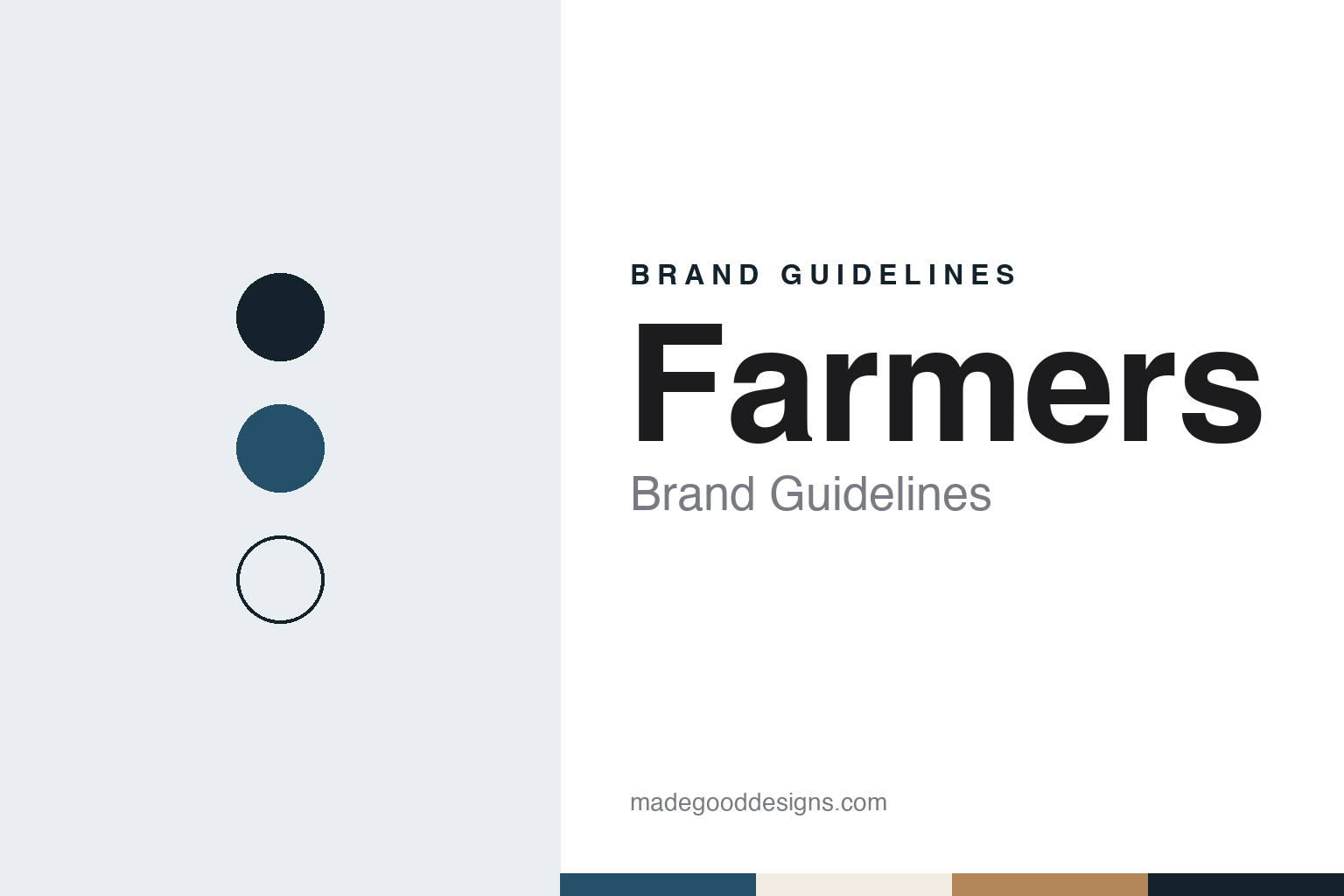
Two constants: a harbour blue, tan and linen palette and a department-store serif register. Abstract homage — not a Farmers asset or mark; no logo, sign or product is reproduced.
Laidlaw Leeds
A mail-order catalogue and a farmers’ union.
Farmers traces its start to 1909, when Robert Laidlaw set up Laidlaw Leeds in Auckland to sell agricultural supplies by mail-order catalogue, following an American model, according to English Wikipedia, which dates the founding to October 1909. In 1910 a group of Auckland members of the Farmers Union formed a trading association, which in 1916 became the Farmers’ Union Trading Co (Auckland) Ltd. In 1917, the encyclopaedia says, that company offered to merge with Laidlaw Leeds; Laidlaw accepted and became managing director of the new Farmers’ Trading Company, which soon moved into retail on the department-store model.
The centre of the business was a high-rise warehouse and office complex in Auckland’s Hobson Street, where a retail space opened to the public in 1920. By then the co-operative had bought many local stores across the Auckland province and had 32 of them, English Wikipedia says, citing newspaper notices of the time. In the 1930s a large wing was added to the 1914 building and the architect R. A. Lippincott gave the enlarged store a new Art Deco front.
Hobson Street was not an easy place to reach for shoppers, so Laidlaw, copying arrangements made by stores in American cities, ran a free bus from Queen Street to the store, later joined by a free tram to Karangahape Road, the same source says. The historian Katie Pickles, writing in the peer-reviewed Public History Review in December 2022, notes that Laidlaw travelled to Chicago in 1915, and that Farmers’ Trading Company opened a rooftop playground in Auckland in 1922. The store also had tearooms, a parking building joined to the shop by an elevated skyway, and, from 1955, escalators opened by the mayor of Auckland, English Wikipedia says.
Colour
A chain built by buying other stores.
Farmers grew by taking over other department stores. In 1970 it bought Calder Mackay, a Christchurch department store with branches around the South Island, and in 1982 it bought 13 stores of the Christchurch-based Farmers-Haywrights chain, a business unrelated to the Farmers Trading Company despite the name, taking its total to 80 stores, according to English Wikipedia. Some of those buildings have their own histories. Heritage New Zealand lists the Farmers Trading Company Building in Timaru as a Category 2 historic place: built in 1902 and 1903 for the drapers T and J Thomson to a design by the Timaru architect James Turnbull, with a decorated Edwardian front, it passed to the department store Hay’s in 1961, Hay’s later merged with Farmers in the 1980s, and the building is still occupied by Farmers, the List entry says.
Hay’s own Christchurch store had a rooftop playground of its own, which Pickles traces in her 2022 article. By the 1990s it had become the “Farmers Fantasy Fun Roof”, and it lasted until the then Farmers Trading Company premises were demolished in 1997; a giant fibreglass fungus from the roof stayed in Farmers’ ownership and moved to the entrance of the Northlands shopping mall, she writes.
Today Farmers is a mid-market chain selling family fashion, beauty, homewares, furniture, large appliances and whiteware, English Wikipedia says, and gives it 58 stores as a 2025 figure, with its head office in Flat Bush, Auckland. The encyclopaedia also lists sleepwear, menswear, footwear, luggage, kitchenware, toys and nursery goods, with a Christmas shop from October to December, and notes that sister companies Goldmark and Stevens run store-within-a-store counters in selected branches.
Typography
Design and documentation.
Australian and New Zealand department, discount and specialty retailers present themselves first through the shop front. Many chains grew by buying older local stores and then putting their own name over the door, so a single fascia in a city mall or a regional town often carries several earlier businesses behind it. Myer, for example, renamed the Grace Bros stores of New South Wales in 2004, two decades after buying the chain. Store names are usually plain: a founder’s surname, a description of what is sold, or a short set of initials.
The calendar does much of the talking. Department stores mark Christmas with window displays, and in Melbourne the Myer windows on Bourke Street have been documented by State Library Victoria since their start in 1956. Discount and specialty chains lean instead on printed and online catalogues, seasonal sales with their own names and colour-coded sale signs, published on the companies’ own channels. Loyalty programmes, cards and apps carry the same name and colours as the stores.
Own-label ranges sit beside the brands a retailer stocks. Many groups sell products under house names, or own fashion and homewares labels that also trade as separate shops, and present them in their own sections of the store and website. A pattern, a single colour or a capitalised wordmark often does the work of recognition: David Jones adopted a black-and-white houndstooth in 1967 so that its packaging would not need the name.
Behind the fascias sit corporate pages. These usually give a founding story and name the founders, the parent group and, for listed companies, the exchange and investor pages with dated announcements. Changes of owner, administrations and store closures appear there and in the business press, which is often the clearest record of how a shop name has passed from one owner to the next.
Aa
A bookish serif for a store that began with a catalogue. (Specimen set in Libre Caslon Text, a serif STAND-IN; NOT the Farmers logo.)
Farmers
From Chase Corporation to the James Pascoe Group.
From the late 1980s Farmers changed hands several times. The property developer Chase Corporation took it over in 1986, English Wikipedia says in its history, while its summary box dates Chase’s ownership from 1987. In October 1989 eight Farmers stores were sold to the brewer Lion Nathan and rebranded as the discount chain DEKA, leaving 50 in the Farmers fleet. The Hobson Street flagship closed in 1991 and stood empty until it reopened as a hotel in 1998. In 1992, according to the same source, Farmers was sold to DEKA and the parent became Farmers Deka Ltd, with stores keeping their separate names; the DEKA stores closed in July 2001 and the company was renamed Farmers Holdings.
In 2003 Farmers was bought by James Pascoe Ltd, now the James Pascoe Group, which English Wikipedia describes as privately owned by the Norman family; the same source says the deal split the business, with James Pascoe taking the retail chain and Fisher & Paykel Finance the finance arm. In March 2025 BusinessDesk, in a report carried by the NZ Herald, named James Pascoe as the group behind Whitcoulls, Farmers, Pascoes The Jewellers and Stewart Dawsons.
Under that owner Farmers left and then returned to Auckland’s main street. Its Queen Street store closed at the start of 2014 when a long lease ended, and in May 2015 Inside Retail reported that Farmers would move into the corner site at Queen and Victoria Streets previously used by Whitcoulls, its sister chain, and refit it as a three-level department store; English Wikipedia says that store opened in November 2015.
For a design guide, Farmers shows how a name taken from a farmers’ co-operative can stay on a fashion-and-beauty department store more than a century later, through owners as different as a property developer, a discounter and a jewellery group. Compare David Jones, the Australian department store that English Wikipedia says showed interest in buying Farmers in 1989, and Myer. For this guide we use a harbour blue, tan and linen with a serif, an unofficial interpretation; no product or logo is reproduced.
Explore & save
Keep Farmers’s identity on hand — save it to a board in the Made Good inspiration library.
Farmers identity set
Pin the Farmers harbour blue, tan and linen palette and the department-store serif register to your own board.