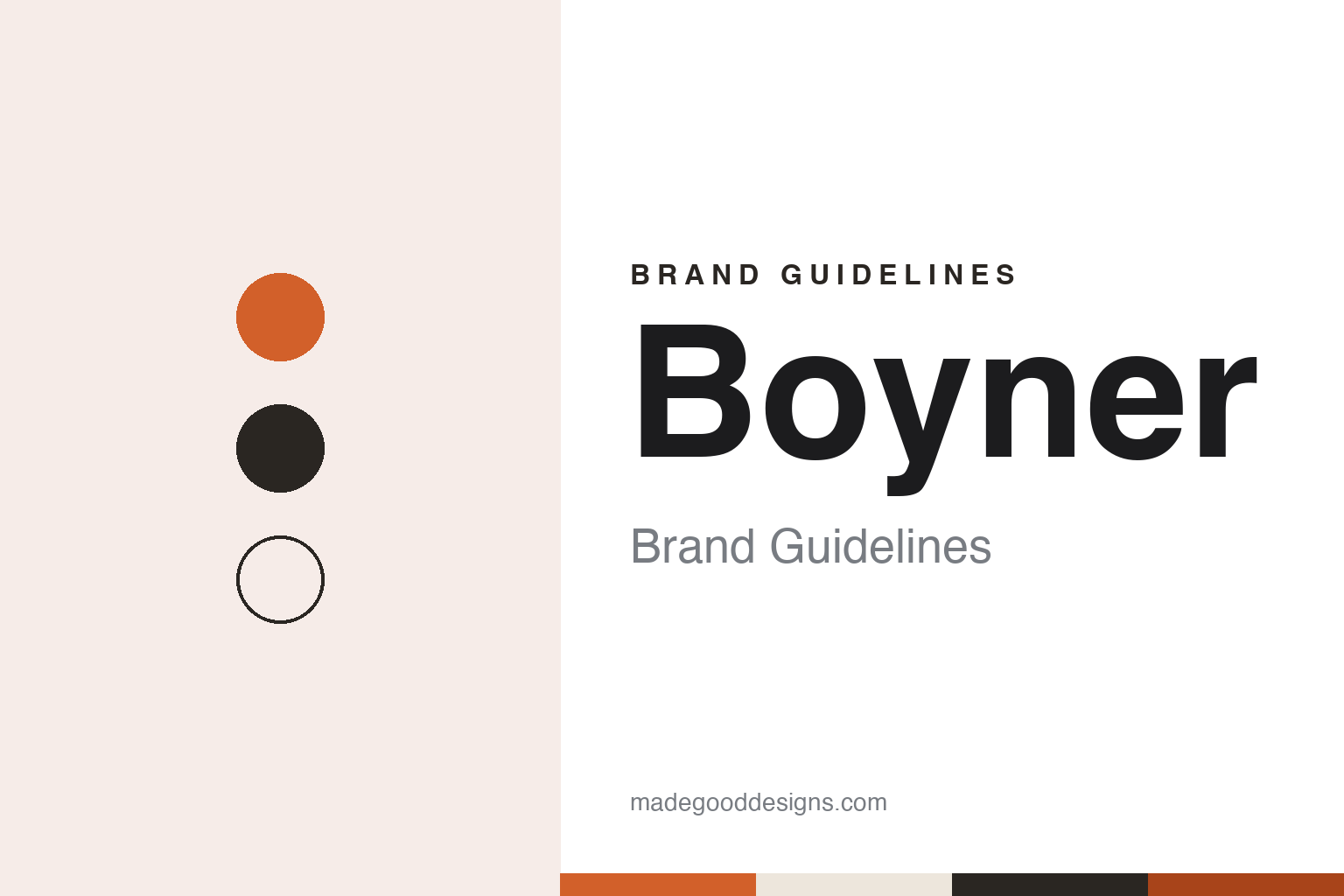
Boyner Brand Guidelines
A bazaar name in Bakırköy that became a family fascia.
Aa
Two constants: a warm orange, charcoal and stone palette and a geometric sans register. Abstract homage — not a Boyner product or mark; no logo, fascia or store sign is reproduced.
Çarşı
A woollen mill, then a store in Bakırköy.
Boyner is a Turkish department-store chain, and the name of the family group behind it. English Wikipedia says the group grew out of the textile and clothing businesses of Ali Osman Boyner, who co-founded the woollen-fabric maker Altınyıldız in 1952 and began exporting in 1956; the company that held Altınyıldız is today’s Boyner Holding. Boyner Grup’s own timeline gives the same 1952 start for Altınyıldız Mensucat ve Konfeksiyon Fabrikaları, and an October 2022 profile by the International Association of Department Stores (IADS), the trade body for department stores, describes the group as founded in 1952 as a clothing manufacturer by Osman Boyner.
Retail came later. At the end of the 1960s, English Wikipedia says, the business began making ready-to-wear clothing, and in 1971 it opened the original store of Beymen, an upscale department store, in Şişli, Istanbul. The chain that now carries the family name began a decade after that. In 1981 a multi-storey store called Çarşı, the Turkish word for a market or bazaar, opened in Bakırköy, on Istanbul’s European side, according to both the group’s timeline and the IADS profile. The group says it became Benetton’s main dealer and manufacturer in Turkey in 1985, and that from 2005 to 2012 it ran the Benetton Group’s brands in Turkey through a 50–50 partnership.
In 2004 the Çarşı stores took the family name and the company became Boyner Büyük Mağazacılık, which translates as Boyner Department Store Retailing, the group says; the IADS profile dates the change from Çarşı to Boyner to the same year. The company’s head office is in Maslak, in Istanbul’s business district, according to the group’s contact page.
Colour
YKM, Mayhoola and a split.
The 2010s reshaped the business. In February 2012 Boyner Holding bought a 63 percent stake in YKM (Yeni Karamürsel), another long-established Turkish department-store chain, according to its statement to the Istanbul Stock Exchange as reported by the Hürriyet Daily News. YKM then had 57 stores in 33 provinces, the paper said, and its family owners were selling on the chain’s 60th anniversary. The IADS profile says the merger with YKM was achieved in 2012; Boyner Grup’s own timeline lists the purchase of YKM under 2013.
Outside investors came and went. The group says Citigroup Venture Capital International held a stake in Boyner and Beymen from 2007 to 2013, and that the Qatar-based investment firm Mayhoola for Investments became a partner in Boyner Perakende, the company that combined Boyner, Beymen, AY Marka and Altınyıldız, in 2015. In May 2019 the two sides agreed to end that partnership by dividing the portfolio, Daily Sabah reported: Boyner Holding would become the sole owner of Boyner Büyük Mağazacılık and Altınyıldız, while Mayhoola would hold a majority stake of about 97 percent in Beymen and AY Marka. Before the deal, the paper said, Mayhoola held 54 percent of the combined company and Boyner Holding 42.8 percent.
The split went through. The IADS profile of October 2022 describes the 2019 restructuring as complete, with Beymen and AY Marka owned by Mayhoola and Boyner Holding the full owner of the Boyner stores and the Altınyıldız textile business. Beymen, which shares the family’s history, is therefore now a separate company from the Boyner chain.
Store counts change, so they are given here with their dates. The IADS profile reported 97 stores in 37 cities in October 2022, with 276,000 square metres of selling space, trading under the Boyner and YKM names and their sports and outlet formats, and 13 private-label brands; it also says Boyner Home opened in 2017 with stores for kitchen, bathroom and home textiles. English Wikipedia lists, as of May 2024, 74 Boyner department stores, 22 Boyner Outlet stores, smaller Boyner Active and Boyner Dynamic boutiques, three YKM boutiques, a Fabrika boutique in Ankara and seven Costa Coffee cafés run by the company. Boyner Grup’s brand page says the stores carry more than 600 local and global brands.
Typography
Design and documentation.
Türkiye’s grocery trade includes three neighbourhood discount chains with stores in all 81 provinces, BİM, A101 and ŞOK, according to English Wikipedia. In October 2021 the newspaper Türkiye counted about 10,150 A101 branches, 9,274 BİM stores and 8,145 ŞOK markets, and ESM Magazine reported in July 2026 that A101 alone ran around 13,600 outlets. Alongside them sit multi-format grocers: Migros, whose formats include Macrocenter stores, and CarrefourSA, with a multi-format network of around 1,237 stores at the end of 2025, according to the same magazine.
The discount chains publish their identity mainly through range and print. BİM says it keeps its store interiors deliberately modest, and its website gives separate sections to its own labels and its special buys; A101 prints a weekly discount catalogue and publishes it online, Turkish Wikipedia says. Own labels are a large part of that picture: English Wikipedia lists more than 150 for BİM and more than 60 for A101, from dairy and pantry lines to small electronics.
The screens follow the shelf. Migros fulfilled online orders from 2,103 stores at the end of 2025, ESM Magazine reported, and A101 launched its A101 Kapıda delivery app in April 2020, according to English Wikipedia. Electronics retailers, home-improvement chains and online marketplaces add showrooms, apps and product pages of their own, and the guides in this group look at each company’s fascia, app screens and naming as the company publishes them.
Ownership is part of the public face too. BİM has been listed on Borsa İstanbul since 2005; A101 is privately owned by the Aydın family and, ESM Magazine noted, does not publish detailed financial results; ŞOK and Migros report full-year results. Each guide sets out who founded the company, who owns it and where it is listed, and marks what rests on the company’s own word.
Aa
A geometric sans for a department-store fascia. (Specimen set in Outfit, a sans STAND-IN; NOT the Boyner logo.)
Boyner
A store group inside a textile group.
The department store is now one part of a wider group. Boyner Grup’s website lists Altınyıldız, the Boyner stores, BR Mağazacılık, the Hopi app, the publisher Boyner Yayınları, Brooks Brothers and a newer format called COMMUNITÉ. English Wikipedia says BR Mağazacılık was set up in 2011 as a joint venture with Ran Konfeksiyon, is based in Torbalı, İzmir, and makes and sells the Altınyıldız Classics and Beymen Business menswear brands; BB Perakende holds the Brooks Brothers licence and had 24 Brooks Brothers stores as of May 2024. The group’s contact page gives Altınyıldız’s address in the organised industrial zone at Çerkezköy, in Tekirdağ province.
Digital ventures run through the group’s timeline. It says it entered e-commerce in 2011 with Morhipo.com, launched the Hopi rewards app in 2015, and in 2022 opened a store format called Boyner Cadde and launched Boyner Now, a service it says delivers orders within 90 minutes. In 2026 it added COMMUNITÉ, which it describes as a meeting place that brings together fashion, home and cosmetics brands. In 2023, English Wikipedia says, Boyner joined the International Association of Department Stores; the IADS profile notes that the company had left the association in 2016, after YKM’s membership passed to it following the merger.
The name itself tells the story of the chain. It moved from a bazaar word, Çarşı, on a single multi-storey store in 1981, to a family surname in 2004, and it now sits over department stores, outlets, sports boutiques and an app. The palette in this guide takes its warm orange, charcoal and stone tones as our own reading of that retail register, not as company colours.
For a design guide, Boyner shows how a family textile name can become a department-store fascia across a country. Compare Vakko, the Istanbul fashion house that opened its eight-storey Beyoğlu store in 1962, and Trendyol, the Istanbul online marketplace. For this guide we use a warm orange, charcoal and stone with a geometric sans, an unofficial interpretation; no product or logo is reproduced.
Explore & save
Keep Boyner’s identity on hand — save it to a board in the Made Good inspiration library.
Boyner identity set
Save the Boyner warm orange, charcoal and stone palette and the geometric sans register to your own board.