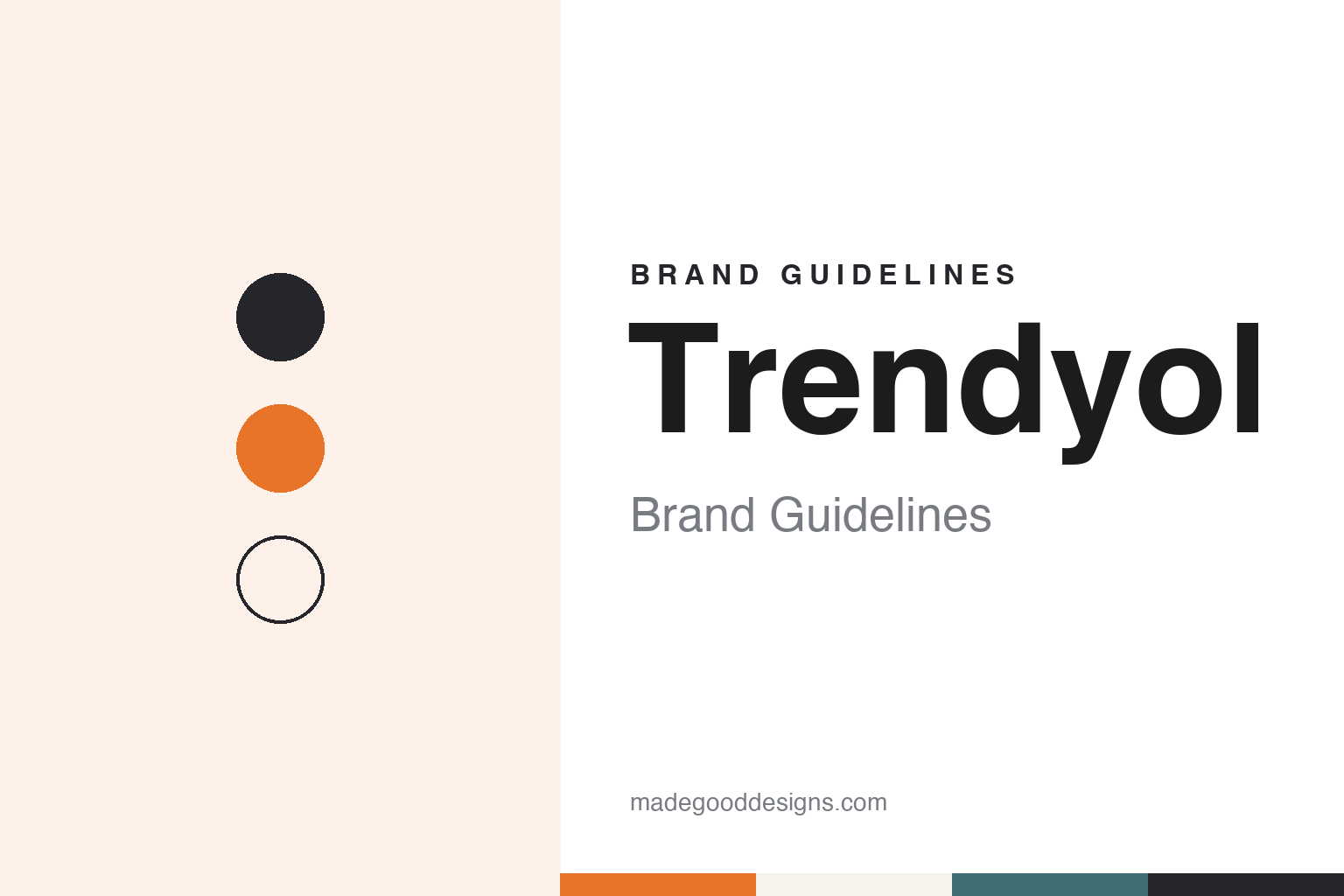
Trendyol Brand Guidelines
The Istanbul clothing site that became a cross-border marketplace.
Aa
Two constants: a tangerine, charcoal and off-white palette and a geometric sans register. Abstract homage — not a Trendyol product or mark; no logo, app screen, label or parcel is reproduced.
June 2010
An online clothing shop in Istanbul.
Trendyol was founded in Istanbul in 2010. English Wikipedia names its founders as Demet Mutlu, Evren Üçok and Begüm Tekin; Turkish Wikipedia dates the start to June 2010 and describes Mutlu as the founder, with two early investors as her first partners. Daily Sabah, reporting in October 2020, described the company as established by Mutlu in 2010 and said the American investment firm Tiger Global put money into it just six months later, followed over the years by the venture capital firm Kleiner Perkins and the European Bank for Reconstruction and Development.
The business began narrowly. Turkish Wikipedia says the site was set up in 2010 to sell clothing and later moved to a marketplace format, selling across many more categories through outside sellers. It also records a move to a new office in 2013, when the company opened a Trend-Store. By 2020, Daily Sabah reported, Trendyol sold clothing, home decoration, cosmetics and electronics, and its own label, Trendyol Milla, was the main brand on the clothing pages of its new European site.
In 2018 the Chinese group Alibaba became Trendyol’s strategic partner. CNN Türk reported on 29 June 2018 that Alibaba was buying the shares of existing financial investors, that the two companies would work together on technology, online trade, mobile payment, logistics and international trade, and that Mutlu would stay on as founder and chief executive. Alibaba has since raised its holding: The National reported in October 2024 that it owned 70 percent of Trendyol, with the rest held by investors including SoftBank Group, General Atlantic, the Qatar Investment Authority and Abu Dhabi’s ADQ. Turkish Wikipedia gives Alibaba a higher share, so the exact figure differs between sources.
Colour
Dolap, Trendyol Express and Trendyol Tech.
Trendyol, too, built services around its shop. Turkish Wikipedia records the second-hand fashion platform Dolap, founded in 2016 and bought by Trendyol in 2018; Trendyol Express, its own delivery network, set up in 2018 and opened in Azerbaijan in 2023; and Trendyol Tech, its technology arm, which the Ministry of Industry and Technology approved as a research and development centre in 2019. Trendyol Go, the meal and grocery delivery service, changed hands in 2025: on 15 May 2025 CNN Türk reported that the Competition Board had approved Uber’s acquisition of 85 percent of Trendyol Go, and Turkish Wikipedia records that the stake was sold to Uber that year.
Competition law has also shaped the platform. Bloomberg HT reported on 27 July 2023 that the Competition Authority had concluded its investigation into DSM Grup Danışmanlık İletişim ve Satış Ticaret A.Ş., the company that runs Trendyol, and found that by intervening in its ranking algorithm and using data from third-party sellers on its marketplace it had given its own retail business an unfair advantage that made rivals’ work harder. The board imposed an administrative fine by unanimous decision, with an appeal open to the Ankara administrative courts within 60 days of the reasoned decision being served.
The name also travels well beyond the app. English Wikipedia says Trendyol took over the title sponsorship of Türkiye’s top two football divisions, the Süper Lig and the TFF First League, from Spor Toto in July 2023, and that the company has sponsored the Turkish National Olympic Committee and national teams in football and volleyball.
Typography
How Turkish retailers present themselves.
Türkiye’s grocery trade includes three neighbourhood discount chains with stores in all 81 provinces, BİM, A101 and ŞOK, according to English Wikipedia. In October 2021 the newspaper Türkiye counted about 10,150 A101 branches, 9,274 BİM stores and 8,145 ŞOK markets, and ESM Magazine reported in July 2026 that A101 alone ran around 13,600 outlets. Alongside them sit multi-format grocers: Migros, whose formats include Macrocenter stores, and CarrefourSA, with a multi-format network of around 1,237 stores at the end of 2025, according to the same magazine.
The discount chains publish their identity mainly through range and print. BİM says it keeps its store interiors deliberately modest, and its website gives separate sections to its own labels and its special buys; A101 prints a weekly discount catalogue and publishes it online, Turkish Wikipedia says. Own labels are a large part of that picture: English Wikipedia lists more than 150 for BİM and more than 60 for A101, from dairy and pantry lines to small electronics.
The screens follow the shelf. Migros fulfilled online orders from 2,103 stores at the end of 2025, ESM Magazine reported, and A101 launched its A101 Kapıda delivery app in April 2020, according to English Wikipedia. Electronics retailers, home-improvement chains and online marketplaces add showrooms, apps and product pages of their own, and the guides in this group look at each company’s fascia, app screens and naming as the company publishes them.
Ownership is part of the public face too. BİM has been listed on Borsa İstanbul since 2005; A101 is privately owned by the Aydın family and, ESM Magazine noted, does not publish detailed financial results; ŞOK and Migros report full-year results. Each guide sets out who founded the company, who owns it and where it is listed, and marks what rests on the company’s own word.
Aa
A geometric sans for an app-led marketplace. (Specimen set in Rubik, a sans STAND-IN; NOT the Trendyol logo.)
Berlin, Baku and Riyadh
A Turkish marketplace abroad.
Expansion abroad began in October 2020. Daily Sabah reported on 2 October 2020 that Trendyol had opened a European website serving 27 countries, among them Italy, Spain and the United Kingdom, starting with clothing, shoes and bags priced in euros. In Germany the company opened an office in Berlin in 2022: Hürriyet reported on 1 June 2022 that the opening followed about a year of activity in the country, and Hürriyet Daily News later described Berlin as Trendyol’s first office outside Türkiye.
Other markets followed through partners. Hürriyet Daily News reported on 2 May 2023 that Trendyol had signed a cooperation agreement with Azerbaijan’s Pasha Holding to set up a joint venture for e-commerce in Azerbaijan, signed during the TEKNOFEST technology festival in Istanbul; English Wikipedia adds that a local office opened in Baku in October 2024. In the Gulf, Hürriyet Daily News reported in April 2024 that Trendyol had been operating in Saudi Arabia, the United Arab Emirates, Qatar, Kuwait, Bahrain and Oman since September 2023, and that it had opened its first pop-up store in the region, at Al Nakheel Mall in Riyadh, for three weeks, with about 150 items from its collection that shoppers bought online by scanning QR codes on them.
Technology is part of how the company presents itself abroad. The National reported in October 2024 that Trendyol had built its own large language model to help cross-border sellers communicate with customers, drawing on Alibaba’s machine-learning technology and chips, and described Çağlayan Çetin as president of Trendyol Group. Turkish Wikipedia says Erdem İnan took over as chief executive in 2023.
For a design guide, Trendyol shows how a single shop name can stretch from a clothing site to a football league, a delivery fleet and storefronts in several countries. Compare Hepsiburada, the Istanbul online retailer that opened its own marketplace in 2015, and Getir, the Istanbul quick-delivery app. For this guide we use a tangerine, a charcoal and a warm off-white with a geometric sans, an unofficial interpretation; no product or logo is reproduced.
Explore & save
Keep Trendyol’s identity on hand — save it to a board in the Made Good inspiration library.
Trendyol identity set
Pin the Trendyol tangerine, charcoal and off-white palette and the geometric sans register to your own board.