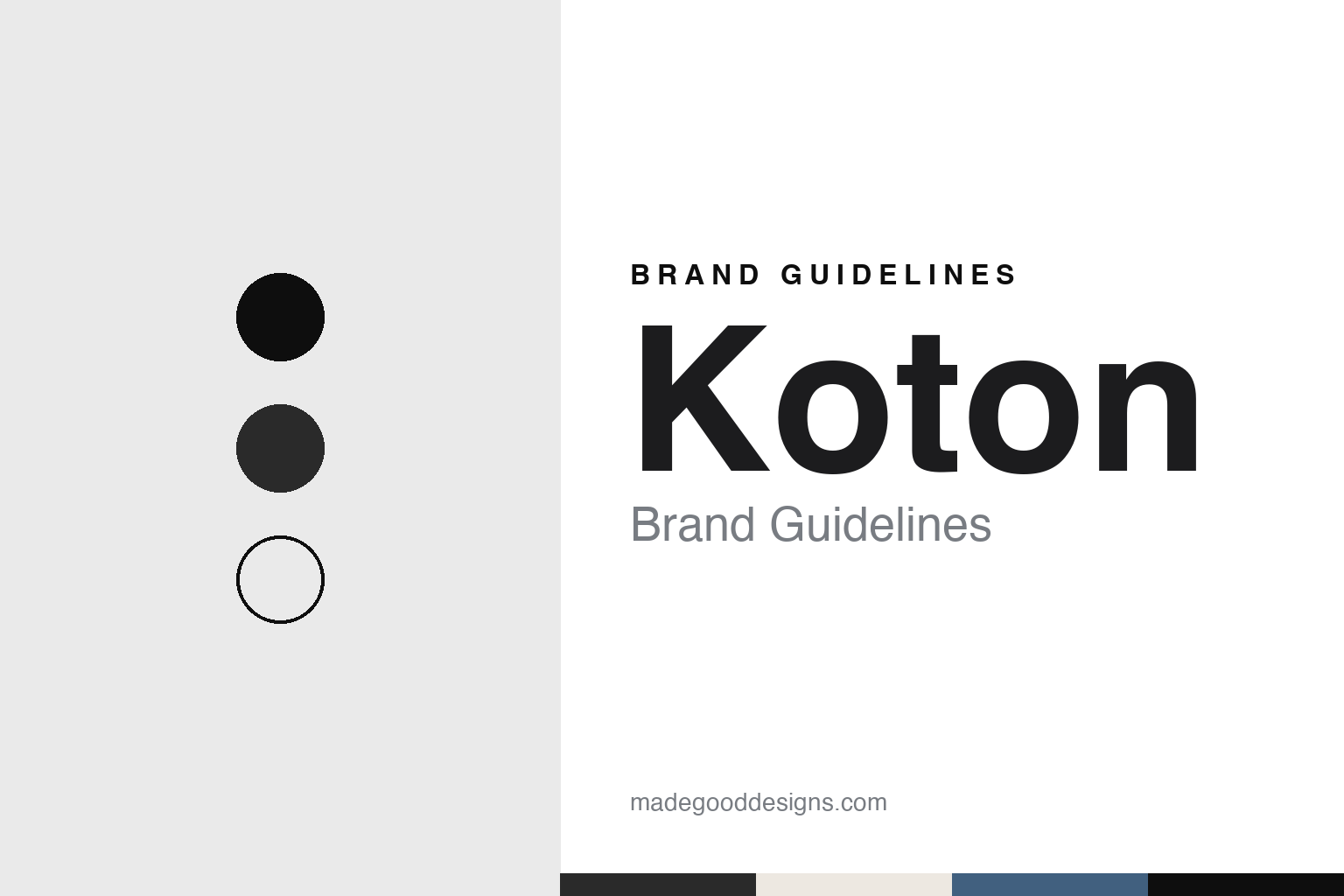
Koton Brand Guidelines
From a 1988 Kuzguncuk shop to Borsa Istanbul.
Aa
Two constants: a Koton black, stone and denim blue palette and a Geometric sans register. Abstract homage — not a Koton product or mark; no logo or garment is reproduced.
Kuzguncuk
A small shop on the Asian shore of the Bosphorus.
Koton began as a single shop in Kuzguncuk, a small neighbourhood on the Asian shore of the Bosphorus in Istanbul. The business monthly TR Monitor reported in April 2021 that the company was set up by the Yılmaz couple in 1988 as a small shop, and the Turkish business weekly Ekonomist repeated the Kuzguncuk origin in January 2024. The founders are Yılmaz Yılmaz, who chairs the board, and Gülden Yılmaz, a board member who, Ekonomist reported, also chairs its sustainability committee. Koton’s own timeline gives the same year and place for its first store.
The founders tell the story as a modest one. Speaking at Borsa Istanbul in May 2024, Yılmaz Yılmaz said the company had started 36 years earlier with a shop of about 25 square metres in Kuzguncuk, run by two people, and that it had since grown to a staff of about 7,900, the Turkish news agency DHA reported. At the same ceremony, Gülden Yılmaz described Koton as having begun with the dream of two people.
The move from shopkeeping to making clothes came in the mid-1990s. TR Monitor reported that Koton began producing its own products in 1995, and a year later, in 1996, opened in Munich, its first step outside Türkiye; the company’s timeline describes that opening as its first international showroom. By April 2021, TR Monitor reported, Koton no longer had a store in Germany.
Colour
Shops in about thirty countries, then a listing.
Koton’s store counts have moved up and down over the years, so they should be read with their dates. In April 2021, TR Monitor reported 470 stores, in markets including Russia, Romania, Kazakhstan, Morocco, Tunisia, the Balkans, France and the Gulf states. The same report said the company had been through a difficult financial period at the end of 2019, and that its partners had put in new capital through a capital increase as it entered 2020. In January 2024, Ekonomist gave 440 physical stores in 30 countries and a range of more than 22,000 different products. In May 2024, DHA counted 437 stores at home and abroad and said that, with e-commerce, the company was active in 70 countries.
Not every market has lasted. In April 2026 the Ukrainian news agency Interfax-Ukraine, citing the Ukrainian Retailers Association, reported that Koton was closing its two stores in Kyiv’s Lavina Mall and leaving the Ukrainian market, where it had opened its first Kyiv store in 2018. The same report, quoting the company’s website, put the chain at more than 450 stores and said the brand was present in more than 70 countries. Together with the German exit reported by TR Monitor in 2021, it is the second market Koton is reported to have left since its first step abroad in Munich.
The largest change in its structure was the stock-market listing. DHA reported that Koton shares began trading on the Star Market of Borsa Istanbul on 10 May 2024, under the code KOTON, after a public offering of 16.5 per cent of its shares; the founders and the chief executive, A. Bülent Sabuncu, attended the opening gong ceremony. The company is still run by its founders, with Yılmaz Yılmaz as chairman.
Koton’s own timeline adds the collaborations it uses to frame the brand. It says it launched a Bora Aksu for Koton collection in 2006, that its Koton Designers’ Line later worked with the designer Jean-Pierre Braganza, and that in 2012 the Brazilian model Alessandra Ambrosio became a global face of its campaigns. It also says it received a design-centre certification in 2017 and launched the Koton Club loyalty programme in 2023. These come from the company’s own pages rather than from independent reporting.
Typography
How the chains present themselves.
Turkish fashion, denim and footwear chains are mostly met in person, in shopping centres. Trade reports on these companies’ expansion abroad tend to describe the same kind of opening: a new unit in a regional mall, the brand name across the fascia, and a launch event at the door. For a design reader, the store front is where the identity is fixed, and the shopping bag is the version of it that leaves the building.
The names are short and usually written as plain lettering. Some of these chains use a word or an abbreviation rather than a symbol, and where a mascot or emblem once existed, published histories describe it being folded into a typographic logo. Campaign imagery, rather than the logo, carries most of the season-to-season change: model-led photography, designer collaborations and named collections are how the companies present each range.
Collection and store naming is generally descriptive. Sub-brands and formats tend to add a plain word to the parent name, such as Home, Outlet or Baby, so the parent name stays visible on every sign. In this guide we describe those ranges by the names the companies publish, without judging one against another.
The corporate side matters too. Some of these businesses began as small family shops or wholesale labels in Istanbul and later became large groups, some of them listed on Borsa Istanbul. Their corporate pages on founders, owners, board members and listings are part of the brand’s public face, and the guides in this series draw on those pages alongside dated independent reporting. The palettes shown are our own unofficial interpretations, not company colour standards.
Aa
A clean geometric sans for a short shop name. (Specimen set in Jost, a sans STAND-IN; NOT the Koton logo.)
Koton
A short word on a shop front.
Koton’s identity rests on one short word: the same five letters on the shop fascia, the website and the stock-market ticker, where the company trades under the code KOTON. In the founders’ own telling at the May 2024 listing ceremony, the name has stayed the same from the 25-square-metre shop in Kuzguncuk to a chain active in dozens of countries.
Much of Koton’s brand story, as the company tells it, runs through people rather than graphics. Its timeline places the designer collaborations, starting with Bora Aksu in 2006 and continuing with Jean-Pierre Braganza, and the campaign work with Alessandra Ambrosio from 2012, near the centre of its history. Those entries sit beside store and loyalty milestones such as the Koton Club, so the brand is presented through collections, faces and shops rather than through a symbol.
The 2024 listing also changed how the company presents itself. Its corporate site now carries investor-relations pages, board lists, corporate-governance reports and quarterly results under the same short name, alongside its advertising films and sustainability reports. For a brand that began as a two-person shop, the corporate site has become part of the public face too.
For a design guide, Koton shows how a founder-run chain can let a short name, a clean shop front and its campaign imagery do the work that a mascot or emblem does elsewhere. Compare LC Waikiki, another Istanbul chain dating from 1988, and Mavi, the Istanbul denim brand. For this guide we use black, stone and a denim blue with a sans, an unofficial interpretation; no product or logo is reproduced.
Explore & save
Keep Koton’s identity on hand — save it to a board in the Made Good inspiration library.
Koton identity set
Pin the Koton black, stone and denim blue palette and the Geometric sans register to your own board.