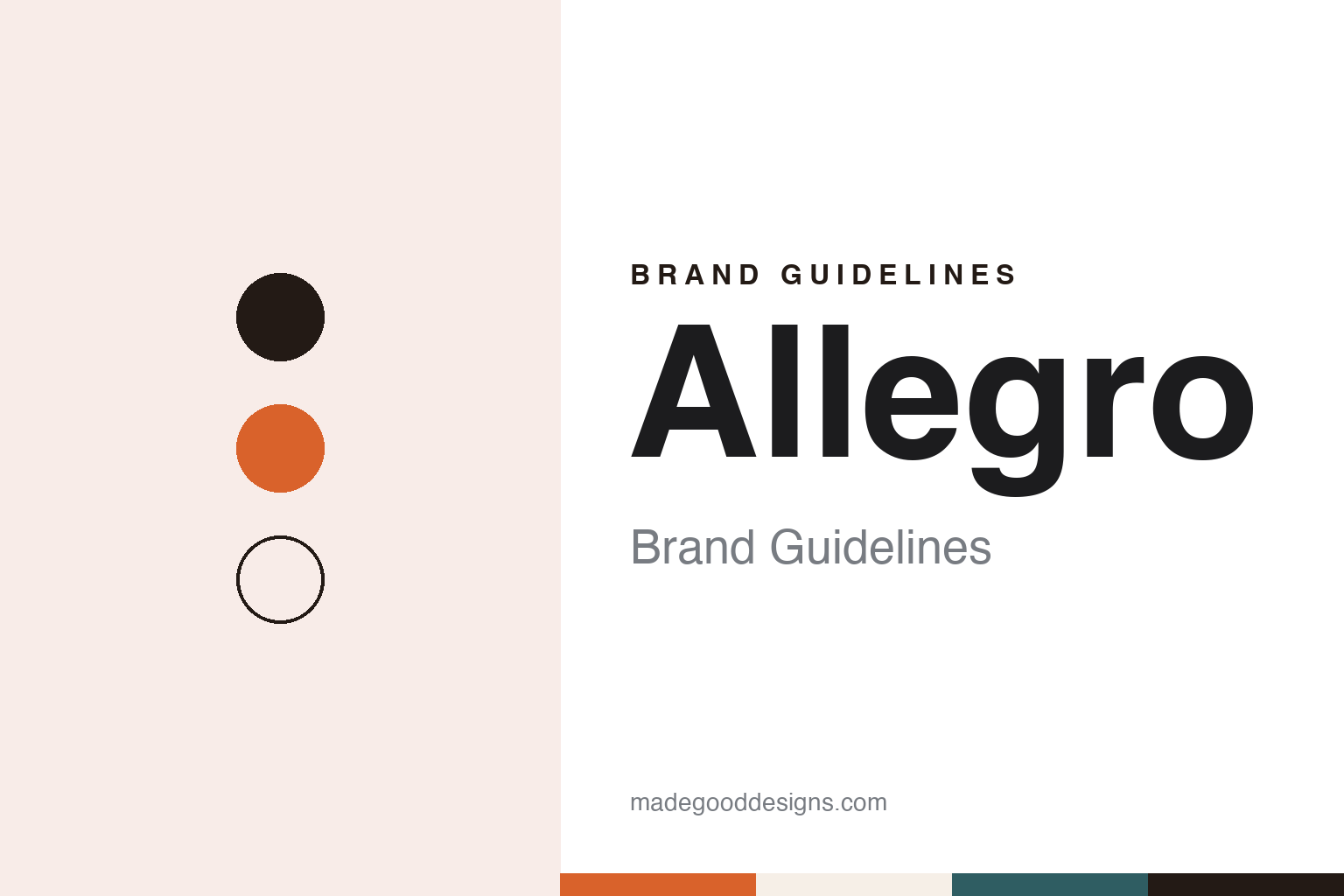
Allegro Brand Guidelines
The Poznań auction site that grew into a marketplace.
Aa
Two constants: an orange, brown and cream palette and a rounded web sans register. Abstract homage — not an Allegro product or mark; no app screen, logo or parcel locker is reproduced.
A basement in Poznań
An auction site launched in a computer magazine.
Allegro is an online marketplace based in Poznań, in western Poland. It began in 1999 as an auction site and now sells goods from small firms, large brands and private sellers across Poland, Czechia, Slovakia and Hungary. The platform is run by Allegro sp. z o.o. in Poznań; its parent, Allegro.eu S.A., is registered in Luxembourg and listed on the Warsaw Stock Exchange, English Wikipedia says.
Polish Wikipedia gives a detailed origin story. The site was set up by a Poznań company called Surf Stop Shop. The idea came from a Dutchman, Arjan Bakker, who had been inspired by the American auction site eBay, and Tomasz Dudziak wrote the first software and chose the name. The launch was announced on 13 December 1999 in the computer magazine Chip, and that date is taken as the platform’s official start. The first office was a basement in the computer wholesale business the founders ran, and the first item put up for auction was a USB camera.
Within months the young site had a foreign owner. The British auction group QXL Ricardo bought it and kept the founders in charge, Polish Wikipedia says. In April 2001 Allegro passed its millionth auction, and the same year it began charging sellers commission. After the dot-com crash the founders and QXL Ricardo fell out over how the site should develop; the dispute ended in a settlement in 2006, after eBay had entered Poland, and QXL Ricardo took full control again.
The group then widened its reach. It bought sites such as the car classifieds portal OtoMoto and the price-comparison service Ceneo, and for a time ran sister auction sites abroad, including Aukro in Czechia and Molotok in Russia, before concentrating on Poland. QXL Ricardo renamed itself Tradus in 2007, English Wikipedia says, and in 2008 the South African media group Naspers bought Tradus and with it Allegro. Under Naspers the Polish group also owned the finance portal Bankier.pl for a few years; it was sold to Bonnier Business Polska in 2015.
Colour
Three funds, a float and a Christmas film.
In 2016 Naspers sold Allegro to a consortium of investment funds advised by Cinven, Permira and Mid Europa Partners, English and Polish Wikipedia both say. Polish Wikipedia puts the volume of transactions at close to 14 million a month that year.
The same December the company had a hit with an advertisement. Its three-minute Christmas film, English for beginners, follows a Polish grandfather teaching himself English before a trip to London, where he will meet his granddaughter for the first time. The BBC reported on 8 December 2016 that it had reached seven million YouTube views in ten days. The film barely mentions the product: an opening title and a closing line, “And you? What are you looking for?” A London creative director told the BBC that the very modest branding worked in its favour, because the advertiser had got out of the way of the emotion.
In 2018 Allegro launched Allegro Smart!, a paid membership that gives free delivery on purchases from the platform. Polish Wikipedia says the programme had 7.5 million users in Poland and one million abroad at the end of 2025.
The funds took Allegro public in October 2020. On its first day of trading, Monday 12 October, more than 36,000 individual investors took part, the English service of TVN24 reported. The same year the group bought the fintech firm FinAi and used it to build Allegro Pay, a deferred-payment service, and took full ownership of the ticket seller eBilet.
Delivery became the next project. In June 2021 Allegro began building its own network of parcel lockers, One Box, and in October 2021 it bought the courier firm X-press Couriers, which was merged into Allegro on 1 April 2022, Polish Wikipedia says. In 2024 it launched Allegro Delivery in Poland, a partner programme combining its own lockers with carriers including DHL and DPD.
Typography
How Polish and Romanian retailers present themselves.
Polish and Romanian retailers mostly present themselves through the places where people shop: the fascia above a corner-shop door, the sign on a discount supermarket at the edge of town, the campaign images in a fashion store window, the screens of a marketplace app and the long front of a DIY megastore. Each of these is a design surface the company controls, and the guides in this group read them as the companies publish them, on their own sites, stores and apps.
Store naming in the region is often plain and local. Several chains carry an ordinary Polish word, an animal or a short invented name, and the guides explain what each name means and where it came from, without reading more into it than the sources do. Where a chain changed its sign or colours, the guides give the date of the change and the source that records it.
The corporate pages matter as much as the shopfronts. Many of these businesses were started by founders in the 1990s, later sold to private-equity funds or foreign groups, and in several cases listed on the Warsaw Stock Exchange. The guides set out founders, owners and listings as dated facts, and they state pending takeovers as pending, with the date they were agreed.
What the guides do not do is rank retailers or judge them as better or worse. Store counts, country counts and formats are given only with the date and source that supplied them, and every palette and typeface shown is our own unofficial interpretation, chosen to describe a look rather than to copy one. No logo, fascia, product or campaign image is reproduced.
Aa
A rounded web sans for a marketplace that lives on screens. (Specimen set in Rubik, a sans STAND-IN; NOT the Allegro logo.)
Central Europe
Mall Group, three new country sites and a narrower map.
Allegro’s largest move abroad came through an acquisition. In November 2021 it announced the purchase of the Czech e-commerce group Mall Group and the Czech logistics company WE|DO, and the deal was completed on 1 April 2022, Polish Wikipedia says. The purchase took the group into six countries: Poland, Czechia, Slovakia, Hungary, Croatia and Slovenia.
Allegro then carried its own marketplace into the new territory. A cross-border site, Allegro.com, opened in February 2022 for buyers and sellers across the European Union, in English, Czech and Ukrainian. Allegro.cz followed in Czechia in May 2023 and Allegro.hu in Hungary in October 2024; the Slovak site, Allegro.sk, opened in 2024, in February according to English Wikipedia and in March according to Polish Wikipedia. English Wikipedia adds that the older Mall online stores in Czechia, Slovakia and Hungary were closed in 2025.
The remaining former Mall businesses were put up for sale. By early 2026 Allegro had agreed to sell Mimovrste in Slovenia and Mall.hr in Croatia to the German investment company Mutares, as part of a restructuring that ends the integration of the former Mall Group, Forbes Slovenija reported on 2 February 2026. As of that report, the sale had not been completed and still awaited regulatory conditions.
Ownership has also changed. The three funds that brought Allegro to the market sold their shares in stages, and in June 2026 Permira sold its remaining holding, leaving almost all the shares in free float, Polish Wikipedia says.
Alongside the main marketplace the group runs Allegro Lokalnie, a site for occasional sellers, often of second-hand goods, and the price-comparison service Ceneo. Polish Wikipedia notes that the site was first popular with collectors before it became a meeting place for shops, brands and professional sellers.
For a design guide, Allegro shows how a marketplace can grow from an auction page into apps, delivery lockers and payment services under one short name. Compare Żabka, a Polish convenience-store chain, and Media Expert, a Polish electronics chain. For this guide we use a parcel orange, a deep brown and a packing cream with a rounded sans, an unofficial interpretation; no product or logo is reproduced.
Explore & save
Keep Allegro’s identity on hand — save it to a board in the Made Good inspiration library.
Allegro identity set
Pin the Allegro orange, brown and cream palette and the rounded web sans register to your own board.