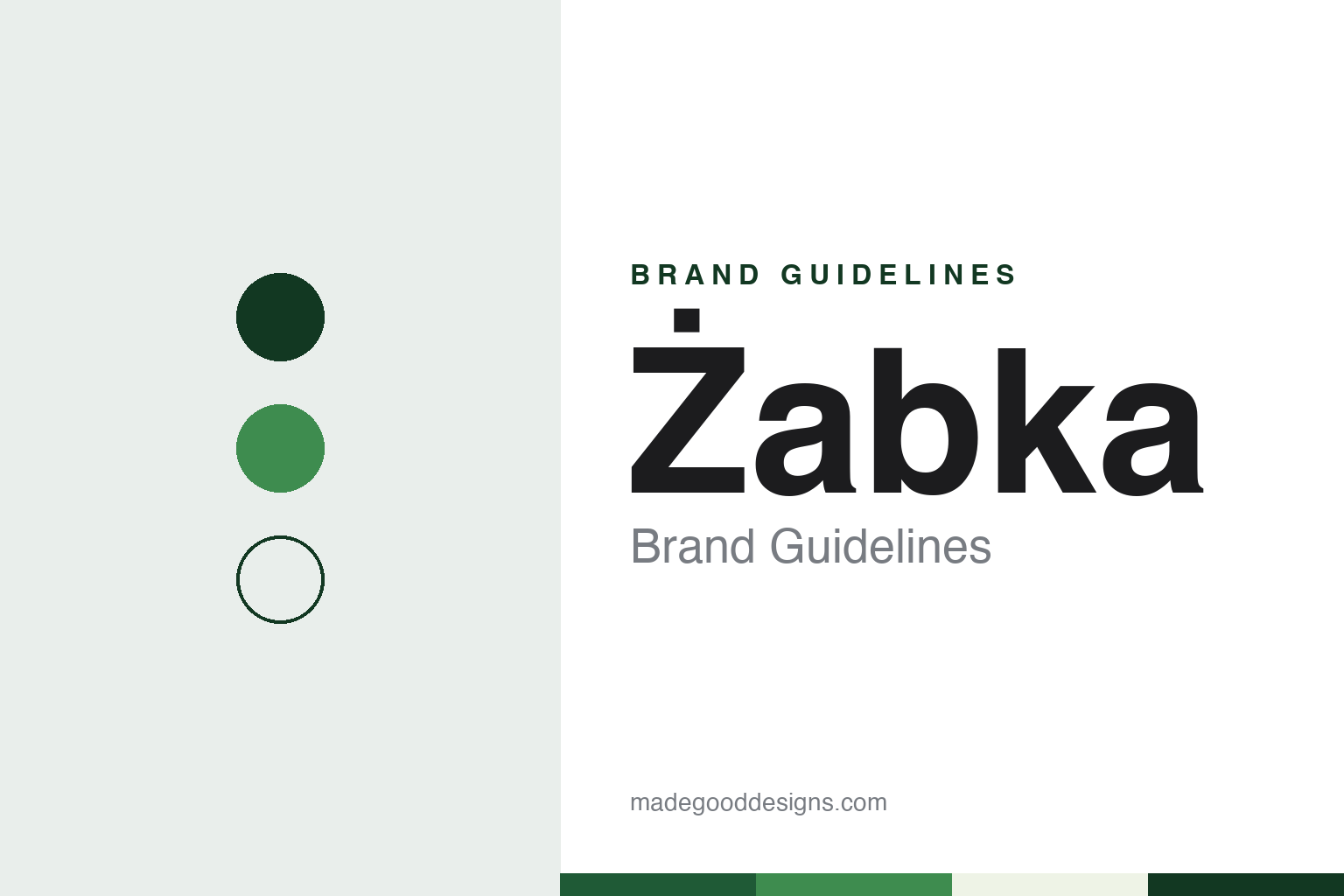
Żabka Brand Guidelines
The Poznań “little frog” that became a convenience chain.
Aa
Two constants: a Żabka greens and oak palette and a rounded sans register. Abstract homage — not a Żabka product or mark; no frog, logo or fascia is reproduced.
Seven shops in 1998
A test network around Poznań.
Żabka, a Polish word that English Wikipedia translates as “little frog,” began in 1998 with seven experimental shops in Poznań and nearby Swarzędz, in western Poland. Polish Wikipedia says the decision to build a national convenience network was taken the same year, and names the founder as Mariusz Świtalski, the former owner of the distribution business Elektromis, who had also founded the Eurocash wholesale business and the Biedronka discount shops. The early Żabka stores opened in towns of more than five thousand people, and by October 2005 there were about 1,700 of them, both Wikipedia editions say.
The founder did not stay long as owner. In May 2007 Świtalski sold the chain to the Czech investor Penta Investments, Polish Wikipedia says. Under Penta the business ran a second format: in 2009 Żabka Polska opened Freshmarket, a deli-style convenience chain with ready meals and hot snacks. Penta sold the Czech Žabka stores to Tesco in a deal agreed in December 2010 and closed in April 2011, English Wikipedia says, and agreed in February 2011 to sell the Polish business to the fund Mid Europa Partners, which held all of Żabka Polska from May 2011.
The Mid Europa years were years of buying smaller networks. Polish Wikipedia lists the Pomeranian chain Zatoka in 2012, five local chains including Agap, Torg and Społem Zabrze in 2013, and the Kraków chain Kefirek in 2014, whose shops were turned into Żabka or Freshmarket stores. By the end of 2019 every Freshmarket had moved to the Żabka name.
In February 2017 the chain passed to CVC Capital Partners, the private-equity group based in Luxembourg, both Wikipedia editions say. In January 2020 the head office moved into a new building in the Nowy Rynek complex in Poznań, Polish Wikipedia says.
Colour
One green, one shop layout.
Żabka’s present look dates from a long remodelling. Polish Wikipedia says the chain began rebuilding its shops in 2016 and went through a rebranding in 2017 and 2018: the logo and visual identity were changed, the older yellow-and-green colours gave way to a single green, and wooden decorative elements appeared inside. The shop layout and shelving were rearranged, own-label ranges, ready meals and breakfast products were added, and selected shops gained a Żabka Café counter for coffee, hot dogs and hot snacks. The remodelling finished in October 2020, and from then every shop carried the same logo and interior.
The own labels give the shelves a voice of their own. English Wikipedia names Szamamm ready meals, Tomcio Paluch sandwiches, Wycisk juices and lemonades and Foodini snacks; Polish Wikipedia adds names such as S!, Dobra Karma and Plant Hunter. The shops also carry services such as parcel collection, bill payments and card top-ups, English Wikipedia says.
The other strand of the identity is the phone. The Żappka app arrived in 2020, and in June 2021 the first Żabka Nano store, without staff or checkouts, opened at the Poznań International Fair grounds, English Wikipedia says. Customers tap a card or the app to enter, and cameras and software record what they take. Polish Wikipedia notes a motorway-side pavilion format for drivers, opened on the A2 in December 2022, and the 10,000th shop in October 2023.
The model behind the fascia is franchise. money.pl, in an October 2024 commentary on the listing, described Żabka as a franchise network of more than 10,500 locations alongside the Żabka Nano autonomous stores, with a digital side that included the meal-delivery brands Maczfit and Dietly and the online grocery services Jush! and Delio. The same piece noted that the group had recently entered Romania by buying the company DRIM; English Wikipedia gives the Romanian store name as Froo, in use since 2024.
Typography
How the category presents itself.
Polish and Romanian retailers mostly present themselves through the places where people shop: the fascia above a corner-shop door, the sign on a discount supermarket at the edge of town, the campaign images in a fashion store window, the screens of a marketplace app and the long front of a DIY megastore. Each of these is a design surface the company controls, and the guides in this group read them as the companies publish them, on their own sites, stores and apps.
Store naming in the region is often plain and local. Several chains carry an ordinary Polish word, an animal or a short invented name, and the guides explain what each name means and where it came from, without reading more into it than the sources do. Where a chain changed its sign or colours, the guides give the date of the change and the source that records it.
The corporate pages matter as much as the shopfronts. Many of these businesses were started by founders in the 1990s, later sold to private-equity funds or foreign groups, and in several cases listed on the Warsaw Stock Exchange. The guides set out founders, owners and listings as dated facts, and they state pending takeovers as pending, with the date they were agreed.
What the guides do not do is rank retailers or judge them as better or worse. Store counts, country counts and formats are given only with the date and source that supplied them, and every palette and typeface shown is our own unofficial interpretation, chosen to describe a look rather than to copy one. No logo, fascia, product or campaign image is reproduced.
Aa
A rounded, friendly sans for a neighbourhood shop sign. (Specimen set in Nunito, a rounded sans STAND-IN; NOT the Żabka logo.)
Żabka
From private equity to the Warsaw exchange.
The holding company is Zabka Group, a Luxembourg société anonyme that owns all of Żabka Polska, the Poznań operating company, and a separate unit for business abroad, including Romania, Polish Wikipedia says. Its shares began trading on the Warsaw Stock Exchange on 17 October 2024 under the ticker ZAB. money.pl reported that CVC remained the main shareholder, that demand from individual investors was heavy enough for their orders to be cut back sharply, and that the shares closed the first day at the offer price.
A change of owner followed within two years. Radio-Canada reported on 31 July 2026 that Alimentation Couche-Tard, the Quebec convenience-store group that owns Circle K, had announced its intention to buy Żabka Group, which then ran more than 13,000 shops in Poland. The offer was backed by Żabka’s senior management and by shareholders holding about 57 per cent of the shares, and it needed regulatory approvals including merger control. A tender offer for all shares was announced on 26 August 2026, and subscriptions ran until 2 December 2026, Wiadomości Handlowe reported in November 2026, with the deal still awaiting a final regulatory approval. The purchase was agreed in July 2026; not completed at the time of writing. Polish Wikipedia also records that Seven & i Holdings said in July 2026 that it was in talks over Żabka shares and withdrew the same month.
Through these changes the operating company, Żabka Polska, has kept its registered seat in Poznań, the city where the first test shops opened in 1998, Polish Wikipedia says.
For a design guide, Żabka shows how a franchise network can be held together by one colour, one layout and one app, from a corner shop to a staffless box at a trade fair. Compare it with Biedronka, the discount chain with the same founder, and with Allegro, the Polish marketplace whose October 2020 listing money.pl set beside Żabka’s. For this guide we use shopfront green, pine ink, leaf, pale lime and oak with a rounded sans, an unofficial interpretation; no product or logo is reproduced.
Explore & save
Keep Żabka’s identity on hand — save it to a board in the Made Good inspiration library.
Żabka identity set
Pin the Żabka greens and oak palette and the rounded sans register to your own board.